
The Pros and Cons of 215kWh Pre-Integrated PV Containers for Coastal BESS
Contents
- The Silent Killer on Your Coastline Project
- Beyond the Spec Sheet: The Real Cost of Salt
- The All-in-One Answer? 215kWh Pre-Integrated Containers
- Weighing the Benefits: It's More Than Just a Box
- The Other Side of the Coin: Honest Drawbacks
- A Case in Point: Learning from the Field
- Making the Right Call for Your Site
The Silent Killer on Your Coastline Project
Hey there. If you're looking at deploying battery storage or a solar-plus-storage setup near the coast C whether it's for a seaside resort in Florida, a port facility in Rotterdam, or a microgrid on a Greek island C we need to talk about salt. Not the kind on your fries, but the fine, corrosive mist that hangs in the air. Honestly, in my 20+ years on sites from the Gulf Coast to the North Sea, I've seen salt-spray do more damage to electrical enclosures than a decade of normal inland wear. It's a silent killer that creeps into every connector, every busbar, every cooling fin. The standard indoor-rated cabinet? It won't last two years. And that's the core problem we're facing: our push for renewable energy is naturally heading to coastal load centers and windy shorelines, but our hardware isn't always ready for the environment.
Beyond the Spec Sheet: The Real Cost of Salt
Let's agitate that pain point a bit. It's not just about a rusty door. The National Renewable Energy Laboratory (NREL) has highlighted how corrosion in Balance of System (BOS) components is a major contributor to increased Levelized Cost of Storage (LCOS) in harsh environments. What does that mean on the ground? I've been called to sites where premature corrosion led to:
- Catastrophic Thermal Runaway Risks: Salt bridges forming across battery module terminals, creating sneak currents and potential short circuits. The thermal management system's fans and heat exchangers clog with salt, reducing efficiency and causing hotspots.
- Sky-High O&M Bills: Think constant cleaning, component replacement every 3-5 years instead of 10+, and unplanned downtime. The operational expenditure becomes a black hole.
- Safety & Warranty Nightmares: Most manufacturers' warranties are voided by "exposure to corrosive elements" not specified in the installation guide. You're left holding the bag on a multi-million-dollar asset.
The dream of a resilient, low-cost energy asset turns into a high-maintenance liability. That's the reality we're trying to solve.
The All-in-One Answer? 215kWh Pre-Integrated Containers
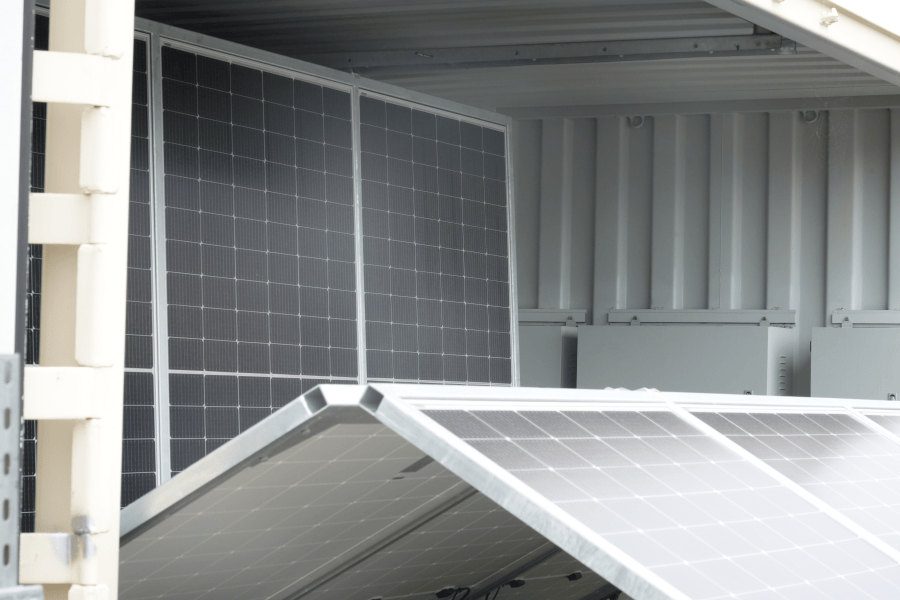
This is where the concept of the pre-integrated, containerized solution built for this specific fight comes in. We're talking about a 215kWh cabinet-style unit, pre-assembled in a factory-controlled environment, with the PV inverter, battery racks, thermal management, and controls all housed within a single, purpose-built container shell. It's not just a battery in a box; it's a system engineered from the ground up for the coastal battlefield. The key shift is moving from trying to protect individual components from the environment, to creating an environment within the container that keeps the corrosive elements out. That's the fundamental solution we're discussing today.
Weighing the Benefits: It's More Than Just a Box
So, what are the real, tangible benefits of opting for a pre-integrated 215kWh container for a salty site?
- Built-In Corrosion Defense: This is the big one. We're talking about C5-M or IEC 60721-3-5 Class 5S-rated coatings as standard. The entire container C from the structural steel to the smallest latch C is treated with multi-stage epoxy and polyurethane paints. Air filtration systems with positive pressure keep salt-laden air from infiltrating. I've seen firsthand how this extends the system's "healthy" life by 2-3 times compared to retrofitted solutions.
- Predictable Performance & LCOE: Because everything is integrated and tested at the factory C the C-rate of the batteries matched to the inverter capability, the thermal management system calibrated for the specific heat load C you get a known quantity. There are fewer field integration errors. This predictability is gold for financial modeling. You can forecast your Levelized Cost of Energy (LCOE) with much higher confidence, which is what every CFO and project financier wants to hear.
- Speed and Simplicity: For a commercial or industrial site, a 215kWh unit is a sweet spot. It's a "plug-and-play" solution. You pour a slab, deliver the container, connect AC/DC and data lines, and you're largely done. This reduces on-site labor by up to 60%, which is crucial in areas where skilled trades are scarce. It also means faster revenue generation.
- Inherent Compliance: A reputable provider like Highjoule Technologies designs these units to meet the stringent standards the market demands from day one C UL 9540 for the energy storage system, UL 1741 for inverters, and IEC 62619 for battery safety. Getting through utility interconnection is smoother when you can present a pre-certified system.

The Other Side of the Coin: Honest Drawbacks
Now, let's have that coffee-chat honesty. It's not a perfect solution for every single scenario. Here are the drawbacks you must consider:
- Upfront Cost Premium: The enhanced materials, coating processes, and integrated engineering come at a cost. The CapEx per kWh will be higher than buying bare battery racks and separate inverters. You're paying for the peace of mind and lower lifetime cost upfront.
- Scalability Nuances: A 215kWh container is a modular block. To scale to, say, 1 MWh, you need multiple containers. This takes up more footprint than a single, large, purpose-built battery building. You need to plan your site layout for multiple units and the interconnections between them.
- Service Accessibility: While designed for easy maintenance, some components are tightly packed. A well-designed unit will have service aisles and pull-out racks, but it's still more confined than a dedicated battery room. This emphasizes the need for high-reliability components from the start and a strong remote monitoring and diagnostic service from your provider.
- Transport Logistics: It's a shipping container. You need to ensure your site has the access for a flatbed truck and a crane to place it. This can be a challenge in very dense urban or remote coastal areas with limited infrastructure.
A Case in Point: Learning from the Field
Let me give you a real example. We worked with a fish processing plant in Norway, north of the Arctic Circle. Brutal coastal winds, constant salt spray, and freezing temperatures. They needed backup power and peak shaving. A standard outdoor cabinet solution was quoted, but we proposed our pre-integrated, salt-spray-optimized 215kWh container.
The challenge wasn't just corrosion, but also condensation inside the unit due to massive temperature swings. Our solution included the C5-M coating, but also a dedicated, humidity-controlled thermal management system that kept the internal environment stable regardless of the external weather. The entire system was commissioned in under a week. Three years on, the internal inspection shows zero corrosion on electrical components, while neighboring non-spec equipment at the plant has already been replaced twice. The plant manager's biggest compliment? "We forget it's even there." That's the goal.
Making the Right Call for Your Site
So, how do you decide? It comes down to a total lifecycle view. If your site is within 5 miles of the coast or in any industrial coastal zone, the salt-spray specification isn't a luxury; it's a necessity. The higher initial investment in a pre-integrated, hardened solution like this pays back through avoided O&M, sustained performance, and warranty security.
The key is to partner with a provider that doesn't just sell you a container, but understands the deployment environment. At Highjoule, our engineering team asks about prevailing wind direction, average salinity data, and site topography before we even propose a design. We've built that expertise from projects across the globe. We also stand behind our systems with localized service networks in key markets, because even the best-designed system needs a knowledgeable eye on it.
Ultimately, the right 215kWh pre-integrated PV container for a coastal environment isn't just a product; it's an insurance policy for your energy resilience. The question isn't really "Can I afford it?" but rather "Can I afford the alternative?" What's the one corrosion-related failure that would keep you up at night on your next coastal project?
Tags: UL Standard BESS LCOE Energy Storage Europe US Market Renewable Energy PV Integration Corrosion Protection
Author
James Zhang
20+ years agricultural energy storage engineer / Highjoule CTO