
All-in-One Solar Container for Military Bases: Pros, Cons & Real-World Insights
Contents
- The Quiet Revolution in Military Energy
- The Problem Isn't Just Fuel, It's Complexity
- Enter the All-in-One Solar Container
- The Benefits: Real Talk from the Field
- The Drawbacks: An Honest Look
- Making It Work: An Expert's Checklist
The Quiet Revolution in Military Energy
Let's be honest. For decades, if you needed power on a forward base or a remote installation, you fired up the diesel gensets. The fuel convoys rolled in, the noise and heat signature went up, and the operational cost C both financial and strategic C became a constant weight. I've been on sites where the logistics tail for fuel was the single biggest vulnerability. Things are changing, fast. The conversation I'm having with base commanders and facility managers across the U.S. and Europe isn't about if they should integrate renewables and storage, but how. And increasingly, the "how" centers on one solution: the all-in-one, integrated solar and battery storage container.
The Problem Isn't Just Fuel, It's Complexity
The core pain point isn't a secret: fuel dependency equals risk. The U.S. Department of Defense has explicitly stated that energy resilience is a critical component of mission assurance. But from my 20+ years on the ground, the secondary pain point is just as debilitating: project complexity.
Imagine a traditional deployment. You need to source PV panels from one vendor, a separate inverter skid, a battery system from another, a climate control unit, and then you have to integrate them on-site with custom cabling, controls, and safety systems. You're dealing with multiple warranties, interoperability headaches, and a construction timeline that's at the mercy of the slowest component delivery. I've seen projects where the engineering and commissioning phase alone took longer than the physical installation. For a military operation needing rapid deployment or a base looking to harden its infrastructure against grid outages, this traditional model is often a non-starter.

Enter the All-in-One Solar Container
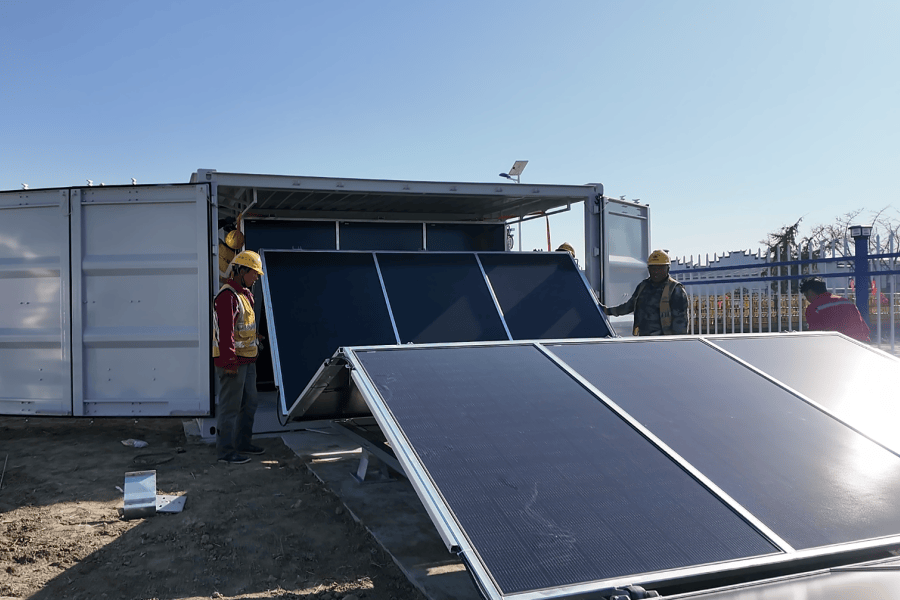
This is where the integrated container steps in. Think of it as a "power plant in a box." All critical components C high-efficiency solar panels (often mounted on or integrated into the container structure), lithium-ion battery racks, hybrid inverters, thermal management systems, and the fire suppression and control brains C are pre-assembled, pre-wired, and pre-tested in a controlled factory environment. It shows up on a flatbed, you connect it to your site's electrical distribution, and you're generating and storing power. The appeal for military applications is immediately obvious.
The Benefits: Real Talk from the Field
Let's break down the real advantages, the ones that matter when you're making a procurement decision.
1. Unmatched Deployment Speed & Mobility
This is the number one benefit. A containerized system can be deployed in days or weeks, not months. It's inherently mobile. If a tactical situation changes or a base is reconfigured, you can literally unplug it and move it. I worked on a project for a National Guard facility in California where they needed critical backup for a communications hub. From contract signing to commissioning, it was under 11 weeks. A traditional build would have taken 6-8 months.
2. Enhanced Energy Security & Grid Independence
By pairing solar generation with storage, you create a microgrid. During the day, you power operations with the sun and charge the batteries. At night or during an outage, the batteries take over. This drastically reduces the runtime required from those diesel generators, slashing fuel consumption by 70-90% in many cases we've analyzed. Your base becomes less of a target for supply line disruption.
3. Predictable Cost & Lower Lifetime Expense (LCOE)
Here's a key term we use: Levelized Cost of Energy (LCOE). It's the total cost of owning and operating an asset over its life, divided by the energy it produces. While the upfront capex of an all-in-one unit can be higher than sourcing components piecemeal, the operational savings are massive. Factory integration reduces on-site labor costs by up to 40%. Zero fuel cost for the solar portion. Minimal maintenance. When you run the numbers over a 15-20 year lifespan, the LCOE of a solar+storage microgrid is now highly competitive with running pure diesel, especially when you factor in volatile fuel prices. The National Renewable Energy Laboratory (NREL) has extensive data showing this crossover point has been reached.
4. Built-in Safety & Compliance
A reputable manufacturer like Highjoule doesn't just throw parts into a box. We design the entire system to meet the strictest codes. This means UL 9540 for the energy storage system, UL 1741 for inverters, and IEC 62443 for cybersecurity in the controls C all pre-certified. The thermal management is engineered for the specific battery chemistry (we typically use LiFePO4 for its superior safety profile) to prevent thermal runaway. The fire suppression is integrated. You're not hoping a field electrician gets the ventilation right; it's a tested, sealed system.
The Drawbacks: An Honest Look
No solution is perfect. Ignoring the drawbacks is how projects fail. Here's my candid take from the front lines.
1. The "Black Box" Dilemma
High integration can mean less flexibility. If the system uses a proprietary communication protocol or a unique battery module, you might be locked into that OEM for service and expansion. It's crucial to ask: "Can I integrate third-party generators or future battery tech? Who owns the control software?"
2. Site Constraints & Logistics
It's a 20- or 40-foot shipping container. You need a suitable, level pad for it. You need access roads for a heavy truck and a crane. In a truly rugged, inaccessible forward area, getting it in place can be as challenging as a traditional build. The "rapid deployment" advantage assumes you can get the truck to the spot.
3. Upfront Capital Cost
As mentioned, the initial investment is concentrated. For budget officers used to spreading costs across multiple fiscal years or different line items (generators, fuel contracts, PV arrays), writing one large check for a container can be a hurdle, even if the long-term math is compelling. Creative financing like Energy-as-a-Service (EaaS) models are becoming a key enabler here.
4. Thermal Management in Extreme Climates
This is a big one I've seen firsthand. The container's climate control system has to work overtime in a desert (120F/49C) or arctic (-40F/C) environment. If it fails, the entire system can shut down to protect the batteries. Redundant cooling/heating loops and robust component selection are non-negotiable, which adds cost. You can't just spec a standard commercial unit.

Making It Work: An Expert's Checklist
So, is an all-in-one solar container right for your base? Based on the projects I've led from Texas to Poland, here's my practical checklist for decision-makers:
- Demand Clarity: Is your primary need backup for mission-critical loads (like a comms center), or is it daily fuel displacement for the entire base? Sizing the system correctly is step one.
- Interoperability Mandate: Insist on open-protocol communications (like SunSpec or Modbus) that allow the system to talk to existing generators, grid connections, and building management systems.
- Service & Support: Where is the nearest service technician? A container reduces on-site maintenance, but you need a clear, rapid-response service agreement. At Highjoule, for example, we maintain a network of local tech partners across Europe and North America for this exact reason.
- Look Beyond the Box: The physical container is just part of the solution. The brain C the energy management system (EMS) C is what turns it from a simple backup into a smart grid asset. Can it perform peak shaving, demand charge management, and participate in grid services if allowed? That's where additional revenue or savings can be found.
The shift towards resilient, renewable power for military assets isn't coming; it's here. The all-in-one container is a powerful tool in that transition, offering incredible speed and simplicity. But its success hinges on choosing a partner who understands the unique demands of military operations C not just the engineering specs, but the need for durability, security, and long-term support. The right conversation starts not with "how big a container do you want?" but with "what mission are we trying to power, and what are we protecting it from?"
What's the biggest energy resilience challenge your facility is facing right now?
Tags: UL Standard BESS Solar Container Microgrid Energy Resilience Military Energy Security
Author
James Zhang
20+ years agricultural energy storage engineer / Highjoule CTO