
IP54 Outdoor Lithium Battery Storage Containers for Construction Sites: Pros, Cons & Real-World Insights
Let's Talk Power on Your Job Site: The IP54 Container Reality Check
Hey there. If you're managing a construction project in the US or Europe right now, you're probably juggling a hundred things. One of the biggest headaches? Reliable, clean, and cost-effective power for your tools, site offices, and temporary lighting. Over my 20+ years deploying battery storage systems from Texas to Bavaria, I've seen the shift from noisy, fume-spewing diesel generators to something smarter. Honestly, the move towards outdoor lithium battery storage containers, especially those rated IP54, is one of the most significant changes on site. But is it the right move for you? Let's grab a coffee and break it down, no marketing fluff, just what I've seen firsthand.
What We'll Cover:
- The Real Problem: It's More Than Just Diesel Smell
- The IP54 Advantage: What "Weather-Resistant" Really Means on Site
- The Drawbacks: It's Not a Silver Bullet
- Case in Point: A German Autobahn Project Story
- Making the Decision: Key Questions to Ask
The Real Problem: It's More Than Just Diesel Smell
The problem isn't just finding a power source. It's about finding one that doesn't eat into your margins or create new risks. Diesel gensets? We all know the issues: fuel theft, volatile prices, noise violations that delay night work, and increasingly strict emissions regulations, especially in urban EU zones. But the deeper pain point is predictability. A National Renewable Energy Lab (NREL) analysis highlighted that temporary power can account for up to 5-8% of total project cost volatility. That's a huge margin of uncertainty.
I was on a site in California where the daily fuel run was a 2-hour logistics nightmare. The real cost wasn't just the diesel; it was the foreman's time, the truck, and the safety hazard of storing fuel on site. This is the agitation - it's a constant, low-grade drain on efficiency, safety, and your bottom line.
The IP54 Advantage: What "Weather-Resistant" Really Means on Site
This is where a properly specified IP54 outdoor lithium container enters as a viable solution. Let's decode the benefits, not just from a spec sheet, but from the mud-and-gravel perspective.
1. Deploy and (Almost) Forget Durability
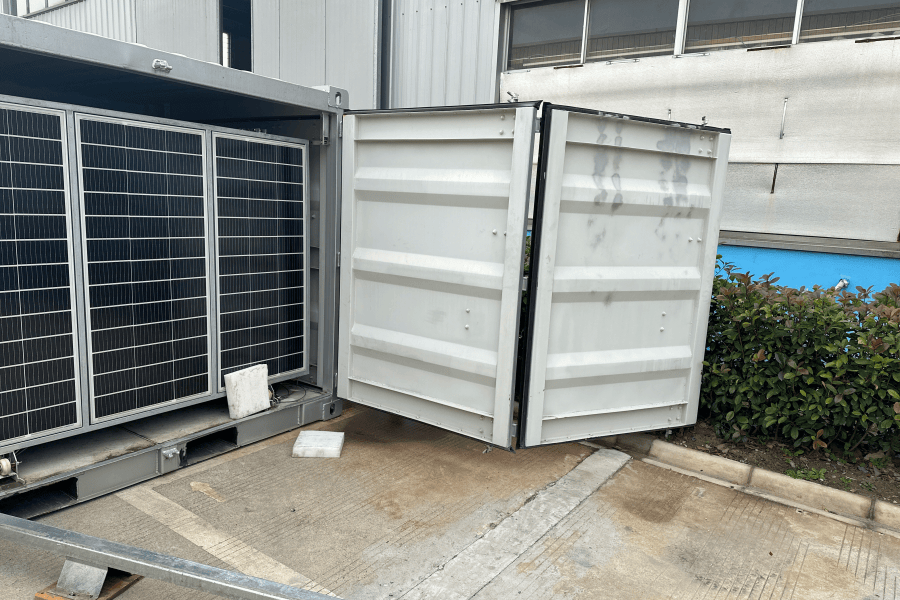
IP54 means it's protected against limited dust ingress and water splashes from any direction. In practice? It can handle a sudden downpour, pervasive construction dust, and that fine spray from site water trucks. You're not building a custom shed for it. You crane it onto a stable pad, connect it, and it's running. This drastically cuts commissioning time.
2. The Safety Stack: Beyond the Rating
The real benefit isn't just the enclosure. It's what a quality provider builds inside it. A container that meets UL 9540 (the standard for Energy Storage Systems) and UL 1973 (for the batteries themselves) gives you a certified safety system. We're talking about integrated thermal management (crucial for lithium longevity - think of it as a constant, smart AC system for the batteries), fire suppression, and gas venting. This isn't just about protection; it's about getting permits approved faster. Authorities Having Jurisdiction (AHJs) in the US and EU recognize these standards.

3. The Silent, Clean Workhorse
This is the game-changer for projects near residences or requiring night work. Zero local emissions means you can keep the lights on and tools charging overnight without community complaints. Pair it with a temporary solar array, and you're literally running on sunlight, cutting the "fuel" cost to near zero. The Levelized Cost of Energy (LCOE) - the total lifetime cost divided by energy produced - starts to look very attractive compared to diesel's rollercoaster.
The Drawbacks: It's Not a Silver Bullet
Now, let's be brutally honest. I've seen projects where these containers weren't the right fit, and it cost the team time and money.
- Upfront Capital Cost: Yes, the CapEx is higher than a diesel generator. You're buying 10+ years of energy in one box, versus renting fuel by the week. The financial case is about total cost of ownership, not day-one price. If your project is only 3 months, the math is tougher.
- Energy Density & Planning: It has a finite "tank." A diesel genny can be refueled in minutes; a depleted BESS needs hours to recharge. This requires smarter energy planning on site - scheduling high-power tasks, integrating solar, or having a grid connection for overnight charging. You need a basic power use plan.
- Site Logistics & Footprint: It's a heavy, sizable unit. You need a suitable spot for it, accessible by crane truck. If your site is a cramped urban retrofit, placement can be a tricky puzzle.
- Technical Oversight: While it's low-touch, it's not zero-touch. Someone on site needs to know how to check its status (usually via a simple tablet interface). This is where a provider with strong remote monitoring and local service, like what we've built at Highjoule with our 24/7 NOC, becomes critical. You shouldn't need a PhD to know if it's working.
Case in Point: A German Autobahn Project Story
Let me give you a real example. We deployed a 250 kWh IP54 container for a bridge repair on the A3 in North Rhine-Westphalia. The challenge: No grid connection for 5 miles, strict noise limits after 7 PM, and a ban on diesel storage near the protected forest area.
The container was placed on the highway shoulder. It was charged daily via a temporary 80 kW solar array set up in a nearby cleared area. It powered lighting, concrete mixers, and the site office. The drawback they had to manage? During a week of heavy fog and low solar yield, they had to carefully ration power for the essential tasks, delaying some non-critical work. The benefit? They avoided potential ?15,000+ in fines for noise and emissions, eliminated all fuel logistics, and the project lead told me the "green" aspect helped them win the public tender. The system's built-in UL/IEC dual certification smoothed the approval process with German technical inspectors (T1V).
Making the Decision: Key Questions to Ask
So, how do you decide? Here's my field-tested checklist:
| Ask Your Team (and Your Provider) | Why It Matters |
|---|---|
| What's our peak and daily average power need? (Get your electrician to log a diesel gen for a week) | Sizes the system correctly. Oversizing kills ROI. |
| Do we have a secure, level placement spot with solar access? | Logistics are half the battle. |
| What is the local AHJ's stance on BESS for temporary power? | Permitting can be a showstopper. UL/IEC paperwork is your friend. |
| What's the provider's response time for service in our region? | A container is a critical asset. You need local, fast support. |
| Can we pair it with a temporary renewable source? | This is where the LCOE truly beats diesel. |
The bottom line? An IP54 outdoor lithium battery container is a powerful tool that solves modern construction's core power dilemmas - sustainability, noise, and long-term cost predictability. But it demands a shift from a "fuel-based" to an "energy budget" mindset. It's not for every single short-term job, but for projects over 6 months, in sensitive areas, or with sustainability goals, it's often the smarter, quieter, and ultimately more profitable choice.
What's the one power constraint on your current site that keeps you up at night?
Tags: Construction Site Power UL Standard BESS Energy Storage IP54 Lithium Battery
Author
James Zhang
20+ years agricultural energy storage engineer / Highjoule CTO