
Black Start Pre-Integrated PV Container: Reliable Power for Construction Sites
Contents
- The Silent Power Problem on Every Construction Site
- Why Your Diesel Generator is Costing You More Than Fuel
- The Game Changer: Black Start & Pre-Integration in a Box
- A Real-World Case: How a Texas Project Ditched the Grid Wait
- Key Considerations for Your Site: Beyond the Brochure Specs
- Making the Shift: What to Look For
The Silent Power Problem on Every Construction Site
Let's be honest. When you're managing a construction project, temporary power is one of those necessary evils. It's rarely the glamorous part of the planning meeting. You need it to run tools, site offices, security lighting, and maybe even early-stage equipment testing. The default, for decades, has been the roar of diesel generators. But I've been on enough sites across California, Germany, and the UK to see the headaches firsthand: the fuel logistics nightmare, the noise complaints from neighbors, the emissions regulations you're constantly dancing around, and that sinking feeling when the grid connection is delayed and you're burning cash just to keep the lights on.
It's more than an inconvenience. The International Energy Agency (IEA) has highlighted the construction sector's slow progress on decarbonization, with temporary power being a significant, often overlooked, contributor. Every liter of diesel burned is a direct hit to your project's sustainability goals and, increasingly, its bottom line due to carbon pricing mechanisms in places like the EU and parts of the US.
Why Your Diesel Generator is Costing You More Than Fuel
We need to talk about the real cost. Sure, you can rent a gen-set for a seemingly low daily rate. But have you ever sat down and calculated the total cost of ownership for that temporary power? I'm talking about:
- The Fuel Runaround: Theft, price volatility, and the labor for refueling.
- Unplanned Downtime: A generator failure can stop an entire site. I've seen a two-day delay on a warehouse project in North Carolina because a gen-set overheated. The labor idle-time cost was staggering.
- The "Black Start" Limitation: This is a critical technical pain point. If your generator stalls or needs maintenance, you need another external power source (sometimes another generator!) just to restart it. There's no inherent resilience.
- Compliance Headaches: Noise ordinances are getting stricter. Local air quality regulations, especially in urban areas or near schools, can limit run hours or require expensive after-treatment systems.
This is where the conversation around a Comparison of Black Start Capable Pre-integrated PV Container for Construction Site Power becomes so relevant. It's not just about comparing products; it's about comparing philosophies of site operation.
The Game Changer: Black Start & Pre-Integration in a Box
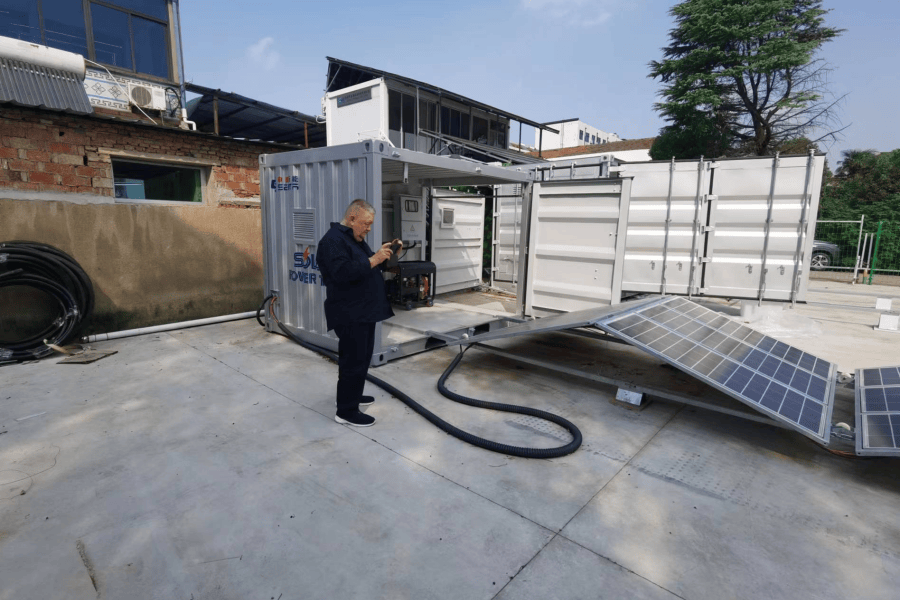
So, what's the alternative? Imagine a solution that arrives on a single truck: a containerized system with solar panels ready to deploy, a battery storage system (BESS) sized for your site's load, and all the power electronics already wired, tested, and certified inside. That's the pre-integrated part. It slashes commissioning time from weeks to days.
But the magic word is Black Start Capable. In grid engineering, "black start" refers to a power plant's ability to start up from a completely dead state without drawing power from the grid. For a construction site container, this means the system can self-energize. If the batteries are depleted, the integrated solar can wake the system up at sunrise. No external generator needed. It's a closed-loop of resilience that diesel simply cannot match.
At Highjoule, when we engineer our mobile power units, black start capability isn't an add-on; it's a core design principle. We've seen it turn potential downtime into a non-issue on sites from windy Scottish highlands to remote Nevada desert locations.

A Real-World Case: How a Texas Project Ditched the Grid Wait
Let me give you a concrete example. We worked with a developer on a mid-sized logistics park outside Austin. The grid connection date from the utility was firm, but they needed power six weeks earlier to begin foundational work and set up their full site compound. The traditional bid was for three large diesel generators.
We proposed a different Comparison of Black Start Capable Pre-integrated PV Container for Construction Site Power. We deployed two of our 40ft containers, each with 50kW of rooftop PV and 250kWh of lithium-ion storage. The challenge wasn't just power, but also providing clean, quiet power for the site offices and meeting local noise regulations.
The outcome? The system covered over 70% of the daytime load directly from solar, charging the batteries. The batteries covered the evening security and lighting load. The silent, emission-free operation kept the neighbors and county inspectors happy. Honestly, the project manager told me the biggest benefit was the predictability of cost - no fuel surprises. They avoided an estimated 8,000 liters of diesel consumption during that phase. When I checked the NREL's technology footprint tools, the carbon avoidance was equivalent to taking several cars off the road for a year, just for a temporary site setup.
Key Considerations for Your Site: Beyond the Brochure Specs
When you're evaluating these systems, the spec sheet is just the start. Based on my 20+ years, here's what you should really dig into:
- Thermal Management: This is huge. A container in the Arizona sun is an oven. How is the battery cooled? I've seen systems throttle power output on hot days because their cooling was undersized. Look for robust, independent climate control systems that keep the battery in its happy zone (usually 20-25C) regardless of outside temps. This directly impacts lifespan and safety.
- C-rate Explained Simply: Think of C-rate as the "speed" of the battery. A 1C rate means a 100kWh battery can deliver 100kW of power. A 0.5C rate means it can only deliver 50kW. For construction sites, you often need high power for short bursts (big tools). Ensure the system's C-rate matches your peak load, not just your average energy use.
- The LCOE (Levelized Cost of Energy) Mindset: Don't just compare upfront rental or purchase cost. Compare the projected cost per kWh over your project phase. With free solar fuel and minimal maintenance, a PV+BESS container often wins on LCOE over diesel, especially for projects longer than 6-12 months.
- Safety & Compliance is Non-Negotiable: This is where you must check the boxes. For the US, look for UL 9540 (system standard) and UL 1973 (battery standard) certifications. In the EU, it's IEC 62619. These aren't just stickers; they mean the system's safety has been rigorously tested by a Nationally Recognized Testing Laboratory (NRTL). Never compromise here.
Making the Shift: What to Look For
The market is evolving fast. When you're doing your own Comparison of Black Start Capable Pre-integrated PV Container for Construction Site Power, partner with a provider that doesn't just sell a box, but understands your site's rhythm. Ask about their deployment process. Do they provide single-point site assessments? Is their container designed for easy relocation if your site work moves? What does the remote monitoring look like - can you see your power generation and usage in real-time from your trailer?
Our approach at Highjoule has always been to engineer out the field problems before they happen. That means using components with proven reliability, designing for serviceability (because things do need maintenance), and building to the strictest local standards, whether it's UL in Houston or IEC in Hamburg. The goal is to make your temporary power so reliable and quiet that you forget it's there - freeing you up to focus on actually building your project.
So, the next time you're planning site power, what's the first cost you'll calculate: the daily rental rate, or the true cost of keeping your project moving forward reliably, cleanly, and quietly?
Tags: Construction Site Power UL Standard BESS LCOE Black Start Pre-integrated Container
Author
James Zhang
20+ years agricultural energy storage engineer / Highjoule CTO