
Environmental Impact of Scalable Modular Industrial ESS Containers for Remote Island Microgrids
The Unseen Footprint: Rethinking Environmental Impact for Island Energy Independence
Let's be honest. When we talk about bringing energy storage to remote islands or off-grid industrial sites, the first conversation is always about reliability and cost. But after two decades on site, from the Caribbean to the Scottish Isles, I've learned there's a second, equally critical discussion that often happens too late: the full environmental impact of the solution itself. It's not just about enabling renewables; it's about how the enabling technology interacts with a fragile, isolated ecosystem.
Jump to Section
- The Real Problem: More Than Just Diesel Displacement
- The Agitation: Hidden Costs & The "Deployment Shock"
- The Solution: Scalable Modular Containers C Designed for Minimal Touch
- From Blueprint to Beachfront: A Pacific Island Case Study
- Expert Insight: Thermal Management & LCOE in the Real World
- The Highjoule Difference: Engineering for Ecosystem and Efficiency
The Real Problem: More Than Just Diesel Displacement
The goal is clear: reduce diesel dependency. The International Energy Agency (IEA) notes that islands often pay 2-4 times more for electricity, primarily from imported fossil fuels. So, the business case for solar-plus-storage seems obvious. But here's the catch I've seen firsthand. Traditional, large-scale BESS deployments for these locations can create their own set of environmental stressors:
- Construction Footprint: Pouring massive concrete pads, extensive site leveling, and permanent structures in sensitive coastal or forested areas.
- Logistical Burden: Transporting oversized, single-piece systems requires heavy lift equipment, port modifications, and causes significant local disruption.
- Inflexibility: A "monolithic" system sized for future needs sits vastly underutilized for years, tying up capital and resources inefficiently. Honestly, it's like bringing a massive cruise ship to service a small fishing village.
The Agitation: Hidden Costs & The "Deployment Shock"
This isn't just theoretical. The agitation comes when the projected "green" savings get eroded by unseen costs. The Levelized Cost of Storage (LCOS) - your true total cost of ownership - gets inflated by things we engineers sometimes overlook in the initial planning:
- Site Preparation Costs: Excavation and civil work in remote areas are exponentially more expensive and ecologically damaging.
- Water & Cooling Demands: Some air-cooled systems, struggling in tropical heat, derate output or require supplemental cooling, consuming precious freshwater resources.
- End-of-Life Complexity: Decommissioning a permanent, bespoke installation in 15-20 years is a future environmental and financial liability for the island community.
The irony? A project meant to reduce environmental impact can start its life with a hefty carbon and ecological footprint from the installation alone.
The Solution: Scalable Modular Containers C Designed for Minimal Touch
This is where the philosophy of the scalable modular industrial ESS container truly shines. It flips the script. Instead of adapting the environment to the technology, we engineer the technology for the environment. The core idea is minimal site touch.
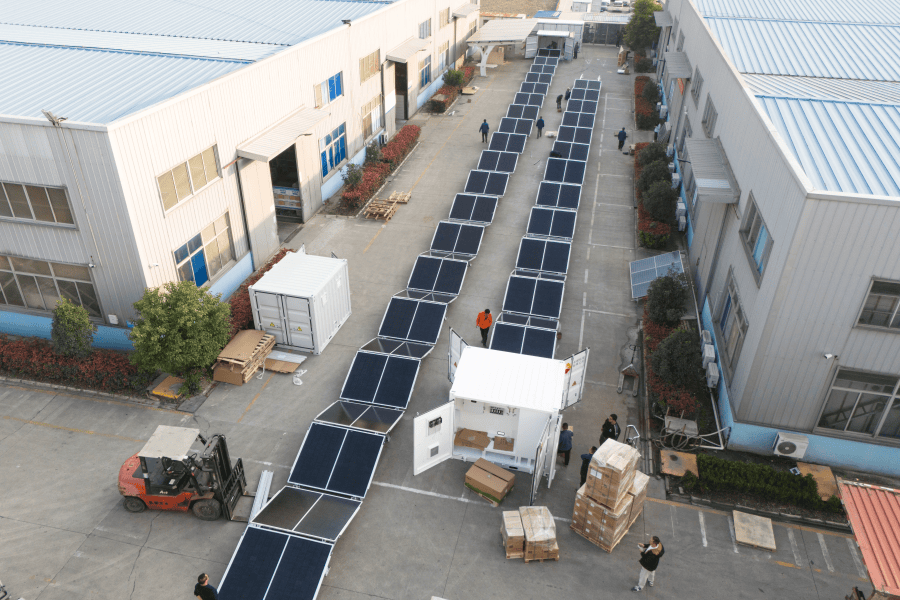
Think of it as LEGO for energy infrastructure. You start with a 20-foot containerized unit that's fully assembled, tested, and certified (think UL 9540, IEC 62933) at the factory. It's delivered as a single object, placed on simple gravel pads or pre-cast footings - no pouring, no major earthworks. Need more capacity? You add another identical container next year, plugging it into the existing microgrid controller. The system grows with demand, avoiding the waste of overbuilding.

From Blueprint to Beachfront: A Pacific Island Case Study
Let me give you a real example. We worked with a community in the Pacific aiming to offset 60% of their diesel consumption. The challenge? A tiny port, limited heavy machinery, and a site next to a protected mangrove area.
The solution was a phased deployment of three modular 500kW/1MWh containers from Highjoule.
- Phase 1 (Year 1): One container was shipped, offloaded with a standard port mobile crane, and placed on a prepared bed of compacted local gravel. It was connected to the existing solar farm and grid within 10 days. The immediate diesel savings funded Phase 2.
- Phase 2 & 3 (Years 2 & 4): Two additional containers were added as renewable penetration increased, with zero modifications to the original site plan. The thermal management system was specifically designed for high ambient salt-air corrosion resistance and used passive cooling to minimize energy drain on the system itself (a critical factor for LCOS).
The environmental win was twofold: drastic diesel reduction and a deployment that left the mangroves entirely undisturbed.
Expert Insight: Thermal Management & LCOE in the Real World
Now, let's get a bit technical, but I'll keep it coffee-chat simple. Two factors make or break an island BESS: thermal management and C-rate.
Thermal Management: In a 35C (95F) tropical climate, a battery's lifespan and safety are directly tied to its cooling. A poorly managed system will degrade faster, requiring premature replacement - a huge environmental and cost setback. Our modular containers use an advanced, closed-loop liquid cooling system. It's like a car's radiator, but smarter. It keeps the battery at its optimal temperature with minimal auxiliary power draw, which directly lowers your operational costs and extends system life to beyond 15 years. This is non-negotiable for UL and IEC safety compliance in harsh environments.
C-rate & LCOE: The C-rate is basically how fast you charge or discharge the battery. A high C-rate (like 1C or more) sounds great for power, but it stresses the battery, increasing heat and shortening life. For island microgrids, you rarely need to discharge the entire system in one hour. We often design for a more moderate C-rate (e.g., 0.5C). This reduces thermal stress, allows for simpler, more reliable cooling, and ultimately delivers a lower Levelized Cost of Energy (LCOE) because the assets last much longer. It's about right-sizing the power (kW) and energy (kWh) for the actual duty cycle.

The Highjoule Difference: Engineering for Ecosystem and Efficiency
At Highjoule, our approach to modular containers is shaped by these on-the-ground realities. It's not just a product; it's a deployment philosophy.
- Standards as a Baseline, Safety as a Culture: Every unit meets UL/IEC/IEEE standards - that's table stakes. We go further with factory-based commissioning, so the system arrives "plug-and-play," reducing on-site technical risks and commissioning time.
- LCOE-Optimized Design: We model the entire lifecycle - from shipping weight and volume to expected degradation in your specific climate - to give you the true financial and environmental cost, not just the lowest upfront price.
- Localized Support, Global Experience: We partner with local technicians and provide comprehensive virtual oversight, ensuring the system performs as designed without needing a constant fly-in of specialists, cutting down on travel-related emissions.
So, when you're evaluating storage for a remote or sensitive site, ask your provider not just about the kWh rating, but about the installation footprint, the cooling efficiency at peak ambient temperature, and the decommissioning plan. The most sustainable solution is the one that solves the energy problem with the lightest possible touch on the environment it's meant to protect.
What's the biggest site constraint you're facing in your next microgrid project?
Tags: UL Standard BESS LCOE Modular Energy Storage Remote Island Microgrid IEEE Standards Environmental Impact
Author
James Zhang
20+ years agricultural energy storage engineer / Highjoule CTO