
Environmental Impact of Scalable Modular Off-grid Solar Generators for Data Center Backup
Contents
- The Silent Dilemma: Your Data Center's Backup Power and Its Hidden Cost
- Beyond Carbon: The Real Environmental Footprint of Traditional Backup
- The Modular Advantage: How Scalability Directly Cuts Environmental Impact
- A Case in Point: Seeing the Theory Work On-Site
- The Technical Edge: Why Smart Engineering Makes a Greener System
- The Path Forward: Making Your Next Backup Decision a Sustainable One
The Silent Dilemma: Your Data Center's Backup Power and Its Hidden Cost
Let's be honest. When we talk about data center resilience, the conversation is almost always about uptime, redundancy, and milliseconds of switchover. The backup generators C those massive diesel units sitting in the yard C are treated as a necessary insurance policy. We test them monthly, maintain them religiously, but we rarely talk about their true cost beyond the capital expenditure and the fuel contracts. Honestly, after 20+ years on sites from California to North Rhine-Westphalia, I've seen this firsthand: the environmental impact of these standby systems is the industry's quietest, most persistent headache.
Beyond Carbon: The Real Environmental Footprint of Traditional Backup
The problem isn't just the CO2 they spew during a rare grid outage. It's the full lifecycle impact. Think about the constant "exercise runs" required by NFPA 110 and other local codes to ensure reliability. Each monthly test burns fuel, emits NOx and particulate matter, and creates noise pollution C all for a system that hopefully never runs at full load. Then there's the embodied energy in those large, single-use engines and the environmental risk of storing thousands of gallons of diesel on-site. The International Energy Agency (IEA) has highlighted the growing carbon footprint of the ICT sector, and backup power is a significant, often overlooked, contributor. It's a model of inefficiency: a high-capital, high-emission asset with a 99%+ idle time. That doesn't sit well with modern ESG mandates or the genuine sustainability goals of most companies I work with today.
The Modular Advantage: How Scalability Directly Cuts Environmental Impact
This is where the concept of a scalable, modular off-grid solar generator changes the game. It reframes backup power from a static, polluting insurance cost to a dynamic, clean energy asset. The key is in the words "scalable" and "modular."
Traditional systems are oversized for the worst-case scenario, leading to wasteful operation at tiny fractions of capacity during testing or minor events. A modular Battery Energy Storage System (BESS), coupled with a dedicated solar canopy, is built differently. You start with what you need for your critical Tier 1 load and can scale up blocks of power (kW) and energy (kWh) as your data hall grows. This "right-sizing" principle has a profound environmental benefit:
- Reduced Embedded Carbon: You're not pouring concrete for a massive generator pad and installing a 2MW engine day one. You deploy a 500kW/1MWh containerized BESS unit that matches current demand.
- Zero Operational Emissions: During grid outages, the power comes from the sun and stored electrons, not combustion. During those mandatory monthly tests? You're cycling the battery and potentially feeding solar power back on-site, not burning diesel.
- Dual-Life Value: Even the batteries have a sustainability story. At Highjoule, our systems are designed for a long first life in demanding backup service. But their journey doesn't end there. With proper degradation management, these battery packs can find a second life in less demanding stationary storage applications, maximizing the use of the raw materials before recycling.

A Case in Point: Seeing the Theory Work On-Site
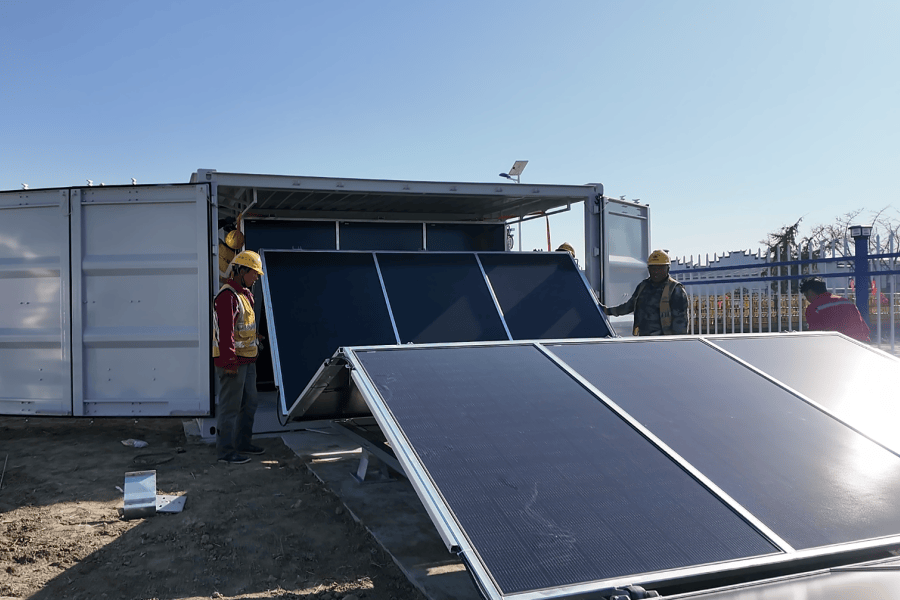
I remember a project in Northern Virginia, a major data center hub. The client needed N+1 backup redundancy but was under strict local emissions caps and corporate net-zero targets. Deploying another set of diesel generators was a political and PR non-starter. Our solution was a modular off-grid solar-battery system designed to cover their critical cooling and control room loads.
The challenge was proving it could meet the same reliability standards (think UL 9540 for energy storage, IEEE 1547 for interconnection) as a traditional generator. We deployed two 40-ft ISO containers housing UL-listed BESS racks and paired them with a dedicated, ground-mounted solar field. The scalability was the clincher. They initially commissioned only 70% of the battery capacity. Later, when they added a new data hall, we integrated a third container, increasing total capacity by 50% without disrupting the existing, operational backup power. The environmental kicker? Their annual diesel consumption for testing dropped by over 90%, and the system actively shaves peak grid demand during normal operations, further reducing their carbon load. It turned a cost center into a clean energy asset.
The Technical Edge: Why Smart Engineering Makes a Greener System
To make this work, you need more than just panels and batteries. The real magic C and where the environmental efficiency is won or lost C is in the system engineering. Let me break down two critical concepts in plain English:
1. Thermal Management & Longevity: A battery's worst enemy is heat. Poor thermal management forces the system to work harder (using more energy to cool itself) and drastically shortens battery life, meaning you're manufacturing and recycling units more often. Our approach uses an advanced liquid cooling system that precisely controls cell temperature. This isn't just about safety; it's about sustainability. By keeping each cell in its happy place, we ensure the battery pack lasts 20-30% longer, directly reducing its lifecycle environmental impact per kilowatt-hour stored.
2. Understanding the True LCOE (Levelized Cost of Energy): Financial decision-makers get this. LCOE is the total cost of owning and operating an asset over its life, divided by the total energy it produces. For a diesel generator, the "fuel" line item is huge and volatile. For a solar-battery system, the "fuel" is free sunshine, and the main costs are upfront capital and long-term maintenance. When you factor in avoided carbon taxes, diesel maintenance contracts, and the societal cost of emissions, the LCOE of a modular renewable backup system becomes compelling. You're locking in clean, predictable backup power costs for decades.

The Path Forward: Making Your Next Backup Decision a Sustainable One
The next time you review your data center's resilience plan, ask a different question. Don't just ask, "Do we have enough backup power?" Ask, "What is the environmental and total cost of ownership of our backup power strategy?" The technology to make a meaningful change is here, it's proven, and it's compliant with the same rigorous UL and IEC standards you trust for your traditional gear.
The shift isn't just about being green. It's about being smart, resilient, and financially astute. It's about building infrastructure that aligns with where the world C and your stakeholders C are heading. What's the one operational headache in your backup regime that you'd love to solve, not just for uptime, but for the long-term footprint of your facility?
Tags: UL Standard BESS LCOE Modular Energy Storage Off-grid Solar Data Center Backup Environmental Impact
Author
James Zhang
20+ years agricultural energy storage engineer / Highjoule CTO