
Environmental Impact of Smart BMS Monitored Hybrid Solar-Diesel System for Construction Site Power
Table of Contents
- The Noisy, Dirty Reality of Construction Power
- Why the Old Ways Are Now a Liability
- The Hybrid Solution: More Than Just Panels and Batteries
- The Smart BMS Difference: It's the Brain, Not Just the Brawn
- A Real-World Case: Quiet Power in the California Sun
- Beyond Fuel Saving: The Ripple Effect of a Smarter System
- Making the Switch: A Practical Path Forward
The Noisy, Dirty Reality of Construction Power
Let's be honest. If you've spent any time on a construction site in the US or Europe, you know the soundtrack: the constant, throaty rumble of diesel generators. It's the background noise to progress. For decades, it's been the only reliable way to power tools, site offices, and temporary lighting. But here's the thing we all feel in our guts, and I've seen this firsthand on site after site: it feels wasteful. You're burning expensive fuel 24/7, often at partial load, just to keep a few lights on overnight. The emissions are visible, the smell is in the air, and honestly, the noise pollution is a headache for everyone C your crew and the neighboring community.
This is the universal starting point. The diesel gen-set is a workhorse, but it's an inefficient, dirty one when used as a standalone solution. The Environmental Impact of Smart BMS Monitored Hybrid Solar-Diesel System for Construction Site Power isn't just a theoretical concept; it's a direct answer to this daily, costly, and increasingly regulated problem.
Why the Old Ways Are Now a Liability
The pain isn't just operational anymore; it's financial and legal. Local emissions regulations, especially in urban areas and across the EU, are tightening. Noise ordinances can limit your working hours. But the real agitation comes from the sheer economic waste. The International Energy Agency (IEA) has highlighted that off-grid diesel generation is one of the most expensive and carbon-intensive forms of power. You're not just paying for the diesel; you're paying for transport, storage, maintenance on overworked engines, and the "idle burn" that happens when load demand is low.
From a pure project management view, it's a volatile, uncontrollable cost line item. When fuel prices spike, your site OPEX spikes with no warning. And let's not forget the carbon footprint reporting that more and more large contractors and developers are mandated to provide. That diesel consumption becomes a big, ugly number on your sustainability report.
The Hybrid Solution: More Than Just Panels and Batteries
So, we add solar panels and a battery, right? Problem solved? Not quite. A simple "solar + battery + generator" setup without intelligent control is like having three musicians playing without a conductor. The generator might still kick on when the battery is half-full, or the solar might overcharge the battery while the diesel is still running.
The true solution is an integrated, smart hybrid system. The goal is to make the diesel generator the last resort, not the first responder. Solar PV acts as the primary fuel source when the sun is shining. A battery energy storage system (BESS) stores that solar energy and acts as a buffer, handling load spikes and providing silent overnight power. The generator only runs when absolutely necessary to recharge the battery during prolonged bad weather or during exceptional peak demands.
This is where the magic C and the real environmental benefit C happens. You can easily cut diesel runtime by 60-80%. I've seen projects where generators that used to run 22 hours a day now only run for 4-5 hours, and at their optimal, efficient load point.
The Smart BMS Difference: It's the Brain, Not Just the Brawn
This brings us to the most critical component: the Smart Battery Management System (BMS). This isn't just a fancy term. In a hybrid system, the Smart BMS is the central nervous system. A basic BMS protects the battery. A Smart BMS actively manages the entire energy ecosystem.
Here's what that means in plain English:
- Orchestration: It decides, in milliseconds, whether to pull power from solar, discharge the battery, or (reluctantly) start the generator. It does this based on load demand, state of charge, fuel cost, and even weather forecasts.
- Battery Health & Safety: This is non-negotiable. A high-quality Smart BMS, like the ones we design into Highjoule systems, continuously monitors every cell for voltage, temperature (that's the Thermal Management), and current. It prevents overcharge, deep discharge, and thermal runaway C the core safety risks. This is why compliance with standards like UL 9540 and IEC 62619 isn't just a checkbox for us; it's the foundation of our design philosophy.
- Performance Insight: It provides real-time and historical data on everything: diesel liters saved, CO2 emissions avoided, solar self-consumption rate, and battery health trends. This turns environmental impact from an estimate into a measurable, reportable metric.
Understanding the C-rate is key here. Think of it as the "sipping vs. gulping" rate for your battery. A Smart BMS manages the C-rate, ensuring the battery isn't stressed by drawing or charging power too quickly, which extends its lifespan dramatically. A longer-lasting battery means lower Levelized Cost of Energy (LCOE) and less environmental waste from premature replacements.
A Real-World Case: Quiet Power in the California Sun
Let me give you a concrete example from a site we worked on in Southern California. A mid-sized commercial developer was building a residential complex. Their challenge was threefold: meet strict local air quality (SCAQMD) rules, reduce noise to comply with a tight site permit, and control energy costs for an 18-month project.
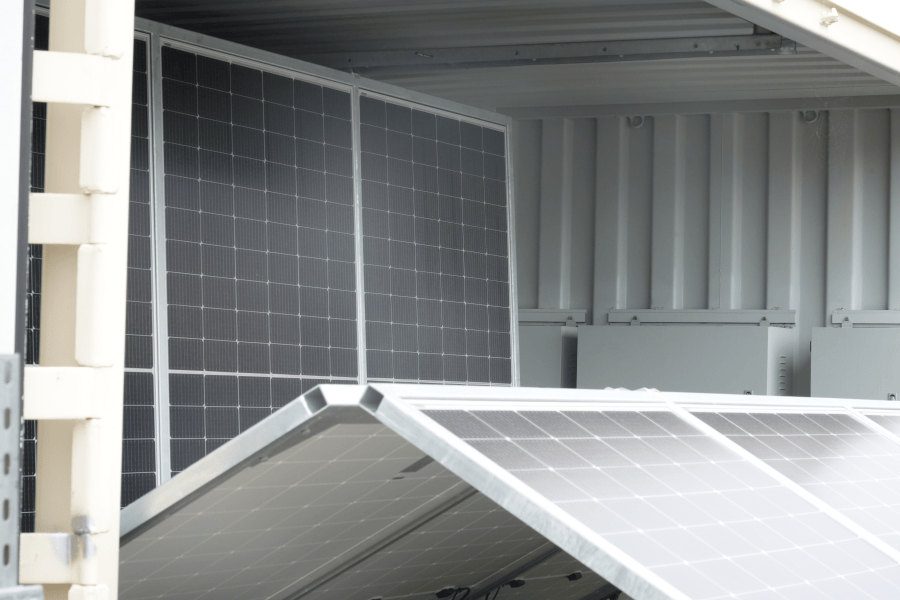
We deployed a containerized Highjoule hybrid system: a 150kW solar canopy over the material storage area, a 250kWh UL 9540-certified BESS, integrated with their existing 200kW diesel generator via our advanced Smart BMS controller.
The results after the first quarter were telling:
- Diesel Use: Reduced by 76%.
- Emissions: Over 80 metric tons of CO2e avoided.
- Noise: Generator off from 6 PM to 7 AM, powered by silent battery.
- Financial: Despite the capital lease, they saw a 15% reduction in monthly energy costs, with the added benefit of predictable pricing.
The project manager told me the quietest benefit was the data. He could pull a report any time for the client or the county, showing exact emissions savings. The Environmental Impact of Smart BMS Monitored Hybrid Solar-Diesel System for Construction Site Power was no longer a promise; it was a live dashboard.
Beyond Fuel Saving: The Ripple Effect of a Smarter System
The benefits cascade. Less generator runtime means far less maintenance - no more frequent oil changes and filter replacements for an engine that's constantly grinding. It means enhanced site safety with fewer fuel storage hazards and reduced fire risk. It improves worker well-being by cutting noise and air pollution on-site.
From a broader perspective, this technology is a bridge. It allows construction, a traditionally hard-to-decarbonize sector, to immediately start integrating renewables and cutting emissions today, not in some distant future. It aligns perfectly with corporate ESG goals and can be a differentiator in bidding for projects with green building requirements like LEED.
Making the Switch: A Practical Path Forward
The thought of switching can seem daunting. But it doesn't have to be a full rip-and-replace. Often, we work with clients to integrate our smart BESS and control system with their existing solar (if they have it) and definitely their existing generators. The key is the intelligence in the middle.
Start with an audit. Look at your historical fuel consumption and load profiles. Ask yourself: what are our pain points - cost, compliance, noise, or all three? Then, talk to a provider who understands the on-site realities, not just the textbook theory. They should be able to model your potential savings and environmental impact before you commit a single dollar.
At Highjoule, we've built our systems for this very transition - modular, compliant with both US and EU standards, and managed by a Smart BMS that we can support remotely. Our goal is to make your diesel generator the silent, seldom-used backup it was always meant to be.
So, next time you hear that generator rumble on site, ask a simple question: Is this just background noise, or is it the sound of money and carbon burning away? The alternative is already here, and it's smarter and quieter than you think.
Tags: Construction Site Power BESS Renewable Energy Solar-Diesel Hybrid Smart BMS
Author
James Zhang
20+ years agricultural energy storage engineer / Highjoule CTO