
Grid-forming BESS for Coastal Sites: Conquering Salt Spray with Containerized Solar Storage
Navigating This Article
- The Coastal Dilemma: Why Your Perfect Site is a BESS Nightmare
- It's More Than Just Rust: The Real Cost of Salt Spray
- A Case in Point: Grid-Forming Power on the North Sea Coast
- The Tech That Makes It Work: Inside the Salt-Spray-Proof Container
- Thinking About Your Site? Key Questions to Ask
The Coastal Dilemma: Why Your Perfect Site is a BESS Nightmare
Honestly, some of the best locations for renewable energy are the toughest on equipment. I've stood on sites from the Gulf Coast to the North Sea, and the pattern is clear: incredible wind and solar potential, but an atmosphere that eats metal for breakfast. We're talking about coastal and near-coastal sites where salt spray aerosol is a constant, corrosive fact of life. For a standard Battery Energy Storage System (BESS), it's like asking it to run a marathon in a sandstorm.
The industry knows this. The International Energy Agency (IEA) highlights the massive potential for offshore wind and coastal solar, but deployment hinges on resilient infrastructure. Yet, too often, I've seen projects where the BESS is an afterthought in site planning - a standard container plonked down, only for the real headaches to begin 18 months later. The problem isn't just getting power online; it's keeping it there reliably for the 15-20 year lifespan your financial model depends on.
It's More Than Just Rust: The Real Cost of Salt Spray
Let's agitate that pain point a bit. It's not merely a cosmetic issue. Salt spray corrosion is a systemic threat:
- Electrical Failures: Salt deposits create leakage paths, leading to short circuits, ground faults, and arc flash risks. I've seen combiner boxes and busbars degrade prematurely, causing unplanned downtime that kills your revenue stack.
- Cooling Catastrophes: Thermal management is the heartbeat of any BESS. Salt clogs air filters and corrodes heat exchanger fins, reducing efficiency. The system works harder to cool itself, increasing parasitic load and accelerating wear. Before you know it, your operating costs are up and battery life is down.
- Structural Weakening: The container itself, the racking, the cable trays - all are under attack. This compromises physical integrity and safety, potentially violating local building codes and OSHA (or equivalent) standards.
The financial hit? It blows up your Levelized Cost of Storage (LCOS). You're facing higher CapEx for premature replacements, lost revenue from downtime, and soaring OpEx for constant maintenance. It turns a profitable asset into a money pit.
The Solution Isn't Just a "Better Coating"
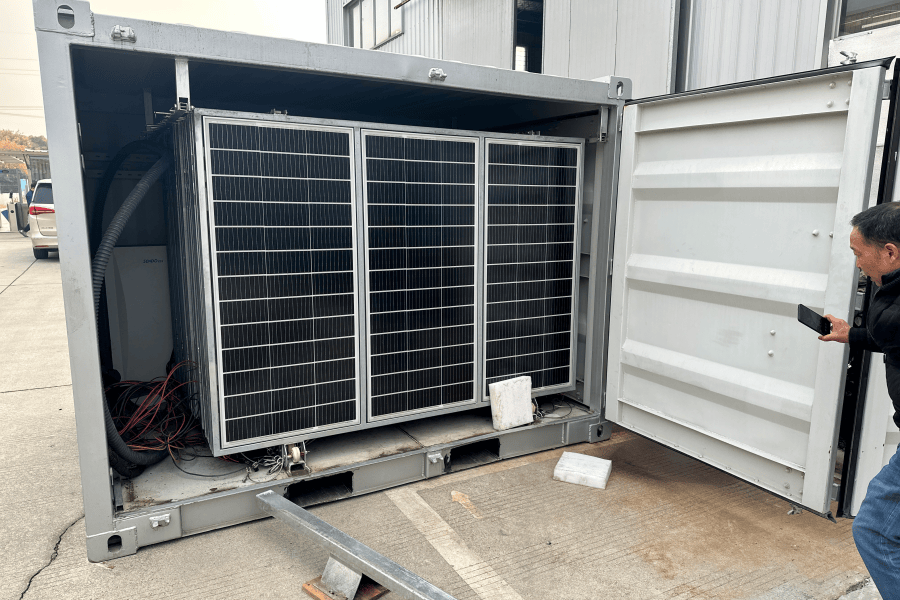
Many think specifying an IP55 enclosure is enough. On paper, maybe. But in the real world, with thermal cycling, salt penetrates. The solution is a holistic, systems-level approach designed from the ground up for the environment. This is where the concept of a purpose-built, grid-forming solar container for coastal salt-spray environments moves from a nice-to-have to a non-negotiable for bankable projects.
A Case in Point: Grid-Forming Power on the North Sea Coast
Let me walk you through a project that crystallizes this. We deployed a 4 MWh containerized BESS for an industrial microgrid at a port facility in Northern Germany. The challenge was classic: high winds, abundant but intermittent renewables, a need for peak shaving, and a brutal salt-laden environment.
The client's main worry was grid stability. They needed more than just backup; they needed an asset that could form a stable voltage and frequency waveform independently - true grid-forming capability - to support critical port operations during grid disturbances. But doing that with a system that would corrode in five years was a non-starter.
Our approach was integrated from day one:
- Container as a Shield: We started with a C5-M (ISO 12944) high corrosion resistance certified enclosure. This isn't just thicker paint; it's a multi-stage process involving zinc spraying, specialized primers, and chemically resistant topcoats on all external and internal surfaces.
- Sealed & Pressurized Cooling: We moved away from standard air-to-air cooling. The system uses a closed-loop, liquid-cooled thermal management for the battery racks, with external dry coolers featuring corrosion-resistant coatings and easy-clean designs. The container interior is slightly pressurized with filtered air to keep salt out.
- Component-Level Armor: Every component, from HVAC units to cable glands, was specified for marine or coastal service. Think stainless steel fittings, conformal-coated PCBs, and connectors meeting IEC 60068-2-52 salt mist standards.
- Grid-Forming Intelligence: At its core, the power conversion system (PCS) was equipped with advanced grid-forming inverters. This allowed the BESS to operate as the "heartbeat" of the local microgrid, providing black start capability and inertial response, mimicking a traditional generator but with zero emissions.
The result? The system has operated flawlessly for over two years now, with zero corrosion-related issues and availability exceeding 99%. It's not just storing energy; it's actively strengthening the local grid's resilience, all while weathering the harsh coastal climate.

The Tech That Makes It Work: Inside the Salt-Spray-Proof Container
For the non-engineers making decisions, here's the plain-English insight on why this integrated approach matters. It all ties back to lifetime cost and safety.
Thermal Management is Everything: Batteries degrade fast if they're too hot or too cold. In a salty environment, if your cooling system fails, you're cooked. A liquid-cooled system, while a higher initial investment, maintains optimal temperature with military precision, dramatically extending battery life. This is the single biggest lever to pull for lowering your LCOE in harsh conditions.
C-rate Isn't Just a Number: The C-rate is how fast you charge or discharge the battery. A 1C rate means full discharge in one hour. In a grid-forming application, you need high C-rate capability to respond to grid faults in milliseconds. But high power creates more heat. So, our design pairs high-quality, UL 9540-certified battery cells engineered for sustained high C-rates with that robust liquid cooling. This ensures the system can deliver on its grid-forming promise day in, day out, without thermal stress.
Compliance is Your Safety Net: Anyone can claim corrosion resistance. At Highjoule, we design to the test standards that matter: UL standards for safety (like UL 9540 for the entire system), and IEC standards for environmental resilience (like IEC 60068 for salt fog). For European and North American markets, this isn't just ticking a box; it's the foundation of bankability and insurance. It's proof we've simulated 20 years of coastal abuse in a test chamber before the first module ships.
Thinking About Your Site? Key Questions to Ask
So, if you're evaluating a BESS for a coastal site, a fish farm, a port, or any corrosive environment, move beyond the basic spec sheet. Ask your provider these questions:
- "Beyond the enclosure, what specific corrosion protection standards do the internal components meet?"
- "How does the thermal management system prevent salt ingress and maintain efficiency over 15 years?"
- "Can you show me a third-party test report for salt spray compliance relevant to my project's specific zone (e.g., C5 per ISO 12944)?"
- "How does the grid-forming capability integrate with my existing site controls, and what's the real-world response time?"
The right solution doesn't fight the environment; it's designed for symbiosis with it. It ensures your energy storage asset is a resilient, revenue-generating pillar for decades, not a maintenance liability. What's the one corrosion-related failure you absolutely cannot afford on your project?
Tags: UL Standard BESS LCOE Coastal Energy Storage Solar Container Salt-Spray Corrosion Microgrid Grid-forming
Author
James Zhang
20+ years agricultural energy storage engineer / Highjoule CTO