
High-voltage DC Hybrid Solar-Diesel Systems for Construction Site Power
Contents
- The Problem: The Silent Drain of Diesel on Your Construction Budget
- The Agitation: It's More Than Just Fuel Bills
- The Solution: A High-Voltage DC Hybrid Approach
- A Real-World Case: From Blueprint to Reality
- Expert Insight: Why the Technical Details Matter (And How We Simplify Them)
- The Future of Your Site Power
The Problem: The Silent Drain of Diesel on Your Construction Budget
Let's be honest. When you're managing a large-scale construction project in remote areas or even on the fringes of the grid, your primary power concern is reliability. You need those cranes, welders, and site offices running 24/7. For decades, the default answer has been diesel generators C loud, dirty, but dependable. Or so we thought.
The real problem isn't just having power; it's the staggering and unpredictable cost of generating it. I've been on sites where the fuel logistics alone felt like a military operation. One project manager in Texas once told me, half-joking, that his fuel budget had a mind of its own. According to the International Energy Agency (IEA), diesel prices have shown extreme volatility, heavily impacting off-grid and remote industrial operations. You're not just paying for fuel; you're paying for transport, storage, security, and the constant maintenance those gensets demand. It's a cost center that's notoriously hard to control.
The Agitation: It's More Than Just Fuel Bills
Now, let's amplify that pain for a second. It goes beyond the invoice from the fuel company.
First, there's the environmental and regulatory squeeze. Noise complaints, emissions targets, and local permitting are becoming huge hurdles. Many municipalities, especially in California and across the EU, are tightening regulations on particulate matter and NOx emissions. Your diesel fleet might literally prevent you from winning the next bid.
Second, efficiency. Diesel generators are notoriously inefficient at partial load C which is how they run most of the time. You might be burning 30% more fuel than necessary just to cover variable demand. Then there's the downtime for maintenance and the risk of a single point of failure. If that 1MW genset fails, the entire site goes dark. I've seen this firsthand on site: the clock is always ticking, and a power outage isn't an inconvenience; it's a direct hit to the critical path and your bottom line.
The Solution: A High-Voltage DC Hybrid Approach
So, what if you could lock in a significant portion of your energy costs, slash your fuel use by half or more, and add a massive layer of redundancy? That's not a future dream; it's what a properly designed high-voltage DC-coupled hybrid solar-diesel system delivers today.
The magic is in the architecture. Instead of just bolting solar panels onto an AC bus (a common but less efficient method), a high-voltage DC system connects solar arrays and a large-scale battery energy storage system (BESS) directly on a common DC bus before conversion to AC. This setup reduces conversion losses C think of it as a "shortcut" for solar energy straight into storage or use. The battery acts as the intelligent buffer: it soaks up solar power, smooths out the demand on the diesel gensets, allowing them to run at their optimal, fuel-efficient point, or shuts them off entirely during peak sun. When demand spikes or the sun sets, the battery seamlessly picks up the slack before the genset needs to ramp up.
A Real-World Case: From Blueprint to Reality
Let me walk you through a project we completed last year for a major infrastructure developer in a semi-arid region of the southwestern U.S. The challenge was powering a remote highway extension project. They were running four 500kW diesel generators around the clock, with a peak demand of about 1.4MW.

The goals were clear: cut diesel consumption by at least 40%, ensure zero power interruptions for critical equipment, and meet stringent local emissions codes.
Here's what we deployed with Highjoule:
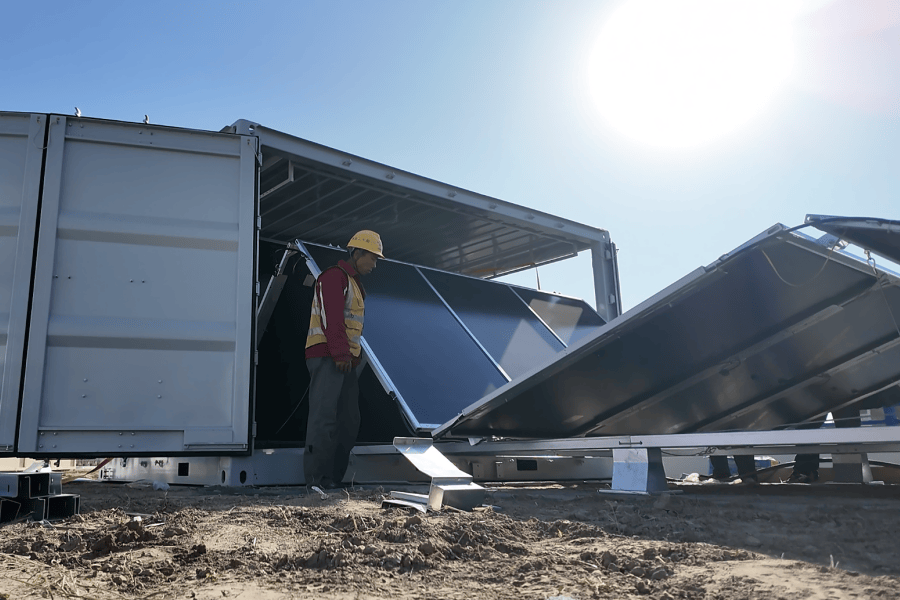
- A 2.5MWp solar PV array, mounted on temporary canopies that also provided shade for material storage.
- A 3MWh, UL 9540-certified containerized BESS from Highjoule, with a DC system voltage of 1500V.
- An advanced energy management system (EMS) to orchestrate everything.
The results after six months of operation? They hit a 68% reduction in diesel fuel use. The gensets now run only at steady, efficient loads or are completely off for 6-8 hours a day. The BESS handles all short-term load fluctuations and provides seamless backup. The project manager told me their fuel logistics headaches are gone, and they've actually insulated themselves from the worst of diesel price spikes. The system paid for itself in under two years just on fuel savings.
Expert Insight: Why the Technical Details Matter (And How We Simplify Them)
When we talk about a system like this, three technical terms are crucial: C-rate, Thermal Management, and LCOE. Let me break them down in plain English.
C-rate is basically the "speed" of the battery. A 1C rate means a 3MWh battery can deliver 3MW for one hour. For construction sites, you need a high C-rate C our systems often use batteries capable of 1C or more C to handle the sudden, large demands from heavy equipment. It's about power on tap.
Thermal Management is the unsung hero of safety and longevity. Batteries generate heat, and heat degrades them fast. Our containerized systems use a liquid cooling system that's far more effective than simple air fans, keeping every cell within a perfect temperature range. This is non-negotiable for both safety (meeting UL 1973 standards) and for ensuring the system lasts for the entire project and beyond. I've seen air-cooled units throttle power on a hot day; with liquid cooling, output is consistent.
Finally, LCOE (Levelized Cost of Energy). This is the big one for financial decision-makers. It's the total cost of owning and operating the system over its life, divided by the energy it produces. By adding solar and storage, you dramatically lower your LCOE compared to 100% diesel. The initial investment is offset by near-zero "fuel" cost for the solar portion and massive diesel savings. You're converting a volatile operational expense (fuel) into a predictable capital expense with a clear ROI.
Our entire design philosophy at Highjoule is to engineer these complexities into a robust, pre-integrated package that meets UL and IEC standards, so you don't have to worry about them. You get a predictable, reliable power plant for your site.
The Future of Your Site Power
The question is no longer if hybrid systems make sense, but when to integrate them. With volatile fuel prices and tightening regulations, the business case is solidifying by the month. The real-world data is in, and it shows dramatic cost and reliability benefits.
What's the one major cost line item on your next remote project that you could finally bring under control? Maybe it's time we looked at your site's power profile together.
Tags: Construction Site Power UL Standard BESS LCOE Renewable Energy Hybrid Power Systems
Author
James Zhang
20+ years agricultural energy storage engineer / Highjoule CTO