
High-voltage DC Off-grid Solar for Construction Sites: A Real-World Case Study
Powering the Job Site: Why We Switched to High-Voltage DC Solar for Off-Grid Construction
Honestly, if you've been on a remote construction site lately, you know the drill. The constant hum - and smell - of diesel generators, the fuel trucks making precarious trips down unpaved roads, the noise complaints from nearby communities. It's the standard way to get power where there's no grid, but after 20 years in this field, I can tell you it's a headache that's ripe for a solution. I've seen this firsthand on site, from Texas solar farms to Canadian mining camps. The good news? The shift is happening, and it's being led by a smarter approach to off-grid power. Let's talk about a real-world case that changed how one of our clients thinks about construction site energy.
Quick Navigation
- The Diesel Dilemma: More Than Just Fuel Costs
- Why Temporary Power is a Permanent Headache
- The High-Voltage DC Off-Grid Solar Generator: A Case Study
- Under the Hood: Key Tech That Makes It Work
- What This Means for Your Next Project
The Diesel Dilemma: More Than Just Fuel Costs
We all know diesel is expensive. But the problem on a construction site goes way deeper than the price at the pump. You're dealing with logistics nightmares - securing fuel storage, managing deliveries in bad weather, and the sheer security risk of having thousands of liters of fuel on site. Then there's the downtime. A generator needs maintenance, and if it fails, your entire site grinds to a halt. I've been called out to sites where a single generator failure cost over $50,000 in lost labor and delayed timelines in just one day.
And let's not forget the regulatory and social pressure. Emission regulations are tightening globally. The International Energy Agency (IEA) notes that diesel generators are a significant source of local air pollution and CO2, and projects in environmentally sensitive areas or near residential zones are facing more pushback. You're not just building a structure; you're managing a community relationship and a carbon footprint.
Why Temporary Power is a Permanent Headache
Here's the thing that really gets me: we treat this "temporary" power as a disposable cost, but its impacts are long-lasting. The volatility of diesel prices alone can blow a project's OPEX budget out of the water. A study by the National Renewable Energy Laboratory (NREL) highlighted that fuel price volatility is a top risk for remote operations. It's not a fixed cost; it's a gamble.
Furthermore, the typical low-voltage, AC-coupled solar setups I've seen tried as a supplement often fall short. They're complex, with multiple conversion steps (DC solar to AC, then back to DC for battery storage, then back to AC for use), each step losing about 2-3% efficiency. For powering heavy equipment - think welders, pile drivers, crane chargers - you need robust, stable power. Many AC systems struggle with the high inrush currents, leading to trips and more downtime. It feels like putting a band-aid on a broken pipe.
The High-Voltage DC Off-Grid Solar Generator: A Real-World Case Study
So, what does a working solution look like? Let me walk you through a project we completed last year for a civil engineering firm building a new bridge access road in a remote part of Colorado. The site had zero grid connection for 8 months.
The Challenge: Power a site office (lights, computers, HVAC), material processing equipment, and electric tool charging stations. The client had a strict noise ordinance to adhere to and a corporate sustainability target to hit. Diesel was their only initial plan, with a budget for over 40,000 gallons of fuel.
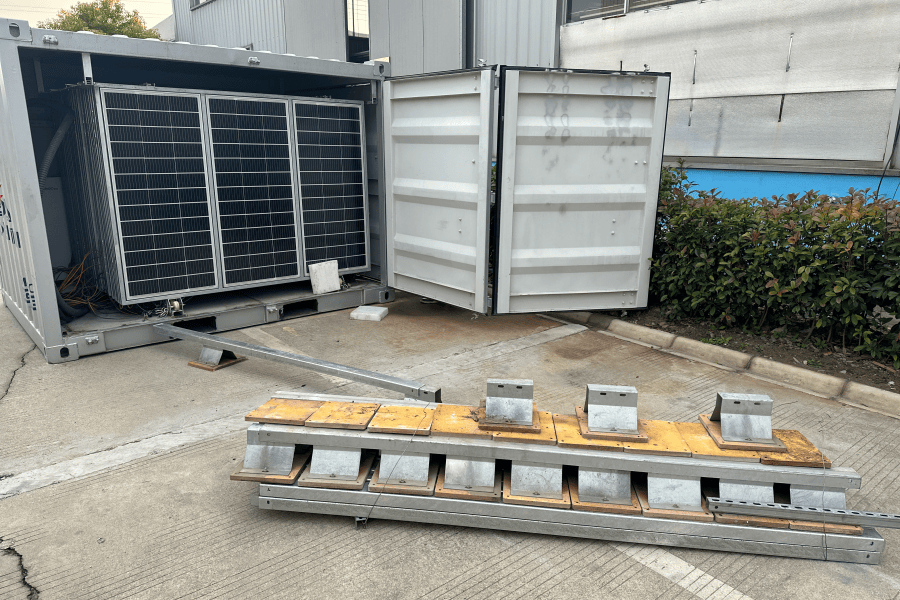
The Solution: We deployed a containerized High-Voltage DC Off-grid Solar Generator system. This wasn't just a few solar panels hooked to a battery. The core innovation was designing a system where the solar arrays output high-voltage DC (up to 1500V), which directly feeds into a similarly high-voltage DC battery storage system (BESS), with minimal conversion needed before use.

The Outcome: The system became the primary power source. The diesel gen-set was relegated to a silent, automated backup that only kicked in after several days of heavy snow. Over the project duration:
- Fuel Savings: Diesel consumption was reduced by 92%.
- Cost Savings: Despite the upfront capital, the Levelized Cost of Energy (LCOE) for the project's power was 35% lower than the projected all-diesel cost.
- Reliability: Zero unplanned power outages. The system's built-in intelligence managed loads and battery health seamlessly.
- Silent Operation: The site met all noise requirements, improving worker communication and community relations.
The key for us at Highjoule was designing this system not as a science project, but as rugged, site-ready equipment. It's built to UL 9540 and IEC 62933 standards, shipped in a weatherproof container, and our local team handled commissioning in under three days. The client's project manager told me the biggest benefit was the "set-it-and-forget-it" reliability - they could focus on building the road, not babysitting the power source.
Under the Hood: Key Tech That Makes It Work
For the non-engineers making budget decisions, don't glaze over. This isn't magic; it's just smart, integrated engineering. Let me break down two critical pieces:
1. High-Voltage DC & System Efficiency: By keeping the solar and battery on a common high-voltage DC bus, we avoid multiple AC/DC conversions. Think of it like a highway versus city streets. High-voltage DC is the direct highway for electrons, getting them from the solar panels to the battery and then to the DC-compatible site loads with far less "traffic" (resistance) and "exits" (conversion losses). This architecture alone can boost round-trip efficiency to over 94%, compared to ~85% for some AC-coupled systems. More efficiency means you need fewer solar panels and a smaller battery to do the same job - a direct capital cost saving.
2. Thermal Management & C-Rate: This is where field experience is everything. A battery's "C-rate" is basically how fast you can charge or discharge it. Construction sites have huge, sudden power demands (a big crane lift). A low C-rate battery would be massive and expensive to meet that peak. We use batteries with a higher, engineered C-rate, but to do that safely, you need exceptional thermal management. Our systems use a liquid cooling system that's miles ahead of standard air cooling. I've opened panels on a 100F Arizona day, and the battery cells are sitting at a steady, optimal 77F. This precise temperature control is what allows for those high power pulses when needed and, more importantly, extends the battery's life by double compared to poorly managed systems. It's the difference between a sprinter who collapses after one race and a marathon runner with endurance.

What This Means for Your Next Project
The Colorado case isn't a one-off. It's a blueprint. Whether it's a mine in Australia, a film shoot in California, or a disaster recovery operation, the principles are the same: reduce fuel dependency, increase reliability, and meet ESG goals. The technology is proven and compliant with the strictest US and EU standards.
The question isn't really if renewable off-grid power is viable for construction - it is. The question is how to integrate it without adding complexity or risk. That's where choosing a partner with real deployment miles matters. It's about having a system that's designed as a unified generator replacement, not a box of parts, and backed by a team that understands your site's specific load profile and environmental challenges.
So, on your next remote site, will you be ordering another diesel tank, or will you be generating your own quiet, clean, and predictable power? I know which one my team would rather manage.
Tags: UL Standard BESS Construction Power Off-grid Solar Microgrid High-voltage DC Case Study
Author
James Zhang
20+ years agricultural energy storage engineer / Highjoule CTO