
Rapid Deployment of 5MWh BESS for EV Charging: A Real-World Case Study
When the Grid Can't Keep Up: A Real-World Look at Deploying 5MWh for EV Charging
Hey there. Let's grab a virtual coffee. If you're reading this, you're probably wrestling with a very modern problem: your site needs serious power for EV fast-charging, but the grid connection is either too weak, too expensive, or just painfully slow to upgrade. Honestly, I've seen this firsthand on site from California to Germany. The promise of electrifying transport hits a very real, very expensive wall of infrastructure. Today, I want to walk you through a real-world case study that's become a blueprint for a lot of our clients C the rapid deployment of a 5MWh utility-scale Battery Energy Storage System (BESS) specifically for EV charging stations. It's not just theory; it's a practical solution that's working right now.
Quick Navigation
- The Real Grid Bottleneck for EV Chargers
- The Hidden Cost of "Waiting for the Grid"
- The 5MWh BESS Blueprint: A Case Study
- Under the Hood: Key Tech That Makes It Work
- What This Means for Your Next Project
The Real Grid Bottleneck for EV Chargers
Here's the phenomenon we all see: the demand for high-power EV charging, especially along highways and at fleet depots, is spiking. A single 350kW ultra-fast charger can draw as much power as 50 homes. Now, imagine a bank of 10 or 20 of them. The local distribution grid, often built decades ago, simply wasn't designed for this concentrated, instantaneous load. The result? Interconnection studies that take 18-24 months, upgrade quotes in the millions, and ultimately, stalled revenue.
The International Energy Agency (IEA) notes in their Global EV Outlook 2023 that public fast chargers are the key to mass adoption, but grid reinforcement is a major hurdle. It's not just a paperwork issue; it's a physical constraint.
The Hidden Cost of "Waiting for the Grid"
Let's agitate that pain point a bit. The delay isn't just about time; it's about massive capital expenditure (CapEx) and lost opportunity. A utility might quote you $2 million for a new substation and lines. Then there are the demand charges C those fees based on your highest 15-minute power draw in a month. With EV fast-charging, you're practically guaranteeing peak demand charges that can obliterate your operating margin.
I was on a site in the Midwest US where a logistics company wanted to electrify their depot. The grid upgrade cost was astronomical, and the timeline meant delaying their sustainability goals by two years. That's two years of higher fuel costs, two years of missing out on ESG incentives, and two years of falling behind competitors. The financial and strategic impact is huge.
The 5MWh BESS Blueprint: A Real-World Case Study
So, what's the solution? This is where our real-world case comes in. A developer on the West Coast was building a new travel plaza with a plan for 12 high-power charging stalls. The utility's timeline for a needed upgrade was 22 months out. They couldn't wait.
The solution was a rapidly deployed, containerized 5MWh BESS. Here's how it worked:
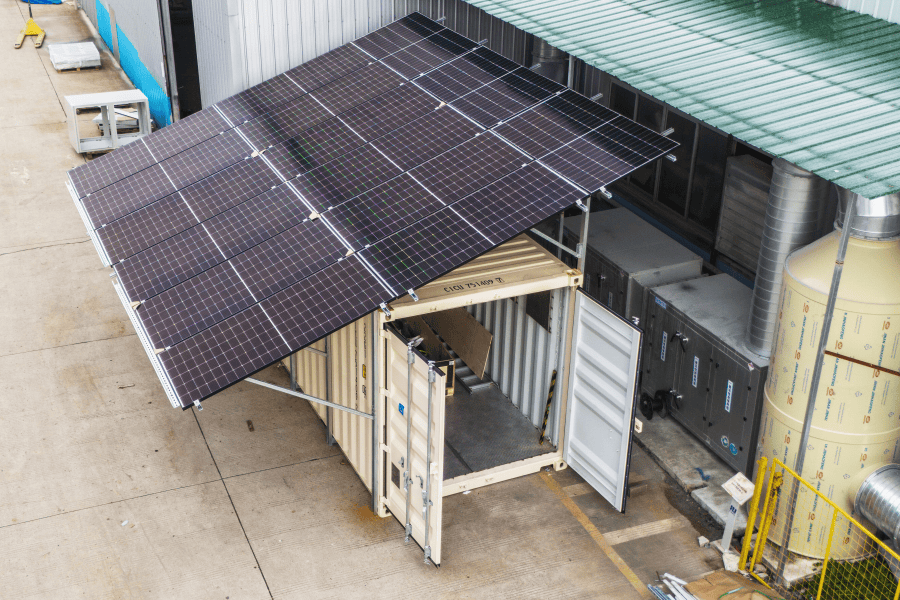
- The Setup: Two UL 9540-certified battery containers (2.5MWh each) and a power conversion system (PCS) container were sited adjacent to the planned charging area.
- The Logic: The system is connected to a modest, existing grid connection. It slowly charges the batteries over hours (like a slow trickle). When an EV plugs in and demands 350kW, that power comes primarily from the battery, not the grid. The grid connection just hums along at a steady, low level.
- The Outcome: The charging plaza opened 8 months after the contract was signed, not 22+. The developer avoided over $1.5M in grid upgrade costs and slashed their monthly demand charges by over 80%. The BESS became a revenue-generating asset, not just a cost center.
For us at Highjoule, this project underscored the value of our pre-engineered, modular systems. Because our core designs are already fully compliant with UL 9540 and IEC 62933 standards, we could focus on site-specific integration and get the permitting moving fast. It wasn't a one-off prototype; it was a repeatable blueprint.

Under the Hood: Key Tech That Makes It Work
Let's break down a few technical points in plain English, because these are the details that determine success or failure on the ground.
1. C-rate: The "Athleticism" of Your Battery
C-rate is basically how fast you can charge or discharge the battery. A 1C rate means you can empty a full battery in one hour. For EV charging, you need a high discharge C-rate C think of it as athletic sprinters, not marathon runners. Our systems for this application are optimized for these high-power bursts without degrading the battery's lifespan. Getting this wrong means your batteries wear out just when you need them most.
2. Thermal Management: The Unsung Hero
This is what I always check on site. Pushing high power generates heat. Ineffective thermal management leads to efficiency loss, safety risks, and a short battery life. Our systems use a liquid cooling design that's far more consistent than air cooling, especially in extreme climates. It keeps every cell in its happy temperature zone, ensuring performance and safety day in, day out. This isn't a place to cut corners.
3. LCOE (Levelized Cost of Storage): The True Cost Metric
Forget just the upfront price tag. LCOE is a calculation that includes installation, maintenance, energy throughput, and lifespan. A cheaper system with poor thermal management might have a higher LCOE because it won't last as long. The goal is to minimize LCOE. In the EV charging case, by avoiding grid upgrades and demand charges, the LCOE of the BESS became negative C it actually saved money overall. That's the power of the right financial model.
What This Means for Your Next Project
This case study isn't a fantasy. It's a proven path. The lesson is that utility-scale BESS is no longer just for solar farms or grid balancing. It's a critical, enabling piece of infrastructure for the EV revolution. It turns a grid constraint into a business advantage.
When you're evaluating partners for a project like this, look for someone who talks about UL 9540 and IEC standards as a baseline, not a bonus. Ask about their thermal management design. Most importantly, ask for real-world references and a clear model of the LCOE and total cost of ownership. At Highjoule, our service model is built around this C we don't just ship containers; we provide the performance modeling, local permitting support, and long-term O&M that ensures the system delivers on its financial promise for 15+ years.
So, what's the biggest grid constraint you're facing on your upcoming site? Is it time, cost, or pure power capacity? Let's talk specifics.
Tags: UL Standard BESS Europe US Market Renewable Energy Utility-Scale Energy Storage EV Charging
Author
James Zhang
20+ years agricultural energy storage engineer / Highjoule CTO