
Smart Solar Container BESS: Powering Remote Construction Sites with Safety & Savings
The Quiet Powerhouse: How a Smart Solar Container Solved a Construction Site's Biggest Headaches
Let me be honest with you. Over two decades on sites from Texas to Bavaria, I've seen the same scene play out too many times: a remote construction project kicking off, and the first major headache isn't the design or the materials - it's power. The diesel generators roar to life, spewing fumes and burning through budgets that were tight to begin with. The noise is constant, the fuel logistics are a nightmare, and honestly, the carbon footprint just doesn't sit right anymore. This is the real, gritty problem we face before we even lay a foundation.
Quick Navigation
- The Real Problem: More Than Just an Outlet
- Why It Hurts: The Hidden Costs of "Temporary" Power
- The Smart Solution: It's All About the Brain, Not Just the Brawn
- Case in Point: A California Hillside Story
- The Expert Take: What Makes a Container Truly "Smart"
- Beyond the Site: Thinking Bigger with Your Power
The Real Problem: More Than Just an Outlet
For project managers in the US and Europe, temporary site power is a necessary evil. You need reliable energy for tools, site offices, lighting, and security. But extending the grid is often prohibitively expensive or physically impossible. Diesel generators become the default, but they come with a bag of troubles: volatile fuel prices, strict emissions regulations (especially here in California and across the EU), noise complaints from nearby communities, and the sheer operational hassle of refueling and maintenance. It's not just a cost line item; it's a risk factor and a management time-sink.
Why It Hurts: The Hidden Costs of "Temporary" Power
Let's agitate that pain point a bit. According to the National Renewable Energy Laboratory (NREL), fuel and maintenance can constitute over 70% of the total lifetime cost of a diesel generator in remote applications. That's money literally going up in smoke. But the cost isn't just financial. I've been on sites where generator failure delayed concrete pours by half a day, throwing the entire critical path schedule into chaos. There's also the safety angle - fuel storage on-site is a fire hazard, and the noise can mask important safety warnings. When you're already managing a thousand details, your power source shouldn't be your biggest worry.
The Smart Solution: It's All About the Brain, Not Just the Brawn
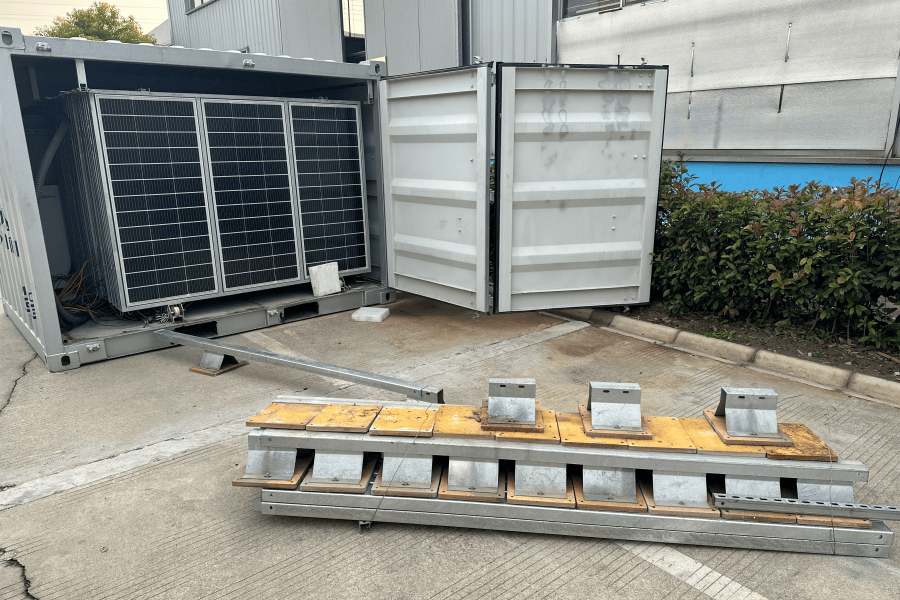
This is where the concept of the smart BMS-monitored solar container changes the game. It's not just a battery in a box, or even just a battery plus some solar panels. The true value - and what we've perfected at Highjoule - lies in the integrated intelligence. Think of it as a self-aware, self-optimizing power plant the size of a shipping container. It combines high-density lithium-ion battery storage, a sizable rooftop solar array, and most critically, an advanced Battery Management System (BMS) that monitors and controls every single aspect of performance, safety, and health in real-time. This system is the solution to the chaos of traditional temporary power.
Case in Point: A California Hillside Story
Let me walk you through a recent project that perfectly illustrates this. We deployed one of our 250kW/500kWh Solar Container BESS units for a luxury residential development in the hills near Napa, California.
The Challenge: The site was completely off-grid. The developer faced immense opposition to diesel generators due to noise and air quality concerns from neighboring vineyards and estates. Grid connection quotes were astronomical. They needed silent, clean, reliable power for 12-18 months for earthworks, foundation work, and the initial framing stages.
The Highjoule Solution: We delivered a pre-integrated, UL 9540 and IEC 62485-2 certified container. The roof was packed with solar panels, and inside, our proprietary Smart BMS was the nerve center. The system was designed for the site's specific load profile - high power for electric excavators and compactors during the day, lower power for site offices and security lights at night.
The Outcome: From day one, the site was quiet. The BMS seamlessly blended solar generation during the day with battery discharge, only drawing a minimal overnight grid charge from a small, quiet connection at the property's edge when needed. The project manager told me they slashed their expected energy costs by over 60% for the temporary power phase. But the real win was intangible: no complaints from neighbors, zero fuel logistics, and the powerful marketing story of a sustainably-built community. The BMS provided them a live dashboard, so they knew their power status and projected runtime at all times - no surprises.

The Expert Take: What Makes a Container Truly "Smart"
Okay, so what's under the hood? As an engineer who's commissioned dozens of these, let me break down the three non-negotiable features that separate a toy from a tool.
1. The BMS is the Guardian. A smart BMS does far more than prevent overcharge. It performs cell-level monitoring for voltage and temperature, ensuring perfect balance. This is critical for safety (thermal runaway prevention) and for maximizing battery lifespan. On the Napa site, the BMS constantly adapted charging rates based on solar input and load demand, a process tied to the C-rate (the speed of charge/discharge). Managing this intelligently prevents stress on the batteries.
2. Thermal Management is Everything. Batteries perform best, and live longest, within a tight temperature range. I've seen systems fail because they used cheap, unregulated cooling. Our containers use a closed-loop, liquid-cooled thermal management system. It's independent of the outside air, keeping the battery rack at an optimal 25C (2C) whether it's 110F in Texas or -10C in Germany. This stability is a core part of our safety-by-design philosophy and is a requirement for meeting stringent UL and IEC standards.
3. It's About LCOE, Not Just Capex. The upfront cost might be comparable to a high-end generator setup. But the business case wins on Levelized Cost of Energy (LCOE) - the total cost of ownership divided by the total energy produced over the system's life. With near-zero "fuel" cost (sunlight), minimal maintenance, and a lifespan that outlasts multiple generator rebuilds, the LCOE of a solar BESS plummets. For a multi-year construction project or a permanent microgrid, the math becomes overwhelmingly compelling.
How Highjoule Embeds This Expertise
Our approach isn't just to sell a box. It's to provide a power resilience service. Every unit we ship for the North American and European markets is built from the ground up to comply with local codes - UL 9540, IEC 62619, IEEE 1547 - because we know that's your ticket to a smooth permit approval. Our service includes remote monitoring from day one, so our team can often diagnose and even correct minor issues before your site crew notices anything. It's this combination of bulletproof hardware, intelligent software, and local support that turns a complex technology into a simple, set-and-forget site utility.
Beyond the Site: Thinking Bigger with Your Power
Here's a thought to leave you with. What happens to that solar container when the construction fence comes down? Its life is just beginning. I've worked with clients who repurpose these units as permanent backup power for the finished facility, integrate them into a community microgrid, or even redeploy them to their next project. The asset doesn't depreciate into a rusty generator in the corner of a yard; it retains value and utility. That's the real shift - from viewing power as a consumable expense to investing in a flexible, durable energy asset.
The question isn't really whether battery storage is ready for prime time on your site. The question is, can you afford the cost, noise, and complexity of the old way for one more project? Maybe it's time we chat about what a quieter, cleaner, and frankly smarter jobsite could look like for you.
Tags: Construction Site Power UL Standard BESS LCOE Thermal Management Solar Container US Market Smart BMS
Author
James Zhang
20+ years agricultural energy storage engineer / Highjoule CTO