
The ROI of Black Start: How 1MWh Solar Storage Powers Profitable EV Hubs
Contents
- The Silent Cost of Grid Dependence
- Beyond Backup: The Black Start Advantage
- Cracking the ROI Code for 1MWh Systems
- The California Case: Resilience Pays Its Bills
- Engineering the Profitable System
- Is Your Next EV Site Ready?
The Silent Cost of Grid Dependence
Let's be honest. When most businesses plan an EV charging hub, the first thought is about chargers, power capacity, and location. The energy storage system? Often an afterthought, a line item that gets value-engineered out to meet budget. I've seen this firsthand on site, from Texas to Bavaria. The mindset is: "The grid is there, we'll just pull more power." But that's where the real cost begins.
The problem isn't just the rising demand charges or the volatile time-of-use rates, though those are painful enough. The core issue is fragility. A single grid disturbance, a rolling blackout, or even scheduled maintenance can turn your state-of-the-art, 24/7 EV charging station into a very expensive parking lot. According to the National Renewable Energy Lab (NREL), commercial and industrial facilities in the U.S. lose an average of $150 billion annually due to power outages. For an EV hub, the loss isn't just idle equipment; it's lost revenue, frustrated customers who might not return, and a direct hit to your brand's promise of convenience and reliability.
Beyond Backup: The Black Start Advantage
This is where the conversation needs to shift from simple backup to energy resilience. And that's precisely what a black-start capable system brings to the table. Most backup systems need an external signal, a "grid heartbeat," to kick in. A true black-start system is like a self-starting engine - it can boot itself up from a completely dead state and create a stable, localized microgrid. For an EV station paired with solar, this is a game-changer.
Imagine this scenario: A storm knocks out the regional grid. Your solar panels are producing, but without storage and black-start capability, that energy is useless - the inverters need a stable frequency reference to operate. A black-start 1MWh battery system changes everything. It can self-energize, establish a stable "grid" on-site, and then seamlessly integrate the solar generation. Your charging station becomes an island of power, potentially the only functional refueling point for miles. Honestly, that's not just resilience; that's a massive competitive and community asset.
Cracking the ROI Code for 1MWh Systems
So, let's talk numbers. A 1MWh system is the sweet spot for many commercial EV charging depots or public fast-charging plazas. The ROI analysis moves beyond simple payback periods. You need to model a multi-revenue stack:
- Demand Charge Management: This is the low-hanging fruit. By discharging the battery during peak grid demand periods, you can shave 20-40% off your monthly power bill. I've seen sites in New Jersey pay off the storage system's finance costs almost entirely with these savings alone.
- Energy Arbitrage: Buy cheap power at night, store it, and use it (or sell it to charging EVs) during expensive peak hours.
- Resilience Premium: How much is guaranteed uptime worth? For fleet operators, it's everything. This can justify a significant portion of the investment.
- Grid Services (Future-Proofing): In many markets, aggregators will pay for your battery's ability to provide frequency regulation or capacity to the grid. This is emerging revenue.
The key is the Levelized Cost of Storage (LCOS) - the total cost of owning and operating the system per MWh delivered over its life. A high-quality, UL 9540-certified system like the ones we deploy at Highjoule isn't just about upfront cost. It's about robust thermal management to prevent degradation, high cycle life, and intelligent controls that maximize each cycle's value. A cheap battery that loses 30% of its capacity in 5 years has a terrible LCOS, no matter how low its sticker price.
The California Case: Resilience Pays Its Bills
Let me share a recent project we completed in California's Central Valley. A logistics company wanted to electrify its 50-truck depot with on-site solar and charging. The challenge? Frequent Public Safety Power Shutoffs (PSPS) and crioming peak demand rates.
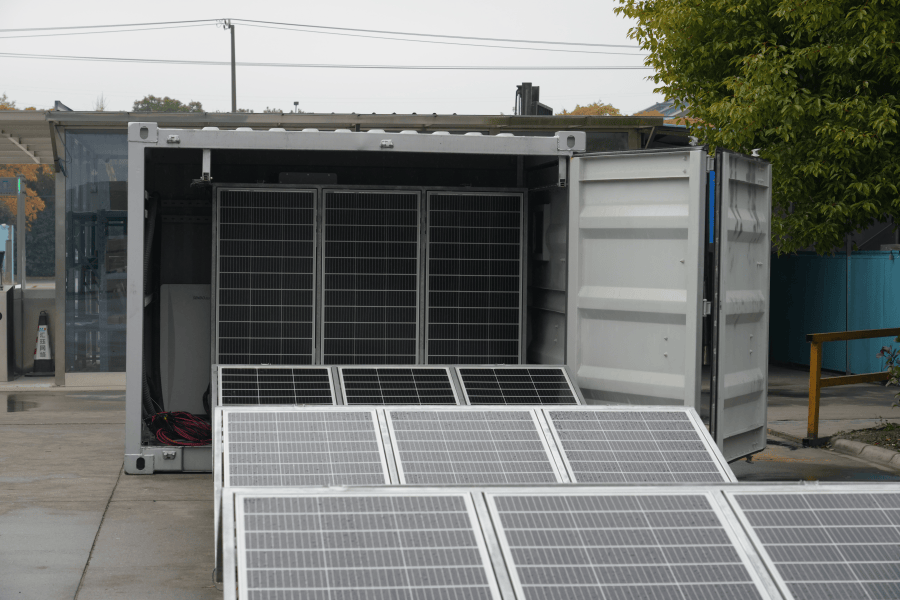
The solution was a 1.2MWh black-start capable BESS integrated with a 500kW solar canopy. The Highjoule system was designed to UL 9540 and IEEE 1547 standards, which was non-negotiable for local permitting and insurance. During a PSPS event last fall, the depot's system islanded flawlessly. While the surrounding area was dark, the depot continued charging its electric trucks using solar + storage, keeping its delivery schedule intact. The CFO told me the avoided logistical losses from that single event covered over 15% of the annual financing cost for the entire storage system. That, on top of their consistent $8,000/month demand charge savings, made the ROI crystal clear.

Engineering the Profitable System
Not all 1MWh systems are created equal. From my 20+ years in the field, three engineering principles make or break the ROI:
1. C-Rate is a Business Decision: The C-rate tells you how fast you can charge or discharge the battery. A 1C system can discharge 1MW in an hour. A 0.5C system discharges 500kW, taking two hours. For demand charge management, you need high power (high C-rate) to meet short, intense peaks. For energy arbitrage, a lower C-rate might be fine. The right balance is crucial for cost and longevity.
2. Thermal Management is Longevity: Heat is the enemy of lithium-ion batteries. Passive cooling often can't handle the sustained loads of EV charging. An active liquid-cooling system, like we use in our Highjoule containers, keeps cells at an optimal temperature. This reduces degradation, ensures you still have your full 1MWh capacity in year 10, and directly improves your LCOS.
3. The Brain Matters More Than the Brawn: The Energy Management System (EMS) is the brain. It must juggle solar production, EV charging schedules, grid tariffs, and black-start protocols seamlessly. It needs to be compliant with local grid codes (like Germany's VDE-AR-N 4110 or the US's UL 1741 SB) but also smart enough to maximize revenue. Our approach is always to design the EMS logic with the site's specific load profile and revenue goals first.
Is Your Next EV Site Ready?
The business case for integrating black-start capable solar storage with EV charging is moving from "interesting" to "essential." It transforms a cost center into a resilient, revenue-generating asset. The question isn't really about if the technology works - we've proven that from Nevada to North Rhine-Westphalia. The question is about designing the system with the right specs, the right standards, and the right financial model from day one.
What's the single biggest grid vulnerability your next charging site faces, and how would pricing that risk change your storage ROI calculation?
Tags: UL Standard BESS Black Start US Market Europe Market Microgrid ROI Analysis Solar Storage EV Charging
Author
James Zhang
20+ years agricultural energy storage engineer / Highjoule CTO