
ROI Analysis of Grid-forming Solar Containers for Data Center Backup Power
Contents
- The Real Problem Isn't Just Backup, It's Economics
- When the Lights Go Out: How Costs Pile Up Fast
- A Smarter Solution: The Grid-Forming Solar Container
- From Theory to Site: A Look at a Real Project
- Breaking Down the ROI: It's More Than Just Batteries
- What to Look For in a Real-World Solution
The Real Problem Isn't Just Backup, It's Economics
Honestly, if we're having coffee and you run a data center, you're not losing sleep over whether backup power exists. You're losing sleep over its cost, its reliability during a multi-day grid event, and the sheer complexity of maintaining it. The old model - rows and rows of diesel generators, fuel contracts, and maybe a basic battery system for brief ride-through - is becoming a financial and operational anchor. I've seen the maintenance logs and the fuel bills firsthand. With grid instability on the rise and sustainability goals moving from PR to boardroom mandates, that model is cracking.
When the Lights Go Out: How Costs Pile Up Fast
Let's agitate that pain point a bit. A study by the National Renewable Energy Laboratory (NREL) highlights that for critical facilities, the cost of downtime isn't just lost revenue; it's contractual penalties, brand damage, and recovery efforts that can spiral. Your diesel gensets are a CAPEX asset that sits idle 99% of the time, depreciating, requiring costly testing and maintenance. And when you need them most - during a widespread outage - fuel supply chains get shaky. I was on site during a regional storm where three data centers were scrambling for the same fuel truck. It wasn't pretty.
The promise of solar-plus-storage is obvious, but traditional "grid-following" battery systems for backup have a critical flaw: they need a stable grid signal to sync to. In a true blackout, they wait. They can't start the electrical grid for your critical load. That's the gap. You end up with a solar field that's useless in an outage and a battery that's stuck in standby mode.
A Smarter Solution: The Grid-Forming Solar Container
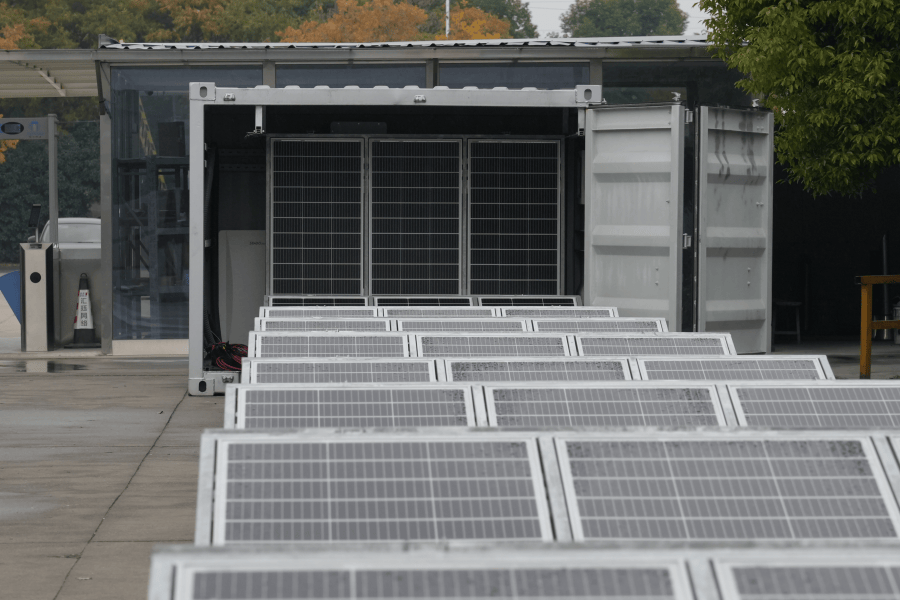
This is where the ROI Analysis of a Grid-forming Solar Container shifts from an academic exercise to a vital business case. The solution isn't just adding more batteries. It's integrating solar generation with a battery energy storage system (BESS) that uses a grid-forming inverter. Think of it as a self-contained, independent power plant in a standardized container. During normal operation, it optimizes energy use, shaves peaks, and integrates renewables. During an outage, its grid-forming inverter does the magic: it creates a stable, clean voltage and frequency waveform from scratch, allowing the solar PV and the batteries to seamlessly power your critical load island. No wait, no black start delay.

From Theory to Site: A Look at a Real Project
Let me give you a real example from the field. We worked with a colocation provider in Northern Germany. Their challenge: meet stringent corporate PPA goals, reduce grid dependency, and achieve Tier IV redundancy without expanding their diesel footprint. The solution was a 2 MW/4 MWh grid-forming solar container from Highjoule, paired with an existing rooftop PV array.
The container itself is the key. It's a pre-engineered, UL 9540 and IEC 62485-compliant system. All the components - the grid-forming inverters, lithium-ion battery racks, thermal management, and fire suppression - are integrated and tested in a controlled factory environment. This slashes on-site commissioning time from months to weeks. For the client, the operational shift was profound. The system now runs daily, performing peak shaving and frequency regulation services, generating revenue. During a planned grid maintenance shutdown, it formed a microgrid for their most critical hall for 9 hours, powered by a mix of stored energy and real-time solar, with the gensets never needing to kick on. That's a direct fuel and maintenance cost avoided, and it showed up clearly in their ROI model.
Breaking Down the ROI: It's More Than Just Batteries
When we talk ROI for this solution, we have to look at the full stack, not just the equipment price. A proper analysis layers in:
- CAPEX Avoidance: Can you defer a substation upgrade? Can you avoid buying a second N+1 diesel generator? Often, the power capacity of the BESS answers "yes."
- OPEX Reduction: This is the big one. Daily energy arbitrage (buying cheap, storing, using when expensive), demand charge reduction, and reduced fuel & maintenance for gensets. The thermal management system we use, for instance, is a closed-loop liquid cooling design. Honestly, it adds a bit to upfront cost but reduces auxiliary power consumption by ~30% compared to standard air-con, improving net efficiency and battery lifespan - a crucial factor in your Levelized Cost of Storage (LCOS).
- Resilience Monetization: How much is 100% uptime during a grid disturbance worth? For a data center, it's the entire business. A grid-forming system provides that, while traditional systems might have a blind spot.
- Sustainability Value: This translates to compliance with local regulations, eligibility for green tariffs, and meeting ESG investor criteria. It's a tangible financial driver now.
I often explain C-rate to clients like this: It's basically how "hard" you're charging or discharging the battery relative to its size. A 1C rate means using the full capacity in one hour. For backup, you might need a high C-rate for sudden, high-power demands. But for daily cycling for energy savings, a moderate C-rate is kinder to the battery's long-term health. A good design balances both needs.
What to Look For in a Real-World Solution
Based on two decades of seeing what works on site and what causes call-backs, here's my checklist:
- Standards are Non-Negotiable: UL 9540 (ESS safety standard) in North America, IEC 62485 for battery safety in the EU. Don't just take a vendor's word; ask for the certification reports.
- Thermal Management is a Lifespan Issue: Ask about the cooling design. Inefficient cooling kills battery cells faster than anything, destroying your ROI.
- True Grid-Forming Capability: Verify it's not just a marketing term. The inverter should be able to black start, form a stable grid, and manage the seamless transition between grid-tied and islanded modes.
- Localized Support: Where are the spare parts? Who answers the 3 AM call? A solution is only as good as the service behind it. At Highjoule, our containers are designed with modularity in mind - if a module needs service, we can often swap it in under 4 hours, minimizing your system downtime.

The conversation is changing. It's no longer "Can we afford this backup?" but "Can we afford the wrong kind of backup?" A detailed ROI Analysis of a Grid-forming Solar Container for Data Center Backup Power often reveals it's not an expense, but a strategic, revenue-generating infrastructure upgrade. What's the one grid-related cost in your last quarterly report that surprised you the most?
Tags: BESS Solar Container Data Center Backup ROI Analysis Grid-Forming Inverter
Author
James Zhang
20+ years agricultural energy storage engineer / Highjoule CTO