
ROI Analysis of Smart BMS Monitored 1MWh Solar Storage for Construction Site Power
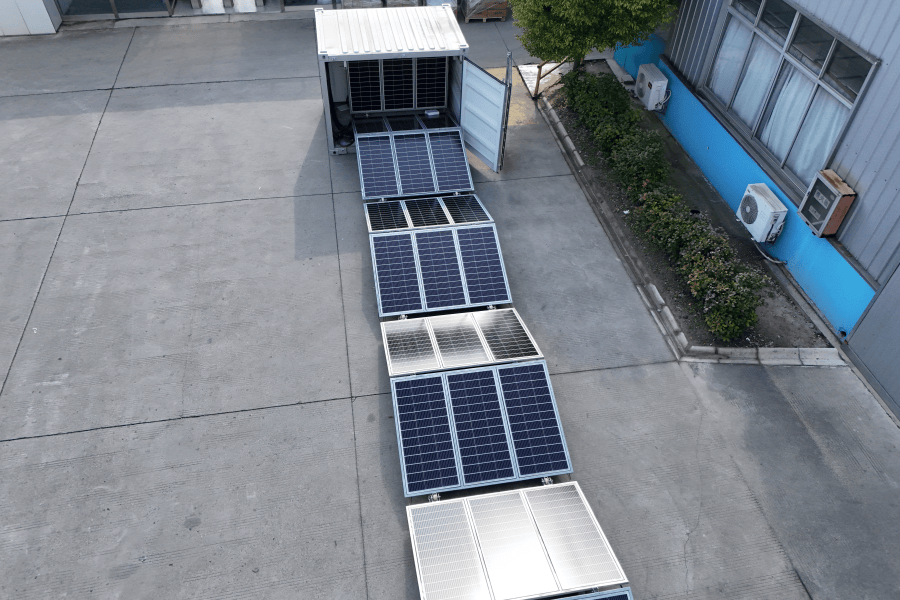
Table of Contents
- The Hidden Cost of "Business as Usual" on Site
- Why Traditional ROI Calculations Fail for Temporary Power
- The Game-Changer: Smart BMS as Your Financial Sentinel
- Breaking Down the 1MWh Solar Storage ROI for a 12-Month Project
- Real-World Proof: A Case from California's Central Valley
- Beyond the Spreadsheet: The Intangible ROI of Resilience
- Getting It Right: What to Look For in Your System
The Hidden Cost of "Business as Usual" on Site
Let's be honest. For most project managers staring down an 18-month construction timeline, power is a line item, not a strategy. The default playbook? Diesel gensets, maybe a temporary grid connection that feels like it's priced in gold, and a resigned acceptance of the fuel truck's weekly visit as a fixed cost of doing business. I've been on those sites C the noise, the smell, the constant worry about fuel theft or a generator hiccup halting the entire concrete pour. It works, but at what real cost?
The problem isn't just the diesel bill. It's the volatility. According to the U.S. Energy Information Administration (EIA), diesel prices have seen swings of over 50% in recent years. Try locking in a firm budget with that kind of exposure. Then there's the carbon footprint, which is no longer just an ESG report checkbox; in many regions like California and the EU, it's translating into direct compliance costs and even affecting your bid eligibility. You're not just paying for kilowatt-hours; you're paying for uncertainty, risk, and a mounting pile of operational headaches.
Why Traditional ROI Calculations Fail for Temporary Power
This is where I see even savvy companies stumble. They run a simple ROI on a solar-plus-storage system: CapEx vs. projected fuel savings. If the payback isn't under two years, they shelve it. This mindset is the single biggest barrier. It treats a 1MWh Battery Energy Storage System (BESS) as a commodity purchase, like a bigger generator, rather than what it truly is: an intelligent, revenue-protecting asset.
Traditional calculations miss the agitation points:
- Unplanned Downtime Cost: A genset failure can cost thousands per hour in idle labor. A smart BESS provides seamless backup.
- Fuel Logistics & Security: That's not a free service; it's man-hours, insurance, and risk.
- Peak Shaving from the Grid: Even with a temporary connection, demand charges can be brutal. A battery can shave those peaks invisibly.
- Asset Residual Value: A diesel genset after your project is worth scrap. A well-maintained, UL 9540-certified BESS? It can be redeployed, leased, or sold. That's a huge part of the ROI story we often model for clients at Highjoule.

The Game-Changer: Smart BMS as Your Financial Sentinel
So, how do you capture that true ROI? The answer is in the subtitle of your search: the Smart Battery Management System (BMS). Honestly, calling it a "BMS" feels outdated. It's the central nervous system of your investment. A basic BMS prevents fires. A smart BMS with predictive analytics and granular monitoring (we're talking cell-level data) is what makes the financial case rock-solid.
Think of it this way: The solar array and the battery rack are the muscles. The smart BMS is the brain that ensures those muscles work efficiently, last longer, and report back on every watt saved and every dollar earned. It turns raw energy into auditable, optimizable financial data. This is the core of a modern ROI Analysis of Smart BMS Monitored 1MWh Solar Storage for Construction Site Power.
Breaking Down the 1MWh Solar Storage ROI for a 12-Month Project
Let's put some typical numbers to it. Assume a mid-sized site in Southern Europe or the Southwestern U.S., with a consistent 80kW base load (site offices, tools, lighting) and peaks to 150kW.
| Cost/Savings Line Item | Traditional Diesel Genset | 1MWh Solar + Smart BESS | Notes |
|---|---|---|---|
| Primary Power Cost | $0.42/kWh (fuel, maint.) | $0.08/kWh (solar + BESS cycling) | Based on avg. diesel $4/gal & solar LCOE. |
| Peak Grid Shaving | $0 (not connected) | $15k - $25k saved | Avoiding monthly demand charges if grid-tied for backup. |
| Carbon Credit / Compliance | Potential cost | $5k - $10k value | Monetizing reduced emissions for reporting. |
| End-of-Project Asset Value | ~10% of CapEx (used genset) | 60-70% of CapEx (redeployable BESS) | This is huge. The BESS is not a sunk cost. |
The smart BMS directly protects the "60-70% residual value" by ensuring optimal battery health. It manages C-rate (charge/discharge speed) to prevent stress, and its advanced thermal management systems keep cells in the perfect temperature window, directly slowing degradation. I've seen firsthand on site how a 5C reduction in average operating temperature can add years to battery life. That's pure financial value preserved by the technology.
Real-World Proof: A Case from California's Central Valley
We deployed a system very much like this for a utility-scale solar farm's own construction phase in Fresno County. The challenge? The grid connection for the permanent plant was 9 months out. The client faced a 9-month diesel bill estimated at $280,000, plus noise complaints from a nearby community.
Our solution was a 1.2MWh containerized BESS (UL 9540/UL 9540A listed, non-negotiable in California) paired with a 400kW solar canopy over the material staging area. The smart BMS was configured for dual purpose: primary power for the day shift via solar/battery, and automatic switchover to grid-backup (from a small temporary service) for night security, all while logging every kWh to validate savings.
The result? Diesel use cut by over 90%. The ROI, including the avoided diesel costs, demand charge savings from the minimal grid use, and the planned redeployment of the BESS to another site, yielded a payback of under 16 months. The project manager's quote stuck with me: "The quiet was a bonus. The certainty on my bottom line was everything."
Beyond the Spreadsheet: The Intangible ROI of Resilience
Numbers don't tell the whole story. The ROI of resilience is real, though harder to quantify. What's it worth to have silent, fume-free power next to a sensitive worksite or community? What's the value of knowing your power source won't be disrupted by a supply chain issue with fuel deliveries? In my 20+ years, the projects that run smoothest are the ones where the power just?- works. A smart BMS-monitored system gives you that peace of mind. It sends you an alert before a performance issue arises, allowing for scheduled maintenance instead of an emergency call-out at 2 AM.
Getting It Right: What to Look For in Your System
If you're considering this path, your ROI depends on getting the fundamentals right. Don't just buy a battery box. Insist on:
- Full Compliance: UL 9540, IEC 62619, IEEE 1547. This is your safety and insurance bedrock.
- BMS with Open Protocols: The system should give you, the owner, access to the data, not lock it behind a proprietary vendor wall.
- Thermal Management Design: Ask about it. Liquid cooling or advanced forced-air? It must be matched to your local climate (Arizona heat is different from German winter).
- Deployment Flexibility: Can the provider, like Highjoule, handle everything from permitting to interconnection, and offer a clear path for redeployment or buyback?
The right partner views the system as a capital asset for you, not just a sale. So, the real question isn't just "What's the payback period?" It's "How can we structure this asset to deliver the strongest total value for our project and our balance sheet?" That's the conversation worth having over that next coffee.
Tags: UL Standard BESS LCOE Europe US Market Construction Power Renewable Energy Smart BMS Solar Storage
Author
James Zhang
20+ years agricultural energy storage engineer / Highjoule CTO