
A Step-by-Step Guide to Installing Air-Cooled BESS for Construction Sites
Contents
- The Diesel Generator Headache on Modern Sites
- Why Getting the Installation Right is Half the Battle
- The Highjoule Way: A Site-Proven, Step-by-Step Process
- Real-World Proof: From Texas Heat to German Precision
- Beyond the Basics: An Engineer's Insights on Thermal & LCOE
- Your Next Steps: Questions to Ask Your Vendor
The Diesel Generator Headache on Modern Sites
Let's be honest. If you're managing a construction project in the US or Europe right now, you're probably dealing with two massive pressures: staying on schedule and controlling runaway costs. And right in the middle of that storm? Your temporary power setup. For decades, the roaring diesel generator has been the default. But between fuel price volatility, tightening emissions regulations, and the sheer noise pollution that annoys neighbors and violates local ordinances, it's becoming a real liability.
I've been on sites where the fuel logistics alone felt like running a separate operation. One delayed delivery could stall critical path work. The International Energy Agency (IEA) has highlighted the construction sector's heavy reliance on temporary, often carbon-intensive power. It's a pain point we've all felt firsthand. The promise of battery storage is clear C silent, zero-local-emission, predictable-cost power. But for many project managers, the big question isn't why to switch, but how to deploy it smoothly and safely. The installation process itself can seem like a black box.
Why Getting the Installation Right is Half the Battle
This is where I need to agitate the problem a bit, based on what I've seen. A lithium battery storage container isn't a plug-and-play appliance. A haphazard installation doesn't just risk underperformance; it can introduce real safety concerns and void crucial warranties. Think about site conditions: uneven ground, dust, vibration from other equipment, and extreme temperature swings. A system designed for a controlled industrial park might struggle here.
The core challenge boils down to three things: Safety (meeting UL 9540 and IEC 62933 standards in a rough environment), Performance (ensuring the battery delivers its promised kWh and power output when your tower crane needs it), and Longevity (protecting your capital investment from premature degradation). A meticulous, step-by-step installation protocol is your absolute best defense against all three. It turns a complex piece of technology into a reliable workhorse.
The Highjoule Way: A Site-Proven, Step-by-Step Process
So, what does a proper, site-tough installation look like? At Highjoule, we've distilled 20 years of global deployment into a clear, phased approach. Forget the overly technical manuals. Here's the practical sequence we follow, the same one I'd walk a site superintendent through over a coffee.
Phase 1: Pre-Staging & Site Prep (The Foundation)
This happens before the container ever leaves our facility. We review your site plans to specify the optimal container model (think capacity, C-rate for those big motor starts). Crucially, we prepare a detailed site readiness checklist for your team:
- Foundation: A level, compacted gravel or concrete pad. We're not talking about a full slab, but it must handle the weight and prevent settling. I've seen a container tilt because of a soft corner C it causes all sorts of connection stresses.
- Access & Clearance: Clear delivery path for a flatbed truck and crane, plus mandated clearances around the unit for maintenance and airflow. Never box it in with other site trailers.
- Utility Interface Point: Coordinating with the local utility and your electrical contractor on the AC connection point. This is where early engagement saves weeks of delay.
Phase 2: Delivery & Positioning (The Heavy Lift)
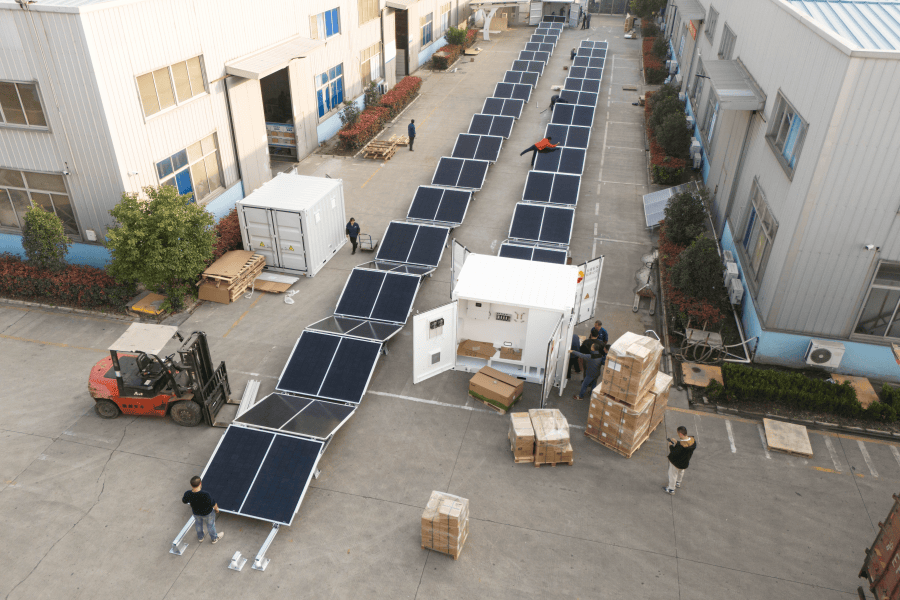
Delivery day. The container arrives pre-assembled and pre-tested C a "BESS in a box." With a qualified crane operator, we lift and position it onto the prepared pad.
 This is more than just setting it down. We use laser levels to ensure perfect alignment. Why? Because our integrated air-cooling system relies on uniform airflow across the battery racks. A severe tilt can create hot spots. We then secure it, often with simple but robust anchors suitable for temporary siting.
Phase 3: Electrical Interconnection & Commissioning (The Moment of Truth)
Here's where our field engineers work hand-in-glove with your electricians.
- DC-Side: Inside the container, everything is already done. All battery modules, wiring, and safety disconnects are factory-installed and validated. This is a huge risk reducer on site.
- AC-Side: We connect the container's main output to your site's main distribution panel via the pre-agreed interface. This involves installing a dedicated AC disconnect (a non-negotiable safety device).
- Commissioning: This is the systematic boot-up. We power on the system, run the battery management system (BMS) diagnostics, verify communication with the integrated energy management system, and perform a controlled test discharge/charge cycle. We don't just check if it turns on; we validate that it performs to its spec sheet under load.
Phase 4: Handover & Operational Training (The Keys)
Our job isn't done until your team is confident. We provide hands-on training for your site foreman on the basic user interface: how to check state of charge, start/stop the system, and understand alarm indicators. You also get access to our remote monitoring portal C you can see your system's performance from your office, and so can we for proactive support.
Real-World Proof: From Texas Heat to German Precision
Let me give you a concrete example. Last year, we deployed a 500kWh air-cooled system for a large commercial development outside Austin, Texas. The challenge? Replacing three diesel gensets powering the site office, material prefab area, and evening security lighting. The site manager needed reliability in 105F (40C+) heat and wanted to slash fuel theft and costs.
The installation followed the steps above. The key was the air-cooling system's performance. Even in the Texas sun, the internal thermal management maintained the batteries within their ideal 25C 5C window. Honestly, the contractor's biggest compliment was that they forgot it was there C it just worked. They achieved their diesel displacement goal and appreciated the silent operation during night shifts, which kept the neighboring community happy.
Beyond the Basics: An Engineer's Insights on Thermal & LCOE
Let's get slightly technical for a minute, but I'll keep it simple. Two concepts are critical for your ROI: C-rate and Thermal Management.
C-rate essentially means how fast you can pull energy from the battery. A high C-rate is like a sports car engine C it gives you the big, instant power needed for heavy equipment starts. Our site containers are engineered for these high-power pulses without damaging the cells.
Thermal Management is the unsung hero. Lithium batteries age faster if they're consistently too hot or too cold. A superior air-cooling system, like the one we use with its intelligent, variable-speed fans and ducting design, doesn't just prevent safety events; it directly extends the battery's life. This is where you win on Levelized Cost of Energy (LCOE) C the total cost of ownership divided by the energy it dispenses over its life. A longer life and higher efficiency mean a lower LCOE, making your investment smarter.
This is why our design and installation rigor focuses on these factors. It's not about being fancy; it's about delivering durable, cost-effective power where you need it.
Your Next Steps: Questions to Ask Your Vendor
If you're evaluating a BESS for your next project, don't just ask about price and capacity. Drill into the installation and long-term support. Here are a few questions I'd recommend asking any vendor:
- "Can you provide a detailed site preparation checklist specific to my location's conditions?"
- "How is the thermal management system designed to handle the peak summer and winter temperatures at my site?"
- "What is the commissioning process, and what performance metrics do you guarantee on-site?"
- "What does the remote monitoring and support look like after installation?"
The right partner will have clear, experience-backed answers, just like we do at Highjoule. A well-installed system isn't just a piece of equipment; it's the quiet, beating heart of a more efficient, sustainable, and cost-controlled job site. What's the one pain point on your current site that a reliable, silent power source could solve?
Tags: Construction Site Power UL Standard BESS Energy Storage Installation Air-Cooled Lithium Battery
Author
James Zhang
20+ years agricultural energy storage engineer / Highjoule CTO