
Step-by-step Installation Guide for C5-M Anti-corrosion Hybrid Solar-Diesel Systems
Contents
- The Remote Power Dilemma: More Than Just Keeping the Lights On
- Why Corrosion is Your Silent Budget Killer
- A Battle-Tested Blueprint: The C5-M Hybrid Approach
- Step-by-Step Installation: A Site Engineer's Perspective
- Real-World Proof: Beyond the Spec Sheet
- The Bottom Line: Thinking in LCOE
The Remote Power Dilemma: More Than Just Keeping the Lights On
Let's be honest. When we talk about powering remote telecom base stations, the conversation has been stuck for years. It's diesel generators, right? You know the drill: the fuel trucks, the noise, the emissions reports, and that constant hum in the background that sounds like burning cash. I've been on sites from the Scottish Highlands to the Nevada desert, and the story is often the same. The initial Capex for a generator seems manageable, but the Opex? It's a leaky bucket. The International Energy Agency (IEA) points out that off-grid and poor-grid sites are a massive growth area, but they remain heavily dependent on expensive, carbon-intensive fuels. It's not just an environmental issue; it's a severe business continuity and cost problem.
Why Corrosion is Your Silent Budget Killer
Here's the part that doesn't always make it into the glossy brochure: the environment is eating your infrastructure. We're not just talking about a little rust on the cabinet. I'm talking about C5-M level corrosion. Think coastal salt spray, industrial pollutants, or the freeze-thaw cycles with road salts in northern climates. This stuff attacks electrical connections, battery terminals, and structural components relentlessly. I've seen firsthand a "sealed" enclosure in a Gulf Coast installation fail within 18 months because the internal climate control couldn't handle the external humidity and salt, leading to condensation and accelerated corrosion on the busbars. The result? Unplanned downtime, safety risks from compromised connections, and a total system lifespan that can be halved. You bought a 15-year asset, but the electronics are failing in 7. That's the hidden cost most generic solutions ignore.

A Battle-Tested Blueprint: The C5-M Hybrid Approach
So, what's the answer? Throwing more metal at it isn't enough. The solution is a designed system - a Step-by-step Installation of C5-M Anti-corrosion Hybrid Solar-Diesel System. This isn't just bolting a solar panel to a diesel genset. It's an integrated, corrosion-engineered power plant. The goal is simple: maximize solar harvest, minimize diesel runtime to only when absolutely necessary, and do it all inside a package built to survive decades in the worst conditions. At Highjoule, this philosophy is baked into our design. We start with UL 9540 and IEC 62933 compliant battery stacks, but the magic is in the enclosure - sealed, nitrogen-inerted where needed, with specialized coatings and stainless-steel fasteners that meet the C5-M spec from day one. It's about designing for the total lifecycle, not just the commissioning photo.
Step-by-Step Installation: A Site Engineer's Perspective
Alright, let's get practical. How does this actually go in? Forget the theory; here's the field manual version.
Phase 1: Site Prep & Foundation (The Most Critical Step Everyone Rushes)
This is where projects are won or lost. You need a level, compacted base, often a concrete pad. We're not just putting a garden shed here; this is a heavy, vibration-sensitive asset. Proper drainage away from the container is non-negotiable. I once had to retrofit a site in Germany where water pooling under the container led to constant moisture ingress. We fixed it, but it cost triple what proper site prep would have.
Phase 2: Unloading & Positioning
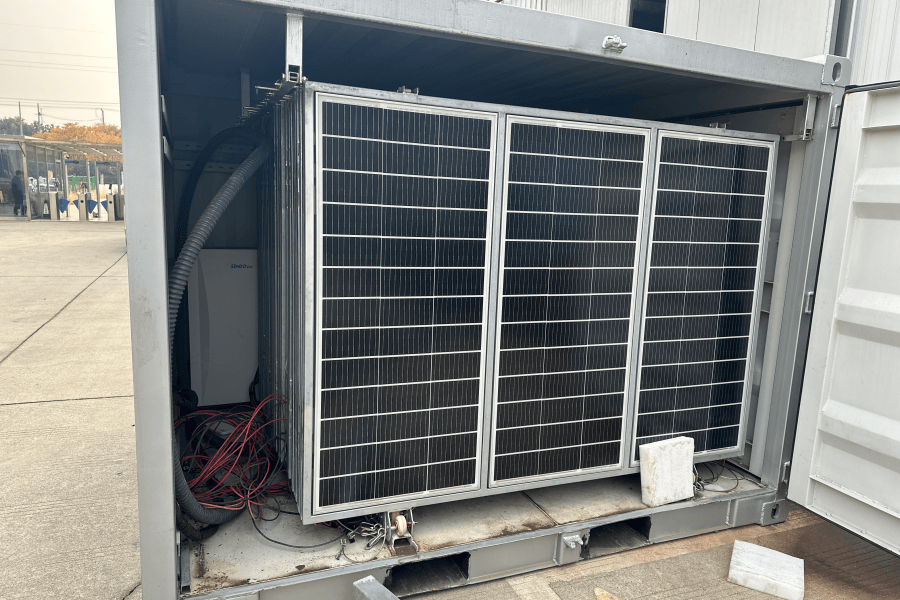
Our C5-M hybrid systems often come as pre-integrated, weatherproof containers. You need the right crane and a crew that understands lifting points. The goal is zero impact on the internal components. We design with integrated lifting lugs that are part of the main frame, not an afterthought.
Phase 3: The Anti-Corrosion Dance: Mechanical & Electrical Hookup
- Mechanical: First, you bolt down to the foundation using galvanized or stainless steel anchors. Every external penetration - for ventilation, cabling - gets a certified gland or sealant compatible with the C5-M environment. We use specific greases on electrical connectors that are rated for high salinity.
- Electrical: This is where you follow the drawings to the letter. DC from solar, AC from the generator, and the grid tie-in (if any) all land in their respective, clearly labeled, corrosion-protected junction boxes. Torque every connection to spec. A loose connection heats up, accelerates corrosion, and fails. We supply calibrated tools for this.
Phase 4: Commissioning & System Handshake
Now we power up the brain. The system controller is programmed with your parameters: battery charge/discharge cycles, generator start/stop thresholds (aiming for >90% solar self-consumption). We test every failsafe - simulate a cloud cover, trigger a generator start, test the seamless transfer. The key is verifying that the thermal management system (the silent hero) is maintaining the optimal 20-25C for the lithium batteries, regardless of whether it's -20C or 45C outside.
Real-World Proof: Beyond the Spec Sheet
Let me give you a case from Northern Minnesota, USA. A telecom provider had a cluster of towers in a forested, lake-dense region. Winters are brutal, road access for diesel trucks was unreliable and expensive. Their challenge was uptime and winterizing cost. We deployed a C5-M rated hybrid system. The installation followed the steps above, with extra attention to sealing against blowing snow and moisture. The result? Diesel fuel consumption dropped by 87% in the first year. But the real win was during a major winter storm. The system ran autonomously on battery for 52 hours, cycling the generator only for brief top-up charges, while other sites relying on generators alone had fuel logistics crises. The National Renewable Energy Laboratory (NREL) has data showing how hybrid systems drastically improve resilience, and seeing it play out in the field is what really matters.

The Bottom Line: Thinking in LCOE
At the end of our coffee chat, let's talk about Levelized Cost of Energy (LCOE). It's the total cost of owning and operating the asset over its life, divided by the energy it produces. A cheap, non-corrosion-protected system has a low upfront cost but a high LCOE because it fails early and needs constant maintenance. A C5-M hybrid system has a higher initial ticket price, but its LCOE is lower. Why? It lasts 20+ years, its fuel (the sun) is free 90% of the time, and it doesn't need you to send a technician out every six months to scrape corrosion. For a CFO or operations director planning a decade ahead, that's the only math that counts.
Honestly, the step-by-step process is the easy part when you have the right kit and drawings. The hard part is making the decision to invest in a system designed for the long haul. So, what's the one site in your network that keeps you up at night worrying about fuel costs or corrosion failures? Maybe it's time we looked at a blueprint for that one.
Tags: UL Standard BESS Anti-corrosion Telecom Infrastructure Solar-Diesel Hybrid Systems Remote Power
Author
James Zhang
20+ years agricultural energy storage engineer / Highjoule CTO