
Step-by-step Installation of Novec 1230 Fire Suppression Pre-integrated PV Container
Contents
- The Safety Gap Everyone's Talking About (But Not Always Fixing)
- Beyond the Spark: When a Small Event Becomes a Big Problem
- A Smarter Start: The Pre-Integrated Container with Novec 1230
- The Installation Playbook: Getting It Right From Day One
- Real-World Proof: It's Not Just Theory
- The Expert Corner: Why This Approach Wins on LCOE
The Safety Gap Everyone's Talking About (But Not Always Fixing)
Let's be honest. When we sit down with facility managers at an industrial park, the conversation starts with ROI and energy independence. But five minutes in, it always, always swings to safety. "What happens if it catches fire?" is the question hanging in the air, right next to the coffee steam. And they're right to ask. The industry's push for higher energy density and faster C-rates (basically, how hard and fast you can charge/discharge the battery) has, frankly, outpaced some of the standard safety setups I've seen deployed in the field.
The common approach? A containerized BESS arrives on site, and then a separate team comes in to design and install a fire suppression system. It's a disjointed process. I've been on sites where the fire system piping runs into conflicts with the battery racks, or where the agent dispersal isn't optimal for the thermal runaway scenario we're actually trying to prevent. According to a 2023 report by the National Renewable Energy Laboratory (NREL), project delays and cost overruns in BESS deployments are frequently tied to last-minute safety and compliance integrations. This two-step dance creates a gap - a gap where risk, cost, and uncertainty live.
Beyond the Spark: When a Small Event Becomes a Big Problem
Agitating this problem isn't about fearmongering; it's about real economics and operational continuity. A thermal event in one battery module can cascade. The real cost isn't just the damaged equipment; it's the downtime for your entire industrial operation, the potential regulatory scrutiny, and yes, the hit to your site's insurance premiums. For an industrial park running critical processes, that downtime translates directly to lost revenue, sometimes tens of thousands of dollars per hour.
I've seen this firsthand on a project in Texas where a legacy system's conventional suppression couldn't contain a module failure quickly enough. The result was a total write-off of the container and a six-week production halt for the host facility. The fire was "contained," but the business loss wasn't. This is the pain we're magnifying: safety is not a line item; it's the foundation of your project's financial model. A weak foundation cracks under pressure.

A Smarter Start: The Pre-Integrated Container with Novec 1230
So, how do we close the gap? The solution lies in shifting left. Instead of treating fire protection as an afterthought, we bake it into the product from the start. This is where the pre-integrated PV container with Novec 1230 fire suppression becomes a game-changer for industrial parks.
Think of it like buying a car with airbags already installed and crash-tested, versus buying a chassis and trying to retrofit them later. At Highjoule, our approach is to engineer the safety system in tandem with the battery and thermal management system. The Novec 1230 fluid is a key player here - it's a clean agent that's electrically non-conductive, safe for people, and has a minimal environmental footprint. More importantly, it's incredibly effective at absorbing heat and interrupting the chemical chain reaction of a fire, which is exactly what you need to stop thermal runaway.
By pre-integrating it, we ensure optimal nozzle placement, perfect agent concentration calculations, and seamless integration with the container's own detection and control systems. It arrives on your site as a unified, tested safety unit that complies with UL 9540A and relevant IEC standards from the get-go. This isn't just a product feature; it's a fundamentally different deployment philosophy.
The Installation Playbook: Getting It Right From Day One
Okay, so you've chosen a pre-integrated system. Here's the step-by-step that makes the on-site experience smooth, based on dozens of deployments we've done across Europe and North America.
Phase 1: Site Prep & Foundation (Weeks 1-2)
This is critical. The foundation must be level and able to bear the dynamic load. We provide exact specs, but I always advise clients to consider future expansion. Run all your conduit and grid-connection trenches before the container arrives. It sounds simple, but a rushed site prep is the number one cause of day-one delays.
Phase 2: Delivery & Positioning (Day 1)
The container arrives via truck. With the pre-integrated system, it's one piece. Using a crane, we position it onto the pre-set foundation pads. The key here is alignment with the pre-installed electrical hookup points. Because the fire suppression system is inside and pre-piped, there are no external tanks or complex plumbing to position separately.
Phase 3: Mechanical & Electrical Hookup (Days 2-4)
We connect the main AC and DC cables, the grounding, and the communication links to your SCADA or energy management system. The container's internal thermal management (the HVAC system) is powered up. Since the Novec 1230 system is already wired into the container's main control panel, its commissioning is part of this electrical sequence, not a separate task.
Phase 4: Commissioning & Agent Charging (Day 5)
This is the crucial moment. We run the full battery management system diagnostics. Then, we activate the fire detection system for a full function test. Only after all electrical and control systems are verified do we charge the suppression system with the Novec 1230 agent. It's a pressurized, sealed system. We verify the pressure and perform a final integrity check. The system is now "live" and armed.
Phase 5: Safety Handover & Training (Day 6)
We don't just leave. We walk your site operations team through the system status indicators, the manual override procedures, and the basic "what to look for" guidance. We provide the full documentation packet, including the stamped UL and IEC certifications for the entire assembled unit.
Real-World Proof: It's Not Just Theory
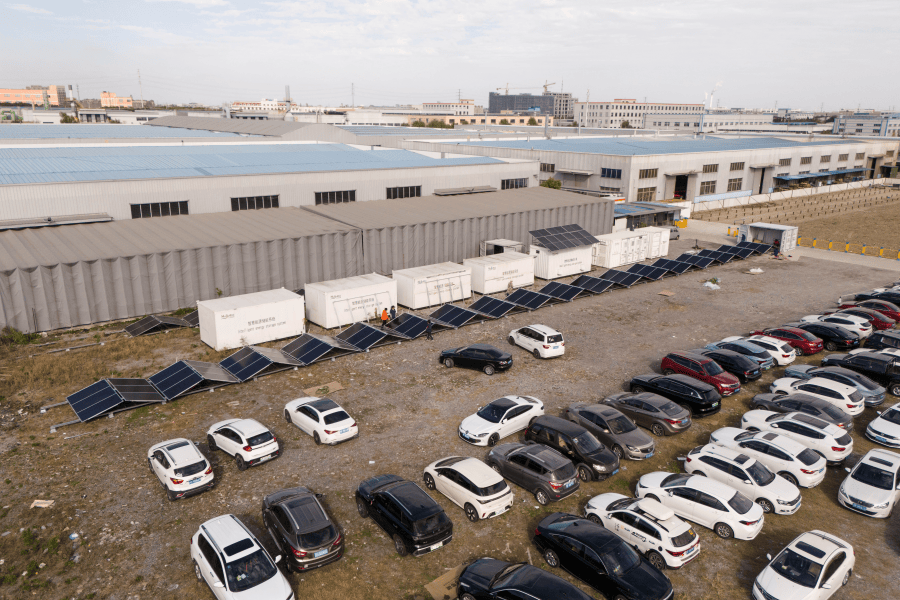
Let me give you a concrete example. We deployed a 2 MWh system for a manufacturing plant in Germany's North Rhine-Westphalia region. Their challenge was space - they had a tight corner of the yard - and they needed to meet the strict local fire safety ordinances (Feuerwehrzufahrten and specific suppression mandates) without a lengthy approval process.
Because our container arrived with the Novec 1230 system pre-certified and pre-integrated, the local building and fire authorities were able to review a single, cohesive set of documentation. The on-site installation focused on the foundation and electrical tie-in. The fire suppression wasn't a separate inspection item. From delivery to grid synchronization took 8 working days. The plant manager told me the streamlined safety approval alone saved them over a month versus their neighbor's traditional BESS project.
The Expert Corner: Why This Approach Wins on LCOE
If you're a financial decision-maker, you're thinking LCOE (Levelized Cost of Energy). Here's the insider take: LCOE isn't just about the cheapest battery cells. It's about total lifecycle cost. A pre-integrated safety system directly improves your LCOE in three ways:
- Cuts Installation Time & Cost: No separate subcontractor for fire suppression, no design conflicts. That's a direct reduction in your upfront soft costs.
- Reduces Operational Risk: A more reliable, purpose-built safety system minimizes the catastrophic risk of total asset loss and business interruption. This lowers your risk premium, both literally with insurers and figuratively in your project finance model.
- Ensures Long-Term Compliance: Regulations are tightening. Having a system that's designed to meet UL and IEC standards from day one future-proofs your investment against evolving code changes, protecting your asset's value and operability for its entire 15+ year lifespan.
Honestly, after two decades in this field, I see safety not as a cost center, but as the ultimate enabler of scale and profitability. A well-protected asset is a bankable, reliable asset. So, the next time you're evaluating a BESS for your industrial park, ask the vendor: "Is the fire suppression an integrated part of the design, or an afterthought?" The answer will tell you everything you need to know about the total cost and security of your project. What's the biggest safety hurdle your team is facing in your next deployment?
Tags: UL Standard BESS Industrial Energy Storage Novec 1230 Fire Suppression
Author
James Zhang
20+ years agricultural energy storage engineer / Highjoule CTO