
Salt-Spray Ready BESS: Protecting Your Coastal Energy Storage Investment
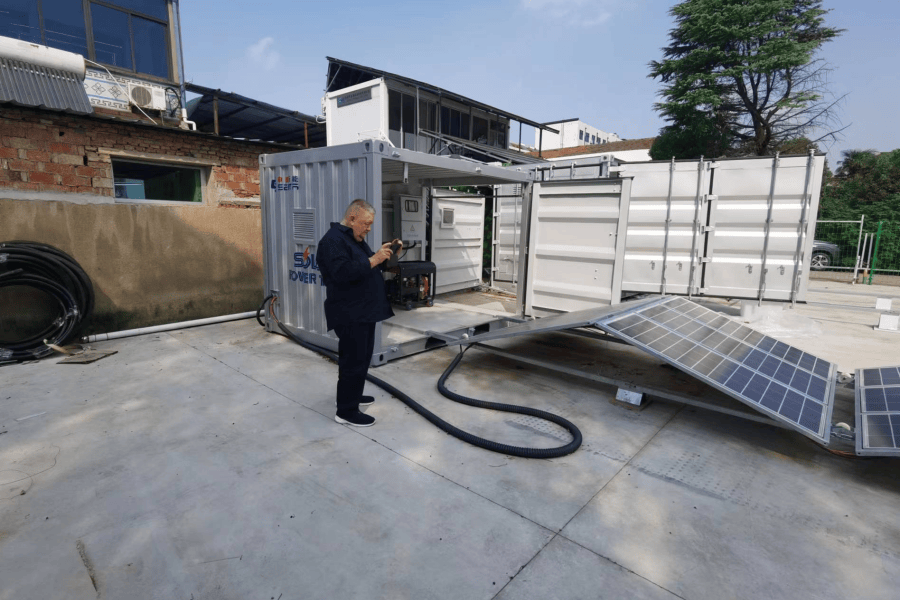
Table of Contents
- The Silent Threat to Coastal Energy Storage
- Corrosion Costs: More Than Just Rusty Metal
- The Coastal-Ready Solution: It's in the Specs
- Case Study: A North Sea Island Microgrid
- Beyond the Box: Thermal & Electrical Integrity in Salt Air
- Your Next Step: Questions to Ask Your Vendor
The Silent Threat to Coastal Energy Storage
Honestly, if you're planning a BESS project anywhere near the coast C whether it's for a seaside data center in Florida, a port microgrid in Rotterdam, or a wind farm integration in Scotland C there's a conversation we need to have. It's not about the batteries' chemistry or the inverter's efficiency, at least not first. It's about the air. That salty, humid, corrosive air that seems harmless but is, in my 20+ years on site, the single biggest accelerator of system failure I've seen. Standard industrial containers? They simply aren't built for this. I've watched enclosures that looked robust on paper develop pervasive corrosion in under 18 months in a coastal zone, leading to insane maintenance headaches, safety concerns, and ultimately, a devastated return on investment.
Corrosion Costs: More Than Just Rusty Metal
Let's agitate that pain point a bit. The problem with salt spray isn't cosmetic. It's a systemic attack. According to a NREL report on renewable asset durability, corrosion from marine environments can increase O&M costs by up to 300% compared to inland sites. Think about that. Your operational budget, gone, just fighting the environment.
It starts with the enclosure. Standard paint blisters. Fasteners seize. Door seals degrade, letting in more moisture and particulate. Once integrity is breached, the real damage begins: corroded busbars and electrical connections increase resistance, creating hot spots and fire risks. PCB boards in your battery management system (BMS) and power conversion system (PCS) get a thin layer of conductive salt fog, leading to short circuits and phantom faults. Your thermal management system C the lungs of your BESS C starts sucking in corrosive air, coating heat exchangers and clogging filters. Efficiency plummets. Downtime skyrockets. And your projected Levelized Cost of Storage (LCOS)? It flies out the window.
I was on a site in the Gulf Coast where a non-spec'd container had its cooling fans fail repeatedly. The root cause? Salt crystallization on the motor bearings. A $500 part was causing $10k+ in downtime every few months. It's death by a thousand cuts.
The Coastal-Ready Solution: It's in the Specs
This is where a true Technical Specification of 20ft High Cube Energy Storage Container for Coastal Salt-spray Environments moves from a "nice-to-have" to the absolute core of your project's viability. It's the difference between buying a standard truck and a marine-rated vehicle. Every detail is purpose-engineered.
At Highjoule, when we build for the coast, we start with the shell. It's not just "better paint." It's a full-system approach:
- Material & Coating: The entire steel structure undergoes a multi-stage pretreatment (zinc phosphating) before a cathodic electrocoating primer is applied. The topcoat is a high-build, chemical-resistant polyurethane. This isn't a paint job; it's a bonded, monolithic barrier. We specify to withstand over 1000 hours of neutral salt spray (NSS) testing per ASTM B117, a standard that would destroy a standard finish.
- Sealing & Pressurization: All seams are continuously welded and sealed. Door gaskets are marine-grade EPDM, and we often integrate a slight positive pressure inside the container using filtered air intakes. This keeps the corrosive ambient air from seeping in through any microscopic gap.
- Component-Level Hardening: This is critical. Every external component is upgraded. Air conditioning condensers use cupro-nickel or coated fins. All external fasteners are stainless steel (Grade 316 or better). Conduit entries are double-sealed. The electrical cabinet inside is itself a separate IP54-rated enclosure for a second layer of defense.

Case Study: A North Sea Island Microgrid
Let me give you a real example. We deployed a 2 MWh system on a North Frisian Island off the German coast. The challenge was brutal: 80% average humidity, constant salt winds, and a community that relied on the system for grid stability with diesel backup. The local utility's main concern was longevity and minimal touch maintenance.
We didn't just sell them a battery. We provided a 20ft High Cube container built to the coastal salt-spray spec, with a few extra tweaks. We used external radiators for thermal management (sealed liquid cooling loop) to avoid bringing ambient air inside at all. The container was also rated for the high wind loads of the location. Three years in, their semi-annual inspection reports show zero corrective maintenance related to corrosion. The LCOS model is holding firm, and they're now planning a second phase. That's the power of getting the specification right from day one.
Beyond the Box: Thermal & Electrical Integrity in Salt Air
Now, a hardened container is just the house. What goes inside it is just as sensitive. A proper spec dictates the internal environment.
Thermal Management: In salt-spray environments, air-to-air cooling is a liability. I always advise for a closed-loop liquid cooling system for the battery racks. It's more efficient, quieter, and crucially, it completely isolates the battery cells from the external corrosive atmosphere. The heat is exchanged via a sealed, external dry cooler or chiller with corrosion-protected fins. This maintains a stable, clean, and dry internal climate, optimizing battery life and performance regardless of the salty chaos outside.
C-rate and Electrical Safety: Corrosion on electrical connections increases impedance. Higher impedance at high C-rate (the rate of charge/discharge) means more heat generation at connection points. A coastal spec must include detailed torque specs for busbar connections, the use of antioxidant compounds, and regular infrared scanning as part of the maintenance plan. Your BMS and system design should have conservative de-rating factors for high C-rate operations in these environments to mitigate risk. It's about designing for reality, not just a lab test.
Ultimately, every part of the Technical Specification of 20ft High Cube Energy Storage Container for Coastal Salt-spray Environments is about preserving your LCOE. The higher upfront cost of a properly engineered system is dwarfed by the avoided costs of premature failure, safety incidents, and lost energy revenue.
Your Next Step: Questions to Ask Your Vendor
So, when you're evaluating suppliers for your coastal project, move beyond the basic container dimensions and battery cell data sheets. Sit down with their technical lead and ask:
- "Can you show me the specific corrosion protection standards (like ISO 12944 C5-M) your coastal container is tested to?"
- "What is the material specification for all externally exposed components (fasteners, hinges, condenser coils)?"
- "How do you ensure internal air quality and positive pressure in a salt-spray environment?"
- "Can you provide a project-specific LCOS analysis that factors in the O&M implications of a coastal vs. standard deployment?"
If they can't answer these clearly, they're selling you an inland system with a weather forecast for stormy financials. At Highjoule, we build these answers into every coastal proposal because we've seen the alternative. Your investment deserves that same protection.
What's the most challenging environmental condition your current or planned BESS asset is facing?
Tags: Energy Storage Container UL Standard BESS IEC Standard Salt-Spray Environment Coastal Microgrid
Author
James Zhang
20+ years agricultural energy storage engineer / Highjoule CTO