
The Ultimate Guide to 215kWh Cabinet Industrial ESS Container for Agricultural Irrigation
The Ultimate Guide to 215kWh Cabinet Industrial ESS Container for Agricultural Irrigation
Hey there. If you're reading this, chances are you're managing a farm, an agricultural co-op, or an energy-intensive agribusiness. And you're probably tired of the rollercoaster ride that is energy costs, especially when it comes to powering those critical irrigation pumps. I've been on-site from California's Central Valley to the farmlands of Bavaria, and honestly, the story is the same: reliable, affordable power for irrigation isn't a luxury; it's the lifeline of the entire operation. Let's talk about how a focused solution - like a 215kWh industrial-grade energy storage container - can be the game-changer you've been looking for.
Quick Navigation
- The Real Cost of Powering Your Pumps
- Why a Containerized ESS Makes Sense for Farms
- Breaking Down the 215kWh Cabinet
- A Case from California: Solar + Storage in Action
- What to Look For in Your ESS Partner
The Real Cost of Powering Your Pumps
Let's cut to the chase. The problem isn't just the electricity bill - it's when you get that bill. Irrigation needs often peak during the day, right in the middle of utility peak demand charges. I've seen farms where demand charges make up over 50% of their total energy cost. You're essentially being penalized for running your business. On top of that, many rural grids are, frankly, aging. Voltage sags or brief outages might not bother a residential customer much, but they can cause pump controllers to trip, disrupting your entire watering schedule and putting crops at risk.
And then there's the push for sustainability. It's not just about feeling good; it's about market access, meeting regulations, and future-proofing. But slapping some solar panels on a barn roof only gets you so far. What do you do when the sun goes down but the crops still need water? Or when a cloud passes over? That intermittent generation is a real headache without a buffer.
Why a Containerized ESS Makes Sense for Farms
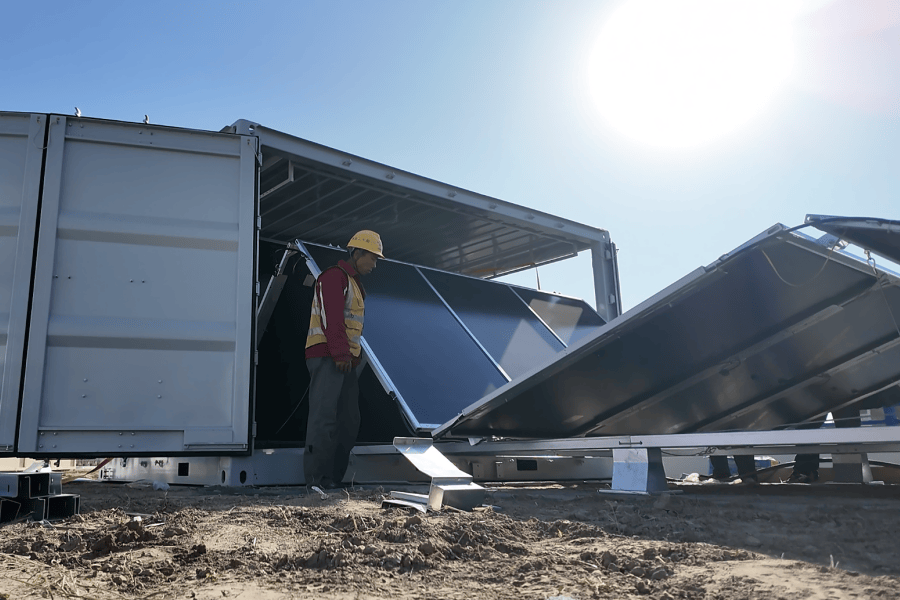
This is where the industrial containerized battery energy storage system (BESS) comes in. Think of it as a giant, sophisticated power bank for your entire farm. The "containerized" part is key. It means the entire system - battery racks, thermal management, inverters, safety systems - is pre-integrated into a standard shipping container at the factory. This isn't a DIY project. It arrives on a truck, gets placed on a simple concrete pad, connected, and commissioned. It dramatically reduces on-site construction time, complexity, and cost.
For agricultural irrigation, the scalability of a solution like a 215kWh cabinet unit is perfect. It's a substantial block of energy that can reliably shift several hours of pump operation. You can start with one unit and add more as your needs grow. According to the National Renewable Energy Lab (NREL), pairing solar with storage can increase the utilization of renewable energy on farms by up to 80%, turning a variable resource into a firm, dispatchable one.

Breaking Down the 215kWh Cabinet: More Than Just Batteries
So, what's inside this "power bank"? Let me walk you through the essentials from an engineer's perspective.
- Battery Cells & C-rate: We use high-quality, cycle-life-optimized LiFePO4 (LFP) cells. The "C-rate" is basically how fast you can charge or discharge the battery. A 1C rate means you can use the full 215kWh in one hour. For irrigation, we typically design for a moderate C-rate (like 0.5C). This is gentler on the batteries, extends their life to well over 6000 cycles, and perfectly matches the multi-hour pumping loads we see on farms. It's about longevity, not just raw power.
- Thermal Management (The Unsung Hero): This is where many systems fail in the field. Batteries generate heat. In a sealed container in the middle of a summer field, that heat needs to go somewhere. Our cabinets use an independent, closed-loop liquid cooling system. It's like the precision cooling in a data center. It keeps every cell within a 2C range of its optimal temperature. This is non-negotiable for safety, performance, and hitting that 10+ year lifespan. I've seen air-cooled systems in Arizona struggle miserably after two seasons; liquid cooling is the only way to go for industrial duty.
- Safety & Compliance: Every component, from the cell to the cabinet door latch, is selected and tested to meet UL 9540 (the standard for ESS safety) and IEC 62619 (safety for industrial batteries). This isn't just a paperwork exercise. It means the system has passed rigorous tests for electrical safety, fire containment, and environmental stress. For us at Highjoule, it's the baseline. We also build in multiple layers of protection - module-level fusing, gas detection, and passive fire suppression - so the system looks after itself.
A Case from California: Solar + Storage in Action
Let me give you a real example. We worked with a 500-acre almond orchard in Fresno County. Their challenge was classic: high peak demand charges and a desire to use their existing solar array more effectively. They were still drawing expensive grid power every evening for irrigation.
We deployed a single 215kWh container alongside their solar inverters. The logic was simple: during the day, excess solar (beyond what was running the daytime pumps) charged the container. Then, from 4 PM to 9 PM - the peak rate window - the farm ran its drip irrigation pumps solely from the stored energy. The result? A 40% reduction in their monthly demand charges in the first season. The Levelized Cost of Energy (LCOE) for that stored power - factoring in the system cost, lifespan, and cycles - came in well below the utility's peak rate. That's the financial win. The operational win was peace of mind; they now had a backup source to keep critical pumps running during a Public Safety Power Shutoff (PSPS) event, which are, unfortunately, a reality in California.
What to Look For in Your ESS Partner
Choosing a storage system is a long-term partnership. Here's my advice from two decades in the field:
Focus on Total Cost of Ownership, Not Just Upfront Price. A cheaper system with poor thermal management will degrade faster, costing you more in replacement cycles. Ask about the expected cycle life and what assumptions (like cooling method) it's based on.
Demand Localized Support. Your provider should have a network of technicians within your region. When (not if) you need a firmware update or a component check, you don't want to wait weeks for someone to fly in. At Highjoule, we've built service hubs near major agricultural regions in both the US and Europe for this exact reason.
Ask for the Compliance Certificates. Don't just take their word on UL or IEC standards. Ask to see the certification reports. A reputable manufacturer will have them readily available.
The move to resilient, self-sufficient farm energy isn't coming; it's already here. The right 215kWh container isn't just a battery; it's an operational asset that stabilizes your costs, de-risks your irrigation schedule, and unlocks the full value of your solar investment. What's the one energy constraint you'd solve first on your farm if you could?
Tags: UL Standard BESS LCOE Microgrid Agricultural Energy Storage Industrial ESS
Author
James Zhang
20+ years agricultural energy storage engineer / Highjoule CTO