
The Ultimate Guide to Grid-forming Energy Storage Container for Construction Site Power
Contents
- The Silent Problem on Your Job Site
- Beyond the Diesel Genset: Why Traditional Power Falls Short
- The Grid-Forming Difference: More Than Just Backup
- Real-World Proof: A Case from the American Southwest
- Key Specs Decoded: What to Look For in a Container
- Your Next Step: Moving Towards Smarter Site Power
The Silent Problem on Your Job Site
Let's be honest. When you're managing a construction project, your primary focus is on timelines, budgets, and materials. The power supply? It's often treated as a given C you plug into the grid, or you fire up the diesel generators. But I've been on enough sites across Europe and North America to tell you that this "given" is usually the source of some of the biggest hidden costs and headaches. Power interruptions that idle a 20-person crew. Skyrocketing fuel bills eating into your margin. Or the growing pressure from clients and local regulations to reduce carbon emissions and noise pollution. The traditional ways of powering a site are becoming a liability.
Beyond the Diesel Genset: Why Traditional Power Falls Short
The diesel generator has been a loyal workhorse for decades. But its drawbacks are now impossible to ignore. First, the cost. With diesel price volatility, you're essentially tying a major operational expense to a global commodity market. Second, reliability. A genset provides power, but it doesn't provide quality power. Sensitive equipment like laser levels, computerized machinery, and even modern tool battery chargers can be affected by voltage sags and harmonics. I've seen a whole day's precision work get scrapped because of "dirty" power.
Then there's the grid. Tapping into it seems ideal, but on greenfield sites, connection fees and timelines can be prohibitive. Even on established sites, the grid isn't infallible. According to data from the U.S. Energy Information Administration (EIA), the average U.S. electricity customer experienced just over seven hours of power interruptions in 2021. Can you afford a seven-hour standstill?
This is where the agitation really sets in. You're caught between expensive, dirty diesel, and an unreliable or unavailable grid. Your project's profitability and schedule are silently bleeding. There has to be a better way.
The Solution Emerges: Battery Energy Storage Systems (BESS)
Enter the Battery Energy Storage System container. At its core, it's a big bank of lithium-ion batteries in a secure, weatherproof shipping container. But calling it just a "big battery" is like calling a smartphone just a "telephone." The real magic, especially for off-grid or weak-grid applications like construction sites, lies in the brain of the system: the grid-forming inverter.
The Grid-Forming Difference: More Than Just Backup
Most people are familiar with grid-following inverters, like those on solar panels. They need an existing, stable grid to sync to and shut down if the grid fails. A grid-forming inverter is different. It can create its own stable electrical grid from scratch. Think of it as the difference between a musician who needs an orchestra to play along with (grid-following) and a conductor who can start the orchestra themselves (grid-forming).
For your construction site, this is a game-changer. A grid-forming BESS container can:
- Start a "Microgrid" on Day One: Deploy the container, connect your site offices, tool trailers, and equipment, and you have instant, clean, stable power. No waiting for utility hookups.
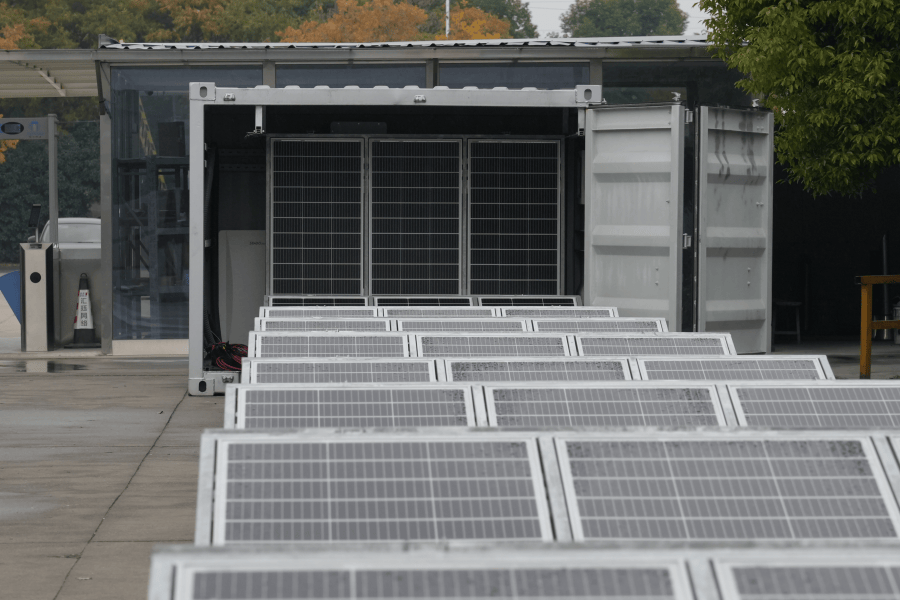
- Integrate Solar Seamlessly: Pair it with a temporary solar array. The grid-forming inverter manages the solar input and battery storage to provide 24/7 power, slashing diesel use by 70% or more in sunny climates.
- Provide "Black Start" Capability: If a generator stalls or needs maintenance, the BESS can instantly power up critical loads and even help restart the genset, eliminating total blackouts.
This isn't theoretical. At Highjoule, our H-Power C Series containers are built around this principle. We design them not just to store energy, but to be the robust, intelligent heart of your temporary site power, with all the safety and compliance features - UL 9540, IEC 62619 - that project managers and safety officers in the US and EU demand.
Real-World Proof: A Case from the American Southwest
Let me share a scenario from a project we supported last year. A contractor was building a utility-scale solar farm in Arizona. The irony? They were using diesel gensets to build a renewable energy plant. The site was remote, grid connection was months away, and fuel truck logistics were a nightmare.

They deployed two of our 500kW/1MWh H-Power C containers, coupled with a 300kW temporary solar canopy. The challenge was powering the administrative complex, concrete batch plant, and crane operations consistently through desert temperature swings. The solution was the grid-forming inverter's ability to balance the highly variable solar generation with the high-power demands of the cranes (what we engineers call a high "C-rate" discharge). The thermal management system kept the batteries at optimal temperature, ensuring performance and longevity even at 115F (46C).
The result? Diesel fuel consumption dropped by over 85%. The noise and fumes were gone. And they had a predictable, low operating cost for power. The containers were later redeployed to their next project, proving the mobility and long-term value.
Key Specs Decoded: What to Look For in a Container
When evaluating a BESS container, don't just look at the kWh capacity. Here's my on-site, practical take on the key specs:
- Grid-Forming Capability: Non-negotiable. Ensure the inverter is truly grid-forming (sometimes called "VSM" or "Grid-Forming Mode"), not just a grid-following unit with a static switch.
- C-Rate: This tells you how fast the battery can discharge its power. A 1MWh system with a 1C rate can deliver 1MW of power. For construction sites with cranes or welders, you might need a higher C-rate (e.g., 1.5C or 2C) to handle those short, intense power surges without oversizing the whole system.
- Thermal Management: This is the unsung hero. A liquid-cooled system is far superior to air-cooled for the harsh, dusty, and thermally volatile environment of a construction site. It maintains efficiency and safety, extending the battery's life dramatically.
- Levelized Cost of Energy (LCOE): This is your true total cost of ownership metric. A slightly higher upfront cost for a more efficient, longer-lasting system with lower maintenance (like ours, designed with serviceability in mind) almost always results in a lower LCOE over the 10+ year life of the asset.
- Certifications: Look for UL 9540 (system level) and UL 9540A (fire safety) in North America, and IEC 62619 / CE in Europe. This isn't just paperwork; it's a testament to rigorous safety engineering.
Where Highjoule Fits In
Our engineering philosophy is to build containers we'd want to operate ourselves in the field. That means designing for the real world: easy access for maintenance, built-in safety redundancies, and a digital monitoring platform that lets your team see performance and health from anywhere. The goal is to give you not just a product, but a predictable, low-risk power asset.
Your Next Step: Moving Towards Smarter Site Power
The transition from diesel dependence to resilient, renewable-powered sites isn't a distant future concept - it's a practical, financially sound decision you can make for your next project. The technology is proven, the standards are in place, and the operational benefits are tangible.
So, on your next site walk-through, instead of just hearing the rumble of generators, ask yourself: What are the true costs - financial, operational, and environmental - of the power I'm using? And what would it mean for my bid competitiveness, my community relations, and my bottom line to change that equation?
Honestly, the most successful project managers I work with are the ones who start asking these questions early. What's the first power challenge you'd like to solve?
Tags: Construction Site Power Energy Storage Container UL Standard BESS IEC Standard Grid-Forming Inverter
Author
James Zhang
20+ years agricultural energy storage engineer / Highjoule CTO