
IP54 Outdoor Lithium Battery Storage Container for Construction Site Power: A Practical Comparison
Contents
- The Noise (and Dust, and Rain) Problem on Your Job Site
- Beyond the Spec Sheet: What "IP54" Really Means for Your Bottom Line
- A Tale of Two Containers: Diesel vs. Lithium on a California Site
- The Thermal Management Factor: Why C-Rate Isn't Just a Number
- Making the Right Choice: Your Checklist for a Site-Ready Container
The Noise (and Dust, and Rain) Problem on Your Job Site
Let's be honest. When you're managing a construction timeline, the last thing you want to worry about is your power source. For decades, the default has been diesel generators C loud, fume-spewing beasts that require constant refueling and seem to attract every bit of regulatory attention in a tightening emissions landscape. I've been on sites from Texas to Bavaria, and the story is the same: the generator is a necessary evil, a cost center that's noisy, dirty, and increasingly expensive.
The shift to temporary battery power isn't just about being "green." It's a practical move for productivity, worker safety, and community relations. But here's the catch I've seen firsthand: not all outdoor battery storage is built for the brutal reality of a construction site. Throwing a standard indoor-rated unit under a tarp? That's a recipe for downtime, safety risks, and a very short equipment lifespan. The real solution lies in a purpose-built IP54 Outdoor Lithium Battery Storage Container. But with options on the market, how do you choose the right one?
Beyond the Spec Sheet: What "IP54" Really Means for Your Bottom Line
You'll see "IP54" on a lot of product pages. It's a standard from the International Electrotechnical Commission (IEC) that defines protection against solids and liquids. The "5" means dust-protected (not totally dust-tight, but enough to prevent harmful ingress), and the "4" means protection against water splashes from any direction. For a construction environment, this is the bare minimum.
But in practice, an IP54 rating is just the starting point. The real comparison comes down to how that rating is achieved and what else is packed into the container. Is the sealing gasket industrial-grade, designed to withstand UV degradation and temperature swings from -20C to 50C? Is the cabinet's positive pressure ventilation system properly filtered to keep fine silica dust C the kind that wrecks battery management systems C on the outside? Honestly, I've opened up units where the internal components were coated in a fine layer of dust because the cooling intake filters were an afterthought. That's a failure waiting to happen.
At Highjoule, when we engineer our site-ready containers, we start with IP54 as a baseline but then build in the ruggedization we know is needed. That means reinforced corners, forklift pockets designed for uneven ground, and external connections that are truly weatherproof. It's about the whole system's durability, not just a code on a sticker.
Key Specs That Actually Matter on Site:
- Enclosure Integrity: IP54 minimum, with a focus on seal longevity and corrosion-resistant materials (hot-dip galvanized steel is a good sign).
- Safety Certifications: This is non-negotiable in the US and EU. Look for UL 9540 (system level) and UL 1973 (battery unit) certifications. In Europe, IEC 62619 is the key standard. These aren't just paperwork; they prove the system's electrical and fire safety has been rigorously tested.
- Footprint & Mobility: Can it be easily positioned where you need it, without requiring a crane for every move?

A Tale of Two Containers: Diesel vs. Lithium on a California Site
Let me give you a real-world comparison from a solar farm construction project in Central California last year. The site manager was facing strict noise ordinances and had a remote section of the site that needed reliable power for tools and lighting, but running diesel generators there was logistically painful and costly.
The Challenge: Provide 24/7 silent power for a 3-month period in a very dusty, open environment with high daytime temperatures.
The Old Way (Diesel): Two 100 kVA generators running in rotation. Fuel delivery costs, daily maintenance checks, noise complaints from a nearby ranch, and an estimated fuel cost of over $18,000 for the period. Not to mention the carbon footprint.
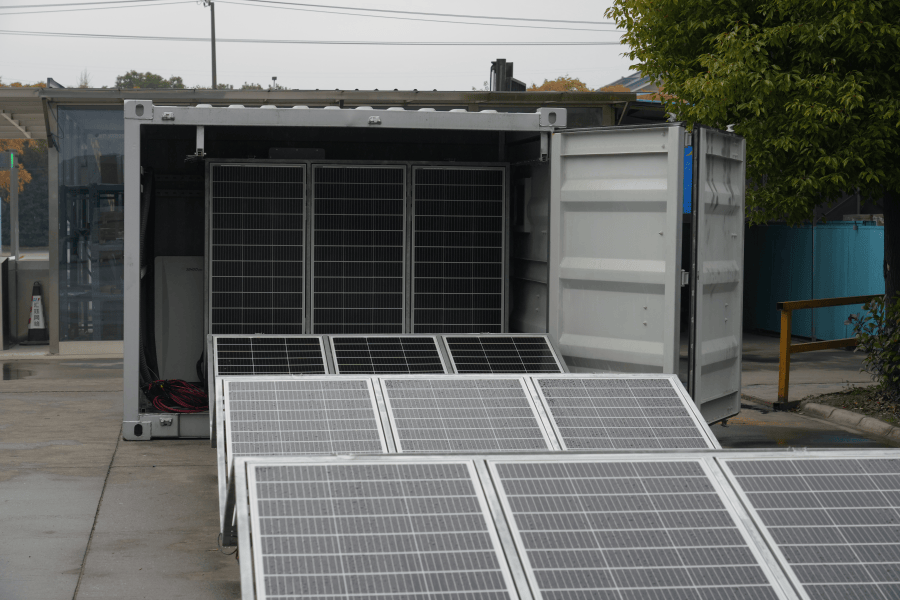
The New Way (IP54 BESS Container): We deployed one of our 200 kWh containers. It was dropped by a flatbed, positioned with a telehandler, and powered on. It was charged overnight via a temporary grid connection (or could be paired with a small solar array).
The Outcome: Zero noise complaints. Zero refueling logistics. The operational cost was essentially the cost of the electricity to charge it, which was about $2,400 for the same period C an immediate and dramatic reduction in the Levelized Cost of Energy (LCOE) for that temporary power. The container's thermal management system kept the lithium batteries optimally cool even on 40C (104F) days, and the IP54 sealing kept the interior pristine despite constant dust clouds. The ROI was clear within the first month.
The Thermal Management Factor: Why C-Rate Isn't Just a Number
This is where a lot of spec sheets can mislead. You'll see a battery's power output listed as a "C-rate" C say, 1C or 0.5C. Simply put, a 1C rate means a 100 kWh battery can deliver 100 kW of power. A 0.5C rate means it can deliver 50 kW. For construction sites, you often need high bursts of power (welding, heavy equipment startup) which suggests a high C-rate.
But here's the expert insight: sustaining a high C-rate in an outdoor enclosure is a thermal challenge. Pushing batteries hard generates heat. If the container's cooling system is just a simple fan, the internal temperature will soar, triggering the system to derate C meaning it will automatically reduce its power output to protect itself. Just when you need full power, your system throttles back.
When comparing containers, dig into the thermal management. Passive cooling? Active air cooling? Liquid cooling? For most temperate climates, a well-designed forced-air system with redundancy can suffice. But for extreme heat or high-power continuous applications, you need a more robust solution. Our approach uses a climate-controlled system that maintains an optimal temperature range, ensuring you get the full, rated power output throughout the workday, regardless of the weather outside. This reliability is what turns a capital expense into a true asset.
Making the Right Choice: Your Checklist for a Site-Ready Container
So, when you're evaluating that Comparison of IP54 Outdoor Lithium Battery Storage Container for Construction Site Power, move beyond the basic specs. Ask these questions, the ones we'd discuss over coffee on site:

The right container isn't just a battery in a box. It's a predictable, silent, and resilient power partner that lets your team focus on building, not on managing power. What's the one power-related headache on your current project that a solution like this could solve?
Tags: Construction Site Power Energy Storage Container UL Standard BESS IP54 Enclosure
Author
James Zhang
20+ years agricultural energy storage engineer / Highjoule CTO