
Black Start Solar Generators for Data Centers: Beyond Traditional Backup
Table of Contents
- The Real Problem: It's Not Just About Having Backup Power
- Why It Hurts: Downtime Costs and Grid Dependency
- The Solution: A Self-Starting, Solar-Powered Island
- Key Specs Decoded: What to Look For (Beyond the Brochure)
- A Case in Point: Learning from a German Colocation Facility
- Making It Work: The On-the-Ground Reality
The Real Problem: It's Not Just About Having Backup Power
Let's be honest. If you're managing a data center in the US or Europe, you already have backup power. Diesel gensets, maybe even some UPS systems. The problem I've seen firsthand on site isn't the existence of backup - it's the assumptions behind it. The grid goes down. Your UPS bridges the gap. The genset is supposed to start. But what if the outage is widespread? What if fuel supply is interrupted, or that genset, sitting idle for months, decides it's not in the mood? Suddenly, your "redundant" system has a single point of failure: its own need for an external kickstart or perfect conditions.
Why It Hurts: Downtime Costs and Grid Dependency
This isn't a hypothetical. The Uptime Institute's data is clear: outage costs and frequencies are still rising. We're talking about millions per hour for major facilities. The traditional model makes you grid-dependent, even in your backup state. A black start capability - the ability for a system to boot itself up from a completely dead state, without drawing from the grid - changes the game. It turns your backup into a true, independent microgrid. The agitation here is about risk exposure. It's the financial director asking, "We paid for backup, why are we still vulnerable?" and the operations team sweating over genset maintenance logs.
The Solution: A Self-Starting, Solar-Powered Island
This is where the technical specification of a black start capable off-grid solar generator for data center backup power moves from a nice-to-have to a critical resilience layer. Think of it as an uninterruptible power system (UPS) on steroids, but one that can also self-energize. The core idea is simple yet profound: integrate a sufficiently large battery energy storage system (BESS) with a solar PV array and intelligent control, designed from the ground up to form an island. When the grid fails, this system doesn't wait for a signal - it can create one, establishing a stable voltage and frequency "seed" to which critical loads and, crucially, other backup assets like gensets can synchronize safely.

Key Specs Decoded: What to Look For (Beyond the Brochure)
Okay, so the concept sounds good. But specs on paper can be misleading. Having deployed these systems from California to North Rhine-Westphalia, here's what I focus on:
- Black Start Time & Ramp Rate: It's not just "can it start," but how fast and how smoothly. Look for specs that detail the time from initiation to stable voltage/frequency. A system that ramps up too aggressively can cause issues. Honestly, I've seen units that promise 2-second starts, but for data center loads, a controlled 10-30 second ramp is often safer and more compatible with sensitive hardware.
- C-rate of the Battery: This tech term just means how fast the battery can discharge its power. A high C-rate (like 1C or above) is crucial for black start because you need a big surge of power to "energize" the island and start motors. But balance is key - consistently ultra-high C-rates can stress the battery. The sweet spot is a system designed for high peak power (for starting) and sustained lower power (for running).
- Thermal Management: This is the unsung hero. A black start sequence pulls maximum current from the battery. If the thermal management (cooling) system isn't overspec'd to handle that peak heat load, you'll get premature throttling or, worse, damage. I always look for liquid cooling or advanced forced-air designs with independent backup power for the cooling system itself. No point having a black start battery that overheats during its main job.
- Standards Compliance (UL, IEC, IEEE): This is non-negotiable in our markets. For the US, UL 9540 for the overall system and UL 1973 for the batteries are your safety bedrock. In Europe, IEC 62619 is key. IEEE 1547 governs interconnection. A system built to these specs isn't just about compliance; it's a proxy for rigorous design and testing. At Highjoule, we've found that designing to the strictest of these standards from day one actually simplifies deployment across regions.
Thinking About Total Cost: The LCOE Angle
Decision-makers rightfully ask about cost. The lens here is Levelized Cost of Energy (LCOE) for your backup power. A diesel genset has a low capex but high, unpredictable operational cost (fuel, maintenance). A solar + black start BESS has a higher upfront cost but near-zero marginal cost per "backup event." Over 15-20 years, especially with volatile fuel prices and carbon taxes in the EU, the LCOE often favors the renewable solution. Plus, that solar array can be used for peak shaving and energy arbitrage when the grid is up, generating revenue.
A Case in Point: Learning from a German Colocation Facility
Let me share a project that taught us a lot. A colocation provider in Germany wanted to achieve Tier IV redundancy but was constrained by space and local emissions regulations for diesel runtime. Their challenge was classic: ensure 100% uptime during grid failures without relying solely on diesel.
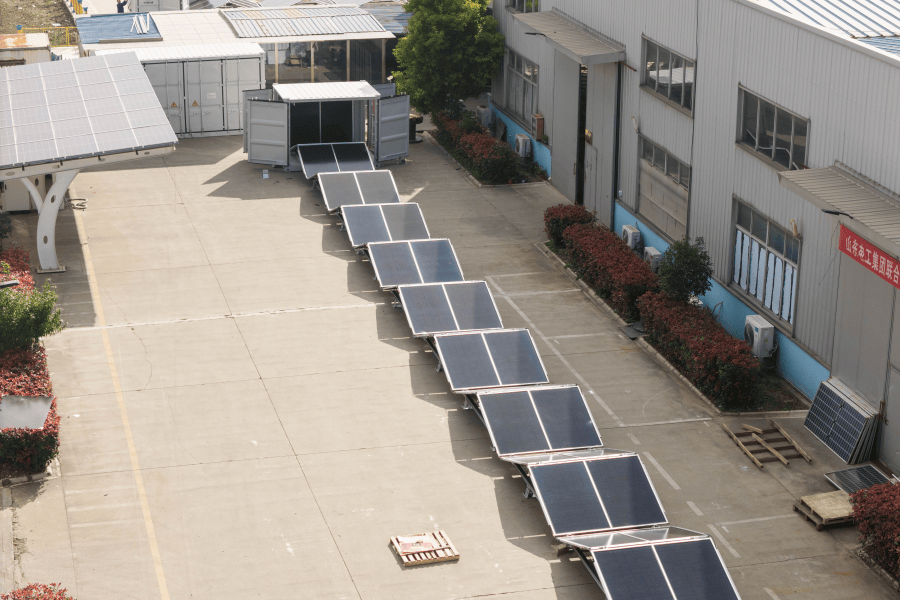
The solution was a 2 MW/4 MWh black-start-capable BESS paired with a rooftop solar canopy. The key spec was its ability to form a 50 Hz grid within 20 seconds. Here's the kicker: during a planned grid maintenance shutdown, the system performed a flawless black start. It first powered the critical server halls, then provided the stable signal for the existing diesel gensets to sync and start under load, eliminating that dangerous "cold start" surge. The diesels then took over the base load, with the BESS handling transients, drastically reducing fuel use and noise. The client's takeaway? Resilience wasn't just added; its operational cost and environmental footprint went down.
Making It Work: The On-the-Ground Reality
Specs and cases are great, but deployment is where theory meets reality. A black start system isn't a plug-and-play appliance. It requires deep system integration. The controls must talk seamlessly with your existing switchgear, SCADA, and genset controllers. This is where choosing a provider with real field experience pays off. You need someone who thinks about the conduit runs, the communication protocol translations (Modbus TCP to DNP3, anyone?), and the sequence of operations that keeps your ops team in the loop.
At Highjoule, our approach is to co-engineer the integration. We don't just drop a container and leave. We think about local serviceability - ensuring critical spares are available within your region and that our remote monitoring platform, which tracks everything from cell-level voltages to PCS readiness, gives your team the transparency you need. The goal is to make this advanced technology feel like a reliable, understandable part of your infrastructure.
So, the next time you review your data center's resilience plan, ask this: Can our backup power start itself? The answer might just redefine your notion of true independence.
Tags: UL Standard BESS LCOE Black Start Off-grid Solar Data Center Backup
Author
James Zhang
20+ years agricultural energy storage engineer / Highjoule CTO