
Smart BESS for Mining: UL-Compliant Solar Container Solutions for Remote Sites
Contents
- The Remote Power Problem: More Than Just Distance
- Why a Standard BESS Can Fall Short in the Field
- The Smart Container Solution: It's About Intelligence, Not Just Boxes
- A Case in Point: Learning from the Field
- Key Tech Made Simple for Decision-Makers
- Beyond the Box: What Really Matters for Your Deployment
The Remote Power Problem: More Than Just Distance
Honestly, when we talk about powering remote mining operations - whether that's in Mauritania, Nevada, or Western Australia - the first thing that comes to mind is diesel. Lots of it. The cost is staggering, the logistics are a nightmare, and let's not even start on the carbon footprint and local emissions. I've been on sites where the fuel convoy is the most critical - and vulnerable - part of the entire operation.
But here's the real, often unspoken, problem it creates: complete uncertainty in your OpEx. According to the International Energy Agency (IEA), fuel costs can constitute over 40% of a remote mine's operating expenses, and that's a number that swings wildly with global markets. You're not just managing a mine; you're managing a volatile commodity risk. Solar and battery storage should be the no-brainer solution. Yet, I've seen firsthand how a poorly specified or managed Battery Energy Storage System (BESS) can turn this promise into a new set of headaches on the ground.
Why a Standard BESS Can Fall Short in the Field
This is where our industry sometimes misses the mark. A mining site isn't a nicely controlled industrial park in California. You deploy a standard, off-the-shelf containerized BESS, and you quickly run into the "on-site reality gap."
The environment is brutal. We're talking about fine, abrasive dust that gets into everything, diurnal temperature swings that can be 30C or more, and limited, expensive local expertise for maintenance. The biggest issue I see? A lack of true visibility and control. Many systems provide basic state-of-charge data, but that's like flying a plane with only a fuel gauge. You don't know about the health of individual battery cells, you can't predict a thermal runaway event before it happens, and you have no way to optimize the system's performance for your specific load cycles to maximize its lifespan.
You end up with a "black box." When it works, great. When it doesn't, you're flying in specialists, facing downtime, and the promised savings evaporate. This is the core challenge a smart BMS-monitored solar container directly addresses.
The Smart Container Solution: It's About Intelligence, Not Just Boxes
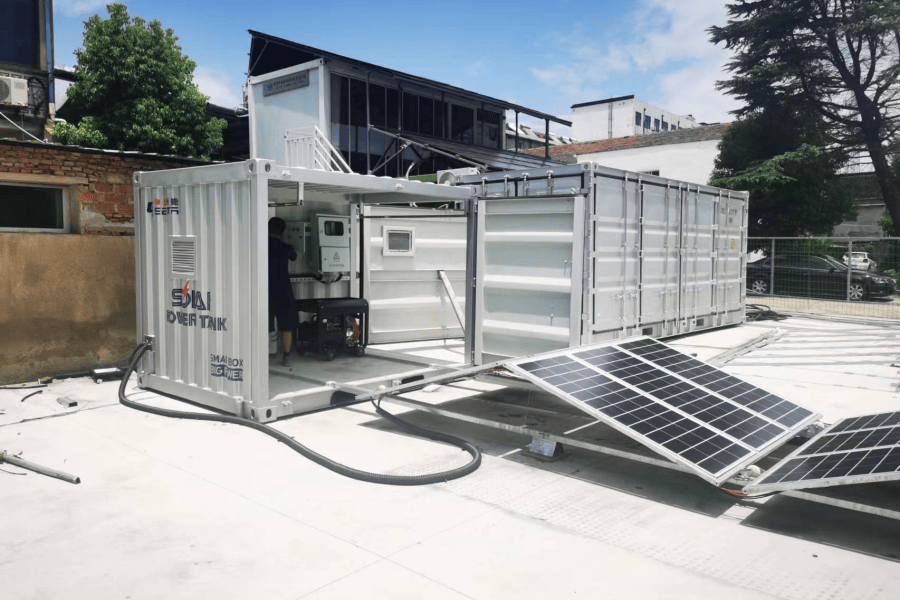
So, what's the difference? When we at Highjoule Technologies evaluate a Comparison of Smart BMS Monitored Solar Container for Mining Operations, we're not just comparing steel boxes and battery racks. We're comparing operational intelligence.
A truly smart system is defined by its Brain: the Battery Management System (BMS). It goes far beyond simple monitoring. We're talking about a system that performs cell-level voltage and temperature tracking in real-time, actively balances charge to prevent weak links, and uses algorithms to predict state-of-health and remaining useful life. This data isn't locked in the container - it's accessible via a secure, satellite-enabled dashboard for the site manager and our global support team.
This means you move from reactive to predictive maintenance. Instead of "Why did this string fail?", you get an alert saying, "Cell Block A7 is showing elevated temperature differentials; recommend inspecting cooling path and scheduling a service check next week." This level of insight is non-negotiable for critical operations.
A Case in Point: Learning from the Field
Let me give you a non-Mauritania example that highlights the principle. We deployed a system for a critical process load at a mining support facility in Northern Canada. The challenge was similar: extreme cold, remote access, and a need for absolute reliability to avoid freezing pipelines.
The client's initial design used a standard BESS. We worked with them to upgrade to a smart BMS-monitored solution with integrated thermal management. During the first polar vortex, the system's BMS proactively triggered internal heating cycles during low solar generation periods, preventing the lithium-ion cells from dipping into dangerous low-temperature states. It also rerouted power flow to prioritize the most critical heaters. The site manager told us the dashboard alerts gave them a level of control over their power they never had with diesel gensets alone.

The outcome? They achieved their reliability target and cut their wintertime diesel consumption for heating by over 60%. The project paid for itself faster than modeled because the system actively optimized itself for the harsh conditions, protecting the asset and delivering more usable energy.
Key Tech Made Simple for Decision-Makers
I know terms like C-rate and LCOE get thrown around. Let me break down what they mean for your bottom line.
- C-rate: Simply put, it's how fast you can charge or discharge the battery. A 1C rate means you can use the full battery capacity in one hour. For mining, you might need high bursts of power (like starting a large crusher) which demands a high discharge C-rate. A smart BMS ensures the battery can deliver this safely without being damaged, by managing the stress on individual cells.
- Thermal Management: This is the unsung hero. Batteries generate heat. Too much heat kills them fast; too much cold stops them working. An advanced system doesn't just have a fan; it has a liquid cooling/heating loop controlled by the BMS, keeping every cell in its optimal 20-25C range. This single feature can double or triple the battery's lifespan, dramatically lowering your...
- Levelized Cost of Energy (LCOE): This is your all-in cost per kWh over the system's life. A cheaper, "dumb" battery with poor thermal management might have a low upfront cost but a high LCOE because it needs replacing every 5 years. A smarter, better-managed system costs more upfront but lasts 15+ years, yielding a far lower LCOE. The smart BMS is the key to achieving this.
Beyond the Box: What Really Matters for Your Deployment
Finally, the container itself. For the US and EU markets, compliance isn't a feature; it's the foundation. Your system must be built to UL 9540 (the standard for energy storage systems) and IEC 62619 (the international standard for industrial batteries). This isn't just paperwork. It dictates the fire suppression, electrical safety spacing, and structural integrity. At Highjoule, our containers are designed from the ground up to meet and exceed these standards - it's baked into our engineering process, because we've seen what happens when it's an afterthought.
The real value of a Smart BMS Monitored Solar Container isn't just in the specs sheet. It's in the certainty it provides: certainty in safety, certainty in performance, and certainty in long-term cost savings. It transforms the BESS from a capital expense into a predictable, manageable asset on your balance sheet.
So, when you're comparing options, my advice is to look past the sticker price per kWh. Ask the harder questions: How does the BMS actually work? Can you show me the data accessibility? What's the proven lifespan under similar environmental stress? The answers will tell you everything you need to know. What's the one operational risk your current power strategy can't see coming?
Tags: UL Standard BESS LCOE Energy Storage Solar Container Renewable Energy Smart BMS Mining Operations
Author
James Zhang
20+ years agricultural energy storage engineer / Highjoule CTO