
Environmental Impact of 20ft High Cube Pre-integrated PV Containers for Industrial Parks
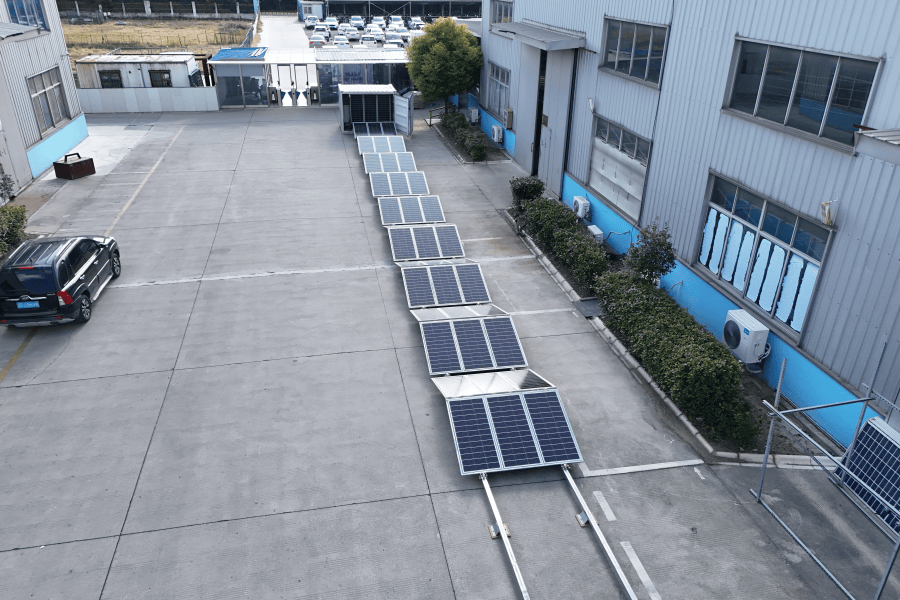
Table of Contents
- The Land Dilemma: More Than Just Square Footage
- Beyond Carbon Numbers: The Full Lifecycle View
- The 20ft Container Advantage: Density, Speed, and Smarts
- A Real-World Case: North Carolina's Textile Park
- Expert Corner: Thermal Management & The Real LCOE
- Making the Right Choice for Your Site
The Land Dilemma: More Than Just Square Footage
Let's be honest. When most plant managers or sustainability directors in the US or Europe think about adding solar and storage, the first mental calculation isn't always about kilowatt-hours. It's about square feet, or square meters. "Where on earth do we put it?" I've had this conversation over coffee on-site more times than I can count. The challenge is acute in industrial parks where every acre is earmarked for production, logistics, or future expansion. Parking lot canopies and rooftop arrays are great, but they often can't meet the full load demand or provide the necessary resilience during a grid event. According to the National Renewable Energy Laboratory (NREL), land-use conflict is a top-3 barrier to commercial-scale renewable deployment in dense industrial zones. It's not just an installation problem; it's a fundamental business problem tied to your most valuable asset: real estate.
Beyond Carbon Numbers: The Full Lifecycle View
We all talk about reducing carbon footprint, and that's crucial. But the environmental impact of an energy asset is measured from cradle to grave. A traditional, piecemeal approach - sourcing PV panels from one vendor, inverters from another, and a BESS from a third, then assembling them on a concrete pad you just poured - creates a hidden web of impacts. Multiple shipments, on-site construction waste, extended commissioning timelines with diesel generators running... the carbon debt before day one of operation can be significant. The industry is moving towards a more holistic view, and frankly, it's about time. The true "green" solution minimizes disruption from the very start of its journey to your site.
The 20ft Container Advantage: Density, Speed, and Smarts
This is where the concept of a pre-integrated, high-cube container solution shifts the paradigm. Think of it as a dense, self-contained power plant optimized for minimal footprint and maximal efficiency. A standard 20ft high-cube container offers about 1,360 cubic feet of space. When every component - high-density lithium-ion battery racks, bi-directional inverters, climate control, and fire suppression - is engineered to fit precisely within that space at our factory, the on-site environmental impact plummets.
- Radically Reduced Site Footprint: You're deploying a solution that fits in a corner of a parking lot or an underutilized service yard, preserving prime land.
- One Shipment, One Connection: This cuts transportation carbon by up to 70% compared to multi-vendor deliveries. I've seen sites where we went from delivery to grid sync in under 72 hours. The reduction in on-site construction activity (no concrete pours, no major civil works) is dramatic.
- Inherently Safer & More Efficient: Factory integration means everything is tested under controlled conditions to meet strict UL 9540 and IEC 62933 standards. The thermal management system is calibrated as a unified unit, which is critical for efficiency and longevity - a point I'll dive into later.

A Real-World Case: North Carolina's Textile Park
Let me share a story from last year. A large textile manufacturing park in North Carolina was facing dual pressures: volatile energy costs and a corporate mandate to achieve 40% on-site renewable generation. Their roof space was insufficient, and the only available land was a long, narrow strip next to a drainage easement - unsuitable for traditional pad-mounted systems.
We deployed two of our 20ft pre-integrated PV containers. The containers themselves housed the storage and power conversion. The PV arrays were mounted on adjacent lightweight canopies over the drainage strip, feeding directly into the containers. The impact?
- Land Use: Zero production land used. The solution fit into a previously unusable space.
- Deployment: The containers arrived from our facility in Texas on two trucks. They were craned into place, connected to pre-laid conduits, and were producing and storing power within 5 days. The alternative would have been months of disruptive construction.
- Outcome: They now shave peak demand by over 30% and have backup power for critical dyeing processes. The lifecycle carbon analysis, factoring in manufacturing, transport, and avoided grid emissions, showed a net-positive environmental benefit in under 18 months.
Expert Corner: Thermal Management & The Real LCOE
Okay, let's get a bit technical, but I'll keep it simple. The single biggest factor in the lifespan - and thus the environmental and economic return - of a battery system is temperature control. Poor thermal management leads to rapid degradation, meaning you'll need to replace batteries sooner. That's a huge hidden environmental cost (and a financial one).
In a pre-integrated container, we design the cooling system (often liquid-based for high-density industrial apps) around the exact heat load of the batteries and inverters inside. It's a sealed, optimized environment. This precision can extend battery life by 20-30% compared to a poorly tuned system. This directly improves the Levelized Cost of Energy Storage (LCOE) - the true measure of your project's cost over its lifetime. A lower LCOE means a better financial and environmental return, because you're squeezing every possible kilowatt-hour out of the materials and energy invested in building the system.

Making the Right Choice for Your Site
So, when you're evaluating the environmental impact of a storage solution for your industrial park, look beyond the marketing claims of "green batteries." Ask the hard questions:
- Deployment: How much site preparation and construction is truly required?
- Density: Does the solution maximize energy density per square foot of my valuable land?
- Design & Standards: Is it built and tested as a unified system to UL or IEC standards, ensuring safety and efficiency from day one?
- Longevity: How is thermal management designed to maximize system life and minimize long-term waste?
At Highjoule, our approach with pre-integrated containers is born from two decades of seeing what works - and what creates headaches - on site. It's about delivering a solution that makes sense for your bottom line and your sustainability goals, without compromise. The goal is to give you a resilient, clean energy asset that feels like it was always meant to be there, with the lightest touch on your site and the planet.
What's the biggest land-use or deployment challenge you're facing in your next energy project?
Tags: UL Standard BESS LCOE Europe US Market Industrial Energy Storage Solar Container Renewable Energy
Author
James Zhang
20+ years agricultural energy storage engineer / Highjoule CTO