
How to Optimize Air-cooled Hybrid Solar-Diesel System for Public Utility Grids
Contents
- The Grid Dilemma: More Renewables, More Complexity
- The Cooling Conundrum: It's Not Just About Temperature
- The Optimization Playbook: Beyond the Spec Sheet
- A View from the Field: Lessons from a 50MW Hybrid Project
- Making It Work for You: The Practical Next Steps
The Grid Dilemma: More Renewables, More Complexity
Let's be honest. If you're managing a public utility grid, your job has gotten a lot more interesting in the last decade. The push for renewables is real C I see it in every RFP. But integrating large-scale solar, especially when you've got legacy diesel gensets as backup, creates a unique kind of headache. It's no longer just about generating power; it's about managing a delicate, constantly shifting dance between intermittent solar, dispatchable diesel, and the grid's unwavering demand for stability.
The real pain point I've seen firsthand, from California to Southern Europe, is the "swing." Solar output plunges during cloud cover or at dusk, and those diesel generators have to ramp up C fast. This isn't just inefficient (running diesel gensets at partial load is a great way to burn money and increase maintenance), it's stressful on the entire grid infrastructure. According to the National Renewable Energy Lab (NREL), effectively managing these rapid transitions is key to reducing overall fuel consumption and emissions in hybrid systems. That's where the right battery energy storage system (BESS) comes in, but not all BESS are created equal for this specific, tough job.
The Cooling Conundrum: It's Not Just About Temperature
When we talk about How to Optimize Air-cooled Hybrid Solar-Diesel System for Public Utility Grids, the first thing most engineers think about is the battery's C-rate C basically, how fast you can charge and discharge it. You need a high C-rate to absorb solar spikes and inject power instantly when diesel is spooling up. But here's the on-site reality everyone learns the hard way: a high C-rate generates heat. A lot of it.
This is where the choice of thermal management C air-cooling versus liquid-cooling C becomes critical. Liquid-cooling is fantastic for extreme, consistent high performance. But for many utility-scale hybrid applications, especially in drier climates or where maintenance simplicity is a priority, a well-optimized air-cooled system isn't just a cheaper alternative; it can be the smarter, more reliable choice. The problem is, most off-the-shelf air-cooled BESS units aren't "optimized" for the brutal, cyclical load profiles of a solar-diesel hybrid. They're designed for smoother, commercial behind-the-meter applications. Deploy one of those, and you'll be fighting cell degradation and capacity loss within a couple of years, honestly.

The Hidden Costs of Poor Thermal Management
Poor thermal control in an air-cooled system doesn't just cause a safety shutdown on a hot day (though I've seen that too). It silently erodes your return on investment:
- Accelerated Aging: Every degree above the optimal temperature range shortens battery life exponentially. You're literally burning through your asset's lifespan.
- Inconsistent Performance: As temperatures rise within the container, you have to derate the system. The 2MW BESS you paid for might only deliver 1.6MW when you need it most.
- Higher LCOE: This is the bottom line. Premature replacement, lost revenue from derating, and increased maintenance all drive up your true cost of stored energy.
The Optimization Playbook: Beyond the Spec Sheet
So, how do you optimize? It's not a single switch to flip. It's a system-level approach. At Highjoule, based on our deployments from Texas to Italy, we focus on three layers beyond the battery cell itself.
1. Intelligent Pack & Rack Design: It starts with physics. We design for maximum intrinsic airflow. This means cell spacing, rack orientation, and internal ducting are all engineered to promote passive convection before the fans even kick in. It reduces the baseline thermal load on the active cooling system.
2. Predictive, Dynamic Cooling Control: The fans shouldn't just react to a temperature sensor. A truly optimized system uses a battery management system (BMS) that predicts heat generation based on real-time C-rate, state of charge, and ambient conditions. It preemptively adjusts fan speeds and airflow patterns. This smooths out temperature gradients across the modules C a major culprit in uneven aging C and cuts auxiliary power consumption by up to 30% compared to simple on/off cooling. That's a direct OPEX saving.
3. Grid-Aware Software Integration: This is the secret sauce for hybrid systems. Your BESS shouldn't be a dumb bucket of electrons. Its operating software needs to communicate directly with the solar farm's controllers and the diesel genset controls. By forecasting solar ramps (down or up), it can pre-charge or pre-cool the battery to handle the coming load transition optimally, keeping the diesel gensets in their most efficient band or even keeping them off entirely for longer.
A View from the Field: Lessons from a 50MW Hybrid Project
Let me give you a concrete example. We worked on a project in the southwestern U.S. C a public utility with a 40MW solar PV farm paired with a 50MW diesel peaking plant. Their challenge was grid stability during evening peak when solar dropped and before diesel could fully carry the load.
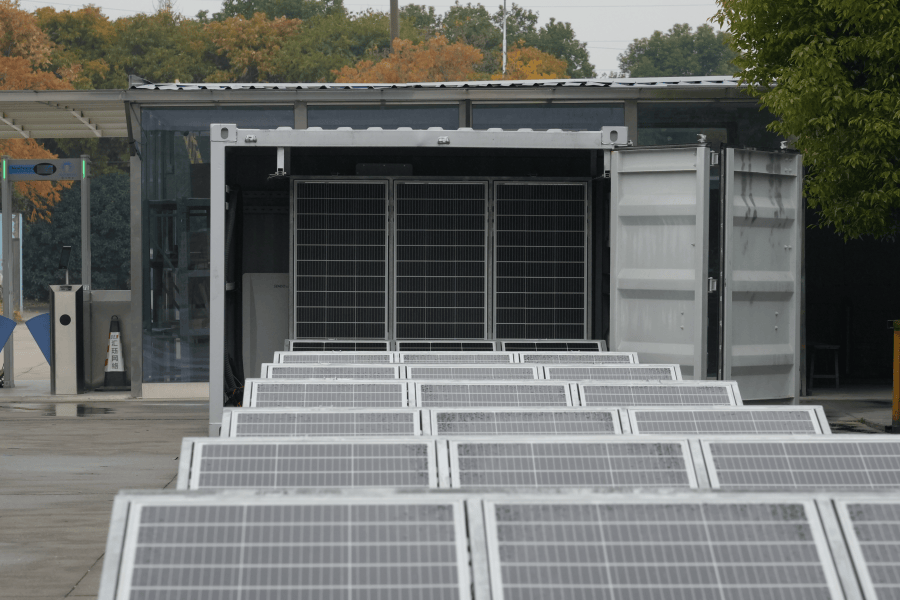
We deployed a 12MW/24MWh air-cooled BESS. The optimization wasn't just in the containers. We co-located the BESS units with strategic spacing between them and the inverter skids to use the prevailing wind for supplemental cooling. More crucially, our system's grid-forming inverters and control software were programmed for specific scenarios: "Solar Drop-Off" mode, "Diesel Support" mode. The BESS would automatically inject power to cover the 90-second diesel start-up sequence, eliminating a voltage dip the utility had simply accepted for years.
The result? A 22% reduction in diesel runtime hours in the first year of operation, and the BESS itself has maintained a cell temperature delta of less than 3C across all racks, which is fantastic for long-term health. It passed all local interconnection standards (IEEE 1547) and, crucially for long-term insurance and safety, was fully UL 9540 certified.

Making It Work for You: The Practical Next Steps
Optimizing an air-cooled system for your hybrid grid isn't about buying a product off a catalog. It's about partnering with a team that understands the thermal, electrical, and control complexities from the cell level up to the grid interface.
When you're evaluating solutions, ask the hard questions: "How is your air-cooled design different for a high-cyclical, high C-rate utility application versus a commercial one?" "Can your BMS software integrate directly with my existing diesel genset controllers and SCADA?" "Show me the third-party test data for temperature uniformity under a 1C continuous discharge cycle."
The goal is to turn your hybrid system from a complex problem into a resilient, cost-optimized asset. Your air-cooled BESS should be the silent, intelligent buffer that lets the solar shine, minimizes the diesel, and keeps the grid stable. That's the optimization that truly moves the needle on your LCOE and operational resilience. What's the one grid transition event that's causing you the most operational pain right now?
Tags: UL Standard BESS IEC Standard Hybrid Solar-Diesel System Public Utility Grids
Author
James Zhang
20+ years agricultural energy storage engineer / Highjoule CTO