
Optimizing Grid-forming Pre-integrated PV Containers for Reliable EV Charging
In This Article
- The Quiet Struggle Behind the EV Charging Boom
- Why "Grid-Forming" Isn't Just a Buzzword for EV Chargers
- The Real Levers for Optimization: A Site Engineer's Perspective
- A Story from the Field: California's Highway Charging Hub
- How Do You Get Started?
The Quiet Struggle Behind the EV Charging Boom
Honestly, if you're looking at deploying EV charging stations, especially fast-charging hubs, you already know the main problem: the grid. It's either too weak, too expensive to upgrade, or simply too slow to get the power capacity you need. I've sat across from countless developers in the US and Europe who have the perfect site, the demand is there, but the utility quote for a transformer upgrade or new connection is a six-to-eighteen-month wait and a seven-figure surprise. It's a gridlock, pun intended.
But here's the agitating part we see on-site. Even if you get that grid connection, you're now tied to its volatility. Demand charges can obliterate your profitability. According to the National Renewable Energy Laboratory (NREL), high-power charging stations can see demand charges constituting 70-90% of their monthly electricity bill. And during peak times or grid stress, you might face curtailment or sky-high spot prices. Your business model for a critical piece of the energy transition is held hostage by external factors. That's a risky proposition.
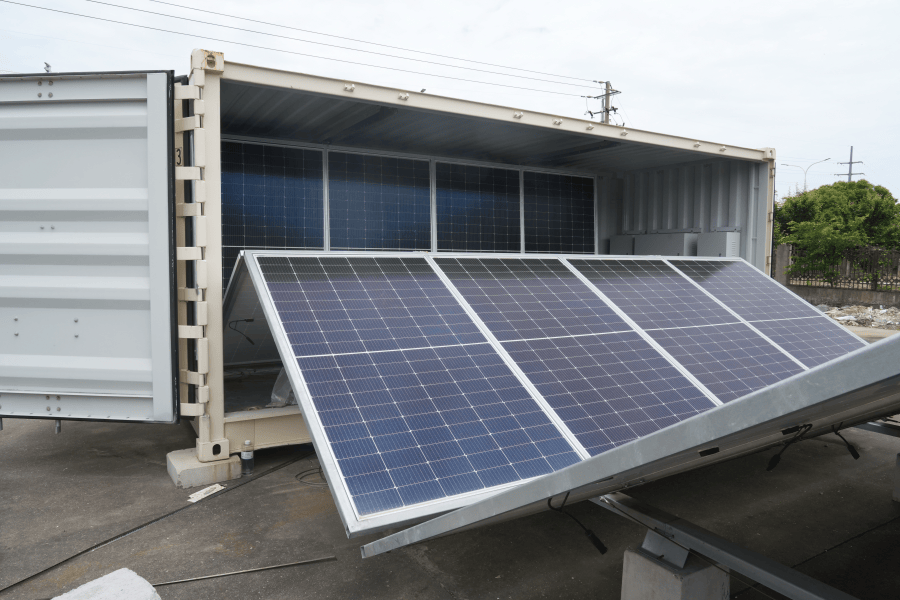
The emerging solution? Pairing solar with a battery that doesn't just follow the grid's rules, but can set its own. That's where the optimization of a grid-forming, pre-integrated PV container comes in. It's not just a battery box; it's a self-contained, intelligent power plant for your charging station.
Why "Grid-Forming" Isn't Just a Buzzword for EV Chargers
Most batteries are "grid-following." They need a stable grid signal to sync to, like a musician following a conductor. Take the conductor away, and the music stops. A grid-forming battery is the conductor. It creates its own stable voltage and frequency waveform, forming a microgrid. For an EV charging station, this is revolutionary.
Imagine a brief grid outage. With a standard system, your chargers go dark, customers are stranded, and you lose revenue. With a properly optimized grid-forming unit, the transition is seamless. The container disconnects from the main grid and continues to power the chargers from solar and stored energy. The driver might not even notice. This isn't just about resilience; it's about uptime and brand reputation. In regions with unstable grids or frequent extreme weather, this is non-negotiable.

The Real Levers for Optimization: A Site Engineer's Perspective
So, how do you optimize such a system? It's not about squeezing in more cells. It's about intelligent design and control. From my 20+ years, here are the key levers to pull:
1. Right-Sizing with LCOE in Mind
Everyone focuses on upfront cost. I tell clients to focus on Levelized Cost of Energy (LCOE) for their microgrid. Optimization means balancing the solar array size, battery capacity, and inverter power. An oversized battery increases capex; an undersized one won't shave enough demand charges. We model local weather, charging profiles, and tariff structures to find the sweet spot where every kilowatt-hour over the system's life is cheapest. For instance, a higher C-rate battery might cost more upfront but allows for a smaller battery to deliver high power for fast charging, improving overall LCOE.
2. Thermal Management: The Silent Killer of Performance
I've seen this firsthand. A container in the Arizona sun or a German heatwave is an oven. Poor thermal management leads to accelerated degradation, reduced capacity, and safety risks. Optimization here means an integrated cooling system designed for the specific thermal load of the power converters and batteries inside, with redundancy. It must maintain optimal temperature with minimal energy use (parasitic load). A system that loses 10% of its energy cooling itself isn't optimized.
3. The Brains: Advanced Energy Management System (EMS)
The hardware is one thing; the software is what makes it smart. The EMS must do three things flawlessly: forecast solar generation, predict charging load (using real-time data), and continuously optimize dispatch to minimize costs. It should automatically decide when to charge from solar, from the grid (at cheap rates), and when to discharge to avoid demand charges or sell back power. This is where companies like Highjoule invest heavily - our EMS platforms are tailored for these complex, multi-objective decisions.
4. Safety & Standards: The Non-Negotiable Foundation
Optimization never compromises safety. For the US and EU markets, this means design and components that are certified to UL 9540 (Energy Storage Systems), UL 1741 SB (Grid Support), and IEC 62443 (Cybersecurity). A pre-integrated container should arrive site-ready with these certifications, drastically reducing permitting time and de-risking the project for financiers. Our containers, for example, are built with this compliance-first approach, which honestly, is the only way to operate at scale.
A Story from the Field: California's Highway Charging Hub
Let me share a recent project. A developer in California was building a 10-bay DC fast-charging station off a major highway. The utility upgrade was 12 months out and costly. Our solution was a pre-integrated container with 250kW of rooftop solar, a 500kWh grid-forming battery, and 1MW of inverter capacity.
The challenge was the highly variable, unpredictable load - from one car at 50kW to ten cars simultaneously at 350kW+. Optimization was key. We used a high C-rate battery chemistry to handle those rapid power surges. The EMS was programmed with aggressive demand charge management, using solar to constantly "top up" the battery during the day. The grid-forming capability meant the site could operate as an island during planned utility maintenance.
The result? The station opened 9 months earlier than waiting for the grid. They've cut their monthly demand charges by over 80%, and the grid-forming feature has already provided backup during two brief outages, maintaining customer satisfaction. The container was commissioned in a week because it was pre-tested and pre-certified.
How Do You Get Started?
The path to an optimized system starts with asking the right questions. Don't just ask for a battery quote. Ask potential providers: How do you model my specific load and solar profile? Can you show me the LCOE analysis? What is the parasitic load of your thermal system? Is your grid-forming inverter certified to the latest IEEE 1547-2018 standards for seamless islanding and reconnection?
Look for partners with deep field experience. The difference between a theoretical design and a field-proven one is massive. It's the difference between a system that works on a spreadsheet and one that works at 2 PM on a blistering hot day when ten EVs roll in and the grid is asking for help.
The future of EV charging is off-grid capable, cost-optimized, and resilient. The technology to do it is here. The real question is, how will you integrate it?
Tags: UL Standards Grid-forming BESS Pre-integrated PV Container EV Charging Stations Energy Storage Optimization
Author
James Zhang
20+ years agricultural energy storage engineer / Highjoule CTO