
Optimize Rapid Deployment PV Storage for EV Charging: A Guide for C&I
How to Optimize Rapid Deployment Photovoltaic Storage for EV Charging Stations: A Practical Guide
Honestly, if you're looking at deploying EV charging infrastructure right now, you're facing a perfect storm of opportunity and challenge. The demand is skyrocketing, but so is the pressure on your local grid connection and your electricity bill. I've been on-site for dozens of these projects across the US and Europe, and the same question keeps coming up from facility managers and business owners: "How do we power this without getting crushed by demand charges or waiting years for a grid upgrade?" That's where a smart, rapidly deployable photovoltaic (PV) and battery storage system (BESS) comes in. It's not just an add-on; it's becoming the core of a viable, future-proof charging hub. Let's talk about how to optimize it.
Quick Navigation
- The Real Problem: More Than Just Power Outlets
- Why "Rapid Deployment" is a Game-Changer
- Key Optimization Levers for Your System
- A Case in Point: The German Logistics Hub
- Making It Work for You: The Highjoule Approach
The Real Problem: More Than Just Power Outlets
Phenomenon: Everyone sees the line of EVs waiting to charge. What you don't see is the massive, instantaneous spike in power demand when multiple fast chargers kick in simultaneously. This isn't like adding a few new office appliances. We're talking about adding the equivalent of several new houses' worth of load - all at once, right on your meter.
Agitation: This spike hits your wallet in two brutal ways. First, your energy consumption (kWh) cost goes up. Second, and often more damaging, is the demand charge. This is a fee based on your peak power draw (kW) in a billing period, and utilities use it to charge for the infrastructure needed to meet that peak. A cluster of 150kW chargers can create a peak that sends this charge through the roof. I've seen commercial sites where demand charges make up over 50% of the total electricity bill after installing EV chargers. Suddenly, that new revenue stream doesn't look so good. Furthermore, getting permission for a grid connection upgrade to support this load can be a 2-3 year odyssey of paperwork and construction, completely stalling your business plans.
Why "Rapid Deployment" is a Game-Changer
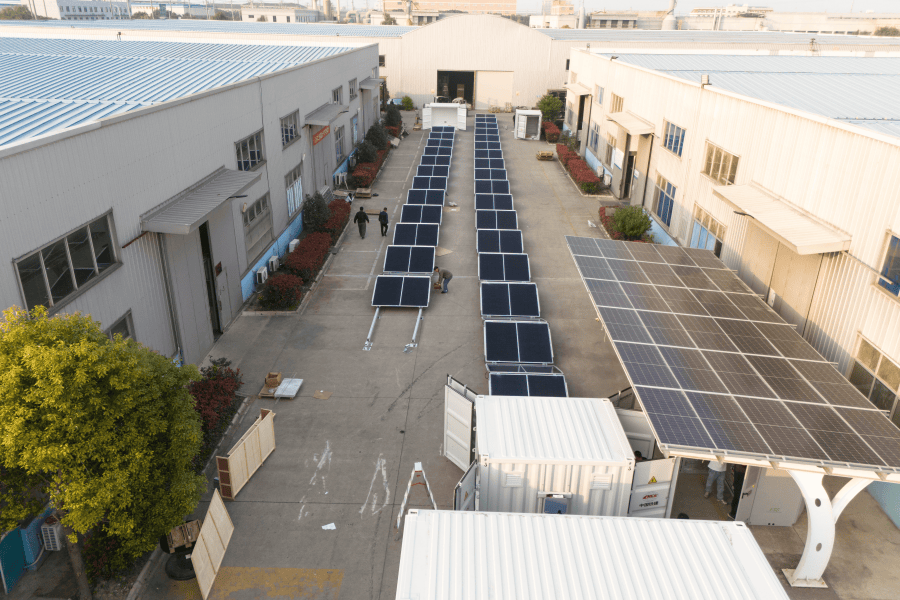
This is where the mindset shifts. We're not building a permanent power plant. We're deploying a flexible, scalable power asset. A "rapid deployment" system, typically using containerized or skid-mounted BESS and pre-engineered PV canopies, can be ordered, delivered, and commissioned in months, not years. It bypasses the grid delay. The optimization goal then becomes: how do we size and operate this integrated system to maximize economic return and reliability from day one?
The solution is an integrated PV + Storage system that acts as a buffer and a source. The PV generates clean, low-cost energy during the day. The BESS stores that energy (or cheap overnight grid power) and delivers it at high power when the chargers need it, shaving that catastrophic peak off your grid draw. It turns a grid-crushing liability into a manageable, even profitable, asset.
Key Optimization Levers for Your System
Getting this right isn't magic; it's about smart engineering choices. Here's what we look at on every project:
1. Sizing the Battery: It's Not Just About kWh
Everyone focuses on total energy (kWh), but for EV charging, the power rating (kW) and the C-rate are just as critical. Simply put, the C-rate tells you how quickly a battery can charge or discharge relative to its size. A battery with a high C-rate can deliver those huge bursts of power to multiple chargers without breaking a sweat. Oversizing a low C-rate battery to meet power needs is a surefire way to blow your budget. We match the battery's discharge capability directly to the anticipated peak draw of your charger cluster, with a safe margin.
2. Thermal Management: The Silent Guardian
Fast discharging for EV charging generates heat. Period. If that heat isn't managed, the battery degrades faster, its lifespan plummets, and safety risks creep in. An optimized system has a robust thermal management system - liquid cooling is often the go-to for these high-power applications. It keeps the battery in its "Goldilocks zone," ensuring performance, longevity, and most importantly, safety. This is non-negotiable and a core part of designs that meet strict standards like UL 9540 and IEC 62619.
3. Thinking in LCOE, Not Just Sticker Price
The cheapest system upfront is often the most expensive over ten years. We use Levelized Cost of Energy (LCOE) as a key metric. It factors in the total cost of ownership (purchase, installation, maintenance, degradation) divided by the total energy delivered over the system's life. A slightly more expensive battery with a better thermal system and higher cycle life will have a significantly lower LCOE, saving you hundreds of thousands. According to a National Renewable Energy Laboratory (NREL) analysis, continued innovation is driving down BESS LCOE, but smart selection is key to capturing those savings.

A Case in Point: The German Logistics Hub
Let me give you a real example from a project we did in North Rhine-Westphalia. A large logistics company needed to electrify its fleet of 40 delivery vans with depot charging. The grid connection was maxed out. The challenge: enable overnight charging for all vans without a costly grid upgrade.
Solution: We deployed a rapidly deployable system consisting of a 1 MWh containerized BESS (UL/IEC compliant) and a 500 kW PV canopy over the parking area. The BESS was charged slowly from the grid during off-peak hours and aggressively by PV during the day. At night, it discharged to power the charging stations.
Outcome: The grid draw was flattened to a near-constant level. Demand charges were reduced by over 80%. The PV covered about 30% of the total energy need, reducing consumption costs. The entire system was operational in under five months from contract signing. The client now has a predictable energy cost model for their fleet transition.
Making It Work for You: The Highjoule Approach
At Highjoule, we've built our C&I and microgrid solutions around this exact problem set. Optimization starts in the design phase. Our containerized systems come pre-integrated with high C-rate cells and liquid cooling for the high-power duty cycle of EV charging. They're built to the UL 9540 standard, which is frankly the benchmark for safety that gives peace of mind to site owners and insurers alike.
But the hardware is just the start. Our energy management system (EMS) is the brain. It doesn't just react; it forecasts. Using weather data and charging schedules, it optimizes when to store PV energy, when to pull from the grid at cheap rates, and exactly when to release the battery's power to shave peaks. This intelligent control is what turns a battery from a simple bucket of energy into a precision financial tool.
The beauty of the rapid-deployment model is its flexibility. If your needs grow, we can add another container. The local support and remote monitoring we provide mean the system keeps performing optimally, year after year, maximizing that all-important LCOE.
So, the next step? Look beyond the charger specs. Map out your true peak power needs, understand your utility rate structure inside and out, and start thinking of your EV charging hub as a integrated, optimized energy asset. What's the one grid constraint that's keeping you up at night about your electrification plans?
Tags: UL Standard BESS LCOE Europe US Market Renewable Energy
Author
James Zhang
20+ years agricultural energy storage engineer / Highjoule CTO