
Manufacturing Standards for High-Altitude Hybrid Solar-Diesel BESS: A Field Engineer's View
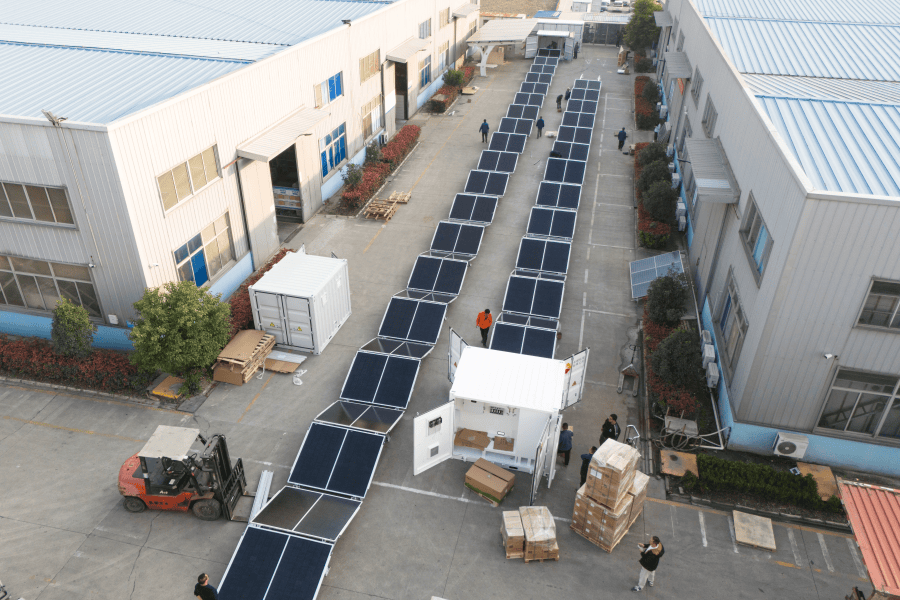
Table of Contents
- The Silent Problem: Why "Sea-Level" Standards Fail at Altitude
- The Real Cost of Ignoring It: More Than Just Downtime
- The Solution: It's in The Manufacturing DNA
- Case in Point: A Rocky Mountain Microgrid
- Beyond the Spec Sheet: What to Really Look For
The Silent Problem: Why "Sea-Level" Standards Fail at Altitude
Let's be honest. When you're sourcing a containerized hybrid solar-diesel system, the spec sheet often screams about battery capacity and solar inverter efficiency. But buried in the footnotes - if it's mentioned at all - is the operating altitude. Most off-the-shelf systems are built and certified for, well, "normal" conditions. I've seen this firsthand: a beautifully engineered system destined for a 3,000-meter mining site in the Andes, built to the same exact UL 9540 and IEC 62485 standards as one going to a coastal warehouse. On paper, it's compliant. On the mountain, it's a liability waiting to happen.
The core issue is that standard manufacturing and testing protocols assume certain environmental baselines. At high altitude, three things change dramatically: air density drops, thermal management becomes trickier, and electrical insulation properties shift. A cooling system rated for 40C at sea level can't dissipate heat as efficiently in thin air. Honestly, the internal temperature delta can be 15-20% higher, which directly accelerates battery degradation. It's not just about comfort; it's about the fundamental physics of your asset.
The Real Cost of Ignoring It: More Than Just Downtime
So what happens if you deploy a system not built for the terrain? It's not a simple "it works a little less efficiently." We're talking about cascading failures. Lower air pressure affects arc flash boundaries and the performance of air-breathing components. I recall a project in Colorado where a standard diesel genset, paired with a BESS, kept derating unexpectedly. The control system was fighting against oxygen-starved combustion, leading to more frequent battery cycling and a Levelized Cost of Energy (LCOE) that was nearly 30% higher than projected. The client wasn't just paying for fuel; they were paying for the hidden cost of a mismatched system.
From a safety and compliance perspective, the risk is even starker. IEEE 1547 and UL 9540A are your bedrock for grid interconnection and fire safety. But their testing parameters matter. A fire suppression system's dispersion, the clearance for convection cooling, even the torque on electrical connections (which can loosen with thermal cycling exacerbated by altitude) - all need to be validated for low-pressure environments. Ignoring this doesn't just risk non-compliance; it risks the entire site's operational license.
The Data Doesn't Lie
A National Renewable Energy Laboratory (NREL) study on PV system performance at altitude noted a measurable increase in string voltage and potential for over-voltage trips due to reduced cooling. While focused on solar, the principle transfers directly to the power conversion and battery management systems inside a hybrid container. The system is an ecosystem, and every part feels the altitude.

The Solution: It's in The Manufacturing DNA
This is where true, purpose-built Manufacturing Standards for 20ft High Cube Hybrid Solar-Diesel System for High-altitude Regions come in. It's not a sticker you add at the end. It's a philosophy embedded from the first design review. At Highjoule, when we build for high-altitude projects - like we've done in the Swiss Alps or for remote telecom sites in Wyoming - the standard changes. We're talking about:
- Derated & Revalidated Components: Fans, blowers, and cooling pumps are selected for volumetric flow, not just wattage. Inverters and transformers are specified with appropriate altitude derating factors applied from the start.
- Pressure-Compensated Enclosures: For critical controls, we sometimes use slightly pressurized compartments to maintain a stable internal environment, keeping dust and moisture out while ensuring consistent thermal transfer.
- Thermal Modeling That Matches Reality: Our CFD (Computational Fluid Dynamics) simulations use actual altitude-adjusted air density data. This might mean designing for a lower C-rate to manage heat, or adding more passive thermal mass, to ensure cycle life isn't sacrificed.
The goal is to deliver the promised LCOE and ROI. If the system is designed for the environment, the battery degrades as modeled, the diesel genset runs at its optimal load, and the solar asset isn't clipped by an overheating inverter. The financial model stays intact.
Case in Point: A Rocky Mountain Microgrid
Let me give you a real example. We deployed a 20ft High Cube hybrid system for a ski resort community in the Rockies, sitting above 2,800 meters. Their challenge was peak shaving during winter storms and providing backup during grid outages, all while dealing with -30C winters and thin air.
The "standard" solution proposed by others kept hitting snags in design review. Our approach, based on our high-altitude manufacturing protocol, included:
- An HVAC system with a 40% higher capacity than standard, using fans rated for continuous operation in low-density air.
- All electrical clearances inside the container were increased by 25% beyond standard IEC 61936 requirements to account for reduced dielectric strength.
- The diesel generator was a high-altitude variant from the factory, and the system controller was programmed with altitude-specific algorithms for fuel-air mixing and switching logic.
The result? Two winters in, the system's availability is at 99.8%. The thermal imaging shows uniform cell temperatures within 2C, which is what we modeled at sea-level conditions. That's the power of building it right the first time.
Beyond the Spec Sheet: What to Really Look For
So, when you're evaluating suppliers for a high-altitude hybrid system, don't just ask if they "can do it." Drill deeper. Ask them:
- "Can you show me the altitude derating calculations for your primary power conversion and thermal management systems?"
- "How do you validate compliance with UL 9540 for the actual installation site pressure, not just the test lab?"
- "What specific adjustments are made to the battery management system's (BMS) charge/discharge algorithms to account for reduced cooling efficiency?"
Honestly, if they start talking about just adding bigger fans as an afterthought, it's a red flag. The standard needs to be holistic.
For us at Highjoule, this isn't a niche offering. It's part of our core engineering discipline for any project outside the typical envelope. It's what ensures that when we hand over the keys, whether in the Atacama or the Alps, the system performs, endures, and saves you money - exactly as we promised over that first coffee chat. The question is, are your current suppliers having these conversations with you?
Tags: UL Standard BESS IEC Standard High-altitude Energy Storage Hybrid Solar-Diesel System Manufacturing Standards
Author
James Zhang
20+ years agricultural energy storage engineer / Highjoule CTO