
Mobile BESS for Industrial Parks: A 215kWh Case Study on Flexibility & Cost Savings
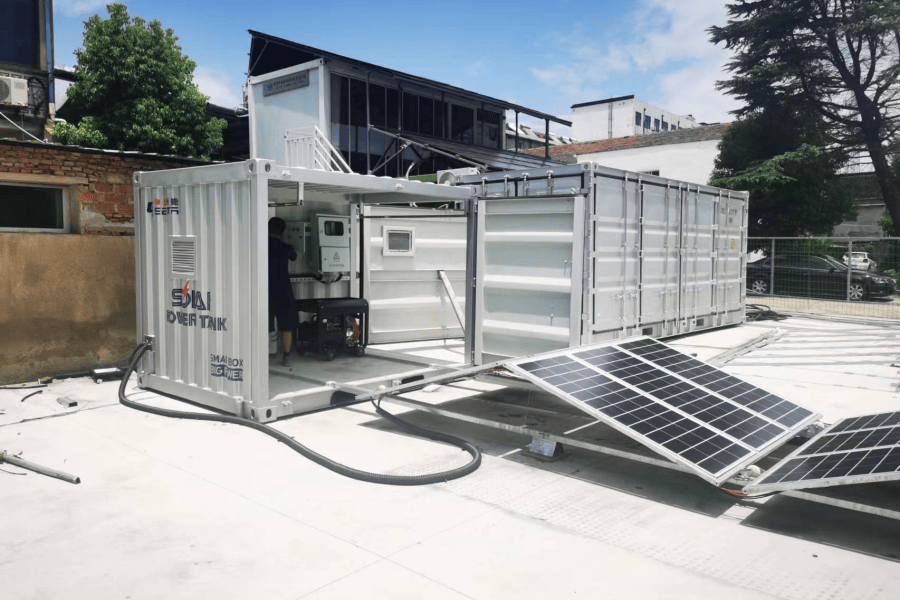
Table of Contents
- The Grid Problem Every Plant Manager Knows
- Why "Fixed" Isn't Always the Answer
- The Mobile Power Container Solution
- A Real-World Case Study: The 215kWh Cabinet in Action
- The Tech Behind the Curtain (Made Simple)
- Thinking About Your Site?
The Grid Problem Every Plant Manager Knows
Let's be honest. If you're running operations at a manufacturing plant, a logistics hub, or any energy-intensive industrial park, you've felt the pinch. It's not just about the rising cost per kilowatt-hour. It's the demand charges that hit you like a ton of bricks after a peak usage period. It's the anxiety during a grid alert, wondering if you'll have to curtail production. And honestly, it's the sheer complexity and capital commitment of "fixing" your energy infrastructure.
I've been on-site for dozens of these conversations. The CFO is worried about the bottom line, the operations manager needs 100% uptime, and the sustainability officer has targets to meet. The traditional answer? A fixed, large-scale Battery Energy Storage System (BESS). It's a great solution, but it's like pouring a permanent concrete foundation for a structure you might need to move in 5 years. What if your load center shifts? What if you need temporary power for a new construction site within your park? The inflexibility is a real, and often unspoken, pain point.
Why "Fixed" Isn't Always the Answer
Here's the thing the glossy brochures don't always tell you: deploying a fixed BESS is a major civil and electrical undertaking. You need the right space - often a lot of it, with specific foundation requirements. The permitting can be a marathon, especially under strict codes like the NFPA 855 standard in the U.S. or the myriad of local fire safety regulations in the EU. And once it's in, it's in. Your energy asset is stationary.
This agitates the core problem. A NREL report highlights that grid congestion and the need for flexible resources are growing faster than traditional infrastructure can keep up. For an industrial park, this rigidity means you can't easily adapt to changing grid tariffs, relocate capacity to a new tenant or a more critical process line, or use the system as a temporary backup during maintenance on your primary substation. You're locked in.
The Mobile Power Container Solution
This is where the concept of a mobile power container shifts the paradigm. Think of it not just as a battery, but as a "energy asset on wheels." It's a fully integrated, plug-and-play BESS inside a standardized shipping container or cabinet-style enclosure. All the components - the battery racks, thermal management system, power conversion system (PCS), and fire suppression - are pre-integrated and tested at the factory. It arrives on a truck, gets positioned on a simple concrete pad or even compacted gravel, and is connected to your point of common coupling. Honestly, I've seen a 215kWh unit go from truck to operational in under 48 hours on site.
The value proposition is crystal clear for industrial parks: deployable flexibility. You can use it for peak shaving at your main facility this quarter, move it to support a new co-generation plant next quarter, and rent it to a construction contractor on-site the quarter after that. It's an operational tool, not just a capital expense.
A Real-World Case Study: The 215kWh Cabinet in Action
Let me give you a real example, though I'll keep the client name confidential. We worked with a large automotive parts supplier in the Midwest U.S. Their challenge was classic: crippling demand charges during afternoon production peaks and a need for backup power for a critical quality control lab that couldn't tolerate even a 2-second blip.
A fixed, mega-watt scale system was overkill and too slow to permit. Instead, we deployed a 215kWh cabinet-style mobile power container. Here's how it worked:
- Scene & Challenge: The park had a constrained grid connection. Peak shaving was mandatory to avoid six-figure demand charges. The lab required seamless backup.
- Deployment: The container was sited adjacent to the main substation. Its key specs were a 100kW continuous power output (that's the C-rate, which I'll explain below) and the ability for "black start" functionality for the lab.
- Outcome: The system is programmed to discharge during the 3-hour peak window every weekday. It's cutting their peak demand by ~90kW, translating to direct savings on their utility bill. For the lab, it acts as an uninterruptible power supply (UPS), bridging any grid outage for over two hours. The plant manager loves that in two years, when they reconfigure the production line, they can just unhook it and move it.

The Tech Behind the Curtain (Made Simple)
When evaluating a mobile BESS, there are three key things you, as a decision-maker, should understand. Don't worry, I'll keep it simple.
1. C-rate (The "Power vs. Energy" Trade-off): This is just a fancy term for the battery's power output relative to its energy capacity. Our 215kWh unit with a ~0.5C rate means it can deliver roughly 100kW of power. A higher C-rate (like 1C) would give you 215kW of power but might trade off some cycle life or cost more. For most industrial peak shaving, a moderate C-rate is the sweet spot for cost-effectiveness (optimizing that LCOE - Levelized Cost of Energy Storage).
2. Thermal Management (The Safety & Longevity Heart): This is non-negotiable. A battery pack must stay in a tight temperature range. I've seen firsthand how a poorly managed system degrades fast. Our containers use a liquid cooling system that's whisper-quiet and incredibly precise, keeping every cell happy. This is a core part of our design philosophy at Highjoule and is built to exceed UL 9540 and IEC 62933 standards.
3. Grid Compliance & Safety: This isn't an area for compromise. The entire system - from cell to container - must be listed to relevant standards. In North America, that's UL 9540 for the system, UL 1973 for the batteries, and UL 1741 for the inverter. In Europe, it's IEC 62619 and IEC 62477. A true plug-and-play mobile unit comes with all this certification in hand, making interconnection approval with your utility dramatically smoother.

Thinking About Your Site?
The move towards flexible, distributed energy assets is accelerating. For an industrial park, a mobile 215kWh power container isn't just a battery; it's a strategic tool for financial management, operational resilience, and sustainability. It allows you to respond to grid signals, internal demand shifts, and physical site changes without a multi-year, multi-million dollar commitment.
The real question isn't if you need energy storage, but what form gives you the most agility. Could a mobile, containerized solution be the right first step to de-risk your energy costs and prove the value on your specific load profile? We've found it often is. What's the one process line or building on your campus that keeps you up at night regarding power quality or cost?
Tags: UL Standard BESS LCOE Europe US Market Industrial Energy Storage Renewable Energy Mobile Power Container
Author
James Zhang
20+ years agricultural energy storage engineer / Highjoule CTO