
Air-Cooled Hybrid Solar-Diesel Systems for Military Base Resilience
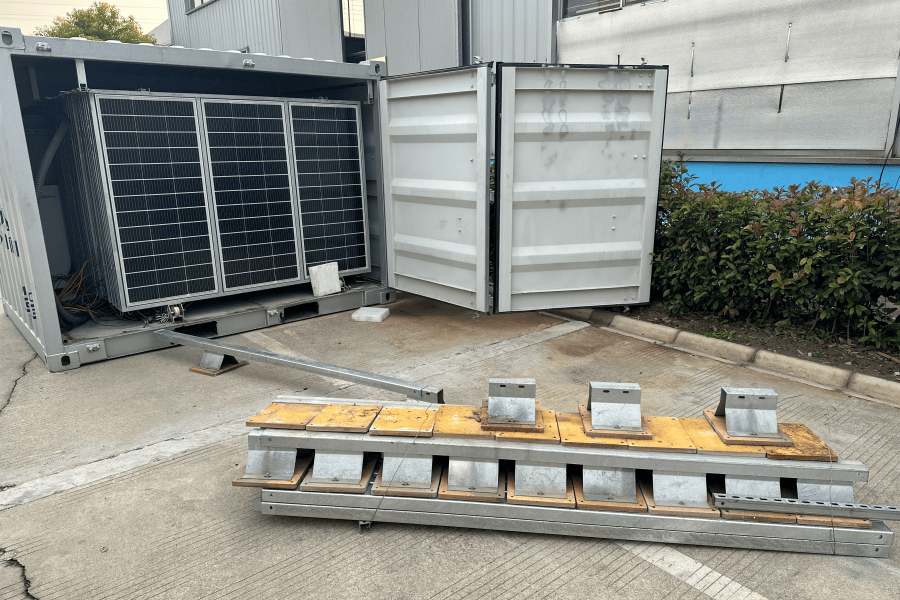
Table of Contents
- The Silent (and Expensive) Problem on Base
- Beyond the Fuel Bill: The Real Cost of Unreliability
- A Practical Solution Emerges: The Hybrid Approach
- Case Study Breakdown: Making it Work in the Field
- Key Technical Insights from the Trenches
- The Future is Modular and Resilient
The Silent (and Expensive) Problem on Base
Let's be honest. For decades, the energy blueprint for remote military installations, communication outposts, and forward operating bases hasn't changed much. You have your diesel generators - reliable workhorses, sure - running 24/7, gulping down fuel that costs a fortune to deliver. The hum is a constant background noise, and the fuel convoys? They're not just a line item on a budget; they're a significant vulnerability. I've been on sites where the logistical tail to keep the lights on was longer and more complex than the operation itself. The U.S. Department of Defense has publicly stated that for every 24 fuel convoys, one soldier or civilian was wounded or killed. That's a sobering statistic that transforms an energy problem into a direct tactical and human risk.
Beyond the Fuel Bill: The Real Cost of Unreliability
So we have cost and security. But let's agitate this a bit more. What about when the primary gen set fails? The switchover to backup isn't always seamless. I've seen firsthand on site a micro-second dip that reset critical servers, or worse, interrupted comms during a drill. This isn't just an inconvenience; it's a mission-impacting event. Furthermore, running diesel gensets at low load - which happens often during low-activity periods - is terrible for the engine. It causes wet-stacking (unburned fuel in the exhaust system) and increases maintenance cycles dramatically. You're burning money on fuel and on premature overhauls.
The industry knows this. The International Renewable Energy Agency (IRENA) highlights that hybridizing power systems for off-grid sites can reduce fuel consumption by over 50% and cut levelized cost of energy (LCOE) significantly. But knowing it and implementing it reliably in a harsh, mission-critical environment are two different things.
A Practical Solution Emerges: The Hybrid Approach
This is where the real-world case for an air-cooled hybrid solar-diesel system comes into sharp focus. The solution isn't about replacing diesel entirely - that's often not feasible for mission assurance. It's about making it the backup, not the primary. The core triad is simple: solar PV arrays, a battery energy storage system (BESS), and the existing diesel gensets, all managed by a sophisticated control system.
The BESS is the heart of the new system. It acts as a buffer, soaking up solar energy during the day and providing instantaneous power to handle load spikes or bridge gaps. This allows the diesel generators to be switched off for long periods, or to run only at their optimal, efficient load when needed. The result? Fewer running hours, less fuel, fewer maintenance events, and a drastic reduction in that vulnerable logistical tail.
Case Study Breakdown: Making it Work in the Field
I can't disclose the exact coordinates, but let's talk about a project we were involved with in a semi-arid region for a NATO ally. The challenge was a communications relay station powered solely by twin diesel generators, with fuel delivered weekly. The goals were clear: cut fuel use by 70%, ensure 99.99% power availability, and eliminate any power transients during generator switchovers.
The deployed system consisted of a 250kW solar canopy, a 500kWh lithium-ion BESS, and the existing gensets. The BESS we supplied was a containerized, air-cooled system pre-certified to UL 9540 and IEC 62933 standards - non-negotiable for military procurement. The "air-cooled" part is crucial here. While liquid-cooled systems have their place, for this environment with dust and limited maintenance personnel, the simplicity and robustness of a well-designed forced-air system won out. Fewer moving parts, no liquid leaks to worry about.
The outcome? The generators now run less than 8 hours a day, only to recharge the batteries if several cloudy days occur. Fuel consumption dropped by 78%. Most importantly, the power quality improved because the BESS provides perfect sine wave output, smoothing out all the dirty power from the gensets. The station's electronic equipment is now under less stress.

Key Technical Insights from the Trenches
For the decision-makers reading this, here are the two technical points you need to understand, stripped of jargon:
- Thermal Management is Everything (Air vs. Liquid): Batteries degrade if they get too hot or too cold. In our case study, an air-cooled system was chosen because it's simpler. We use intelligent climate control inside the container to keep the batteries at their happy place (around 25C/77F). It uses more space and power for the fans than a liquid system, but for a fixed, remote installation where ultimate power density isn't the top priority, its reliability and lower maintenance tipped the scales. You must match the cooling tech to the site's reality, not just the spec sheet.
- Understanding C-rate in Plain English: You'll hear engineers talk about "C-rate." Think of it as the speed limit for charging or discharging the battery. A 1C rate means you can use the battery's entire capacity in one hour. A 0.5C rate means it takes two hours. For a military base, you need a high discharge C-rate - sometimes 2C or more. Why? Because if a large radar system kicks on, the BESS needs to supply that massive surge of power instantly to prevent the generators from stumbling. Our systems are designed with this in mind, ensuring the battery can deliver that "punch" of power without breaking a sweat, which directly supports mission resilience.
This is where companies like Highjoule Technologies focus. It's not just about selling battery containers. It's about engineering the system dynamics - the controls, the thermal management, the right battery chemistry and C-rate - to ensure that when the grid is down or the sun isn't shining, the power profile remains stable and the generators stay off as long as possible. Our service model is built on remote monitoring and predictive maintenance, so the folks on site have one less thing to worry about.
The Future is Modular and Resilient
The case study we just walked through isn't a one-off. It's a blueprint. The economics are now undeniable, and the technology is proven under harsh conditions. The next evolution we're seeing is toward modular, scalable designs. Start with a core system to shave the peak fuel consumption, then add more solar or storage as needs grow. This phased approach aligns perfectly with budget cycles and reduces initial risk.
So, the question isn't really "Can a hybrid system work for a military base?" The data and real-world deployments have answered that with a resounding yes. The question now is, "What's the optimal design for your specific load profile, threat landscape, and sustainability targets?" Getting that answer right requires partners who've been on the ground, who understand that a spec sheet is just the beginning of the conversation.
What's the single biggest operational cost your base is looking to mitigate right now?
Tags: UL Standard BESS Off-grid Power IEEE Standards Military Energy Hybrid Power Systems Solar-Diesel
Author
James Zhang
20+ years agricultural energy storage engineer / Highjoule CTO