
Air-Cooled BESS for High-Altitude Solar: A Real-World Case Study
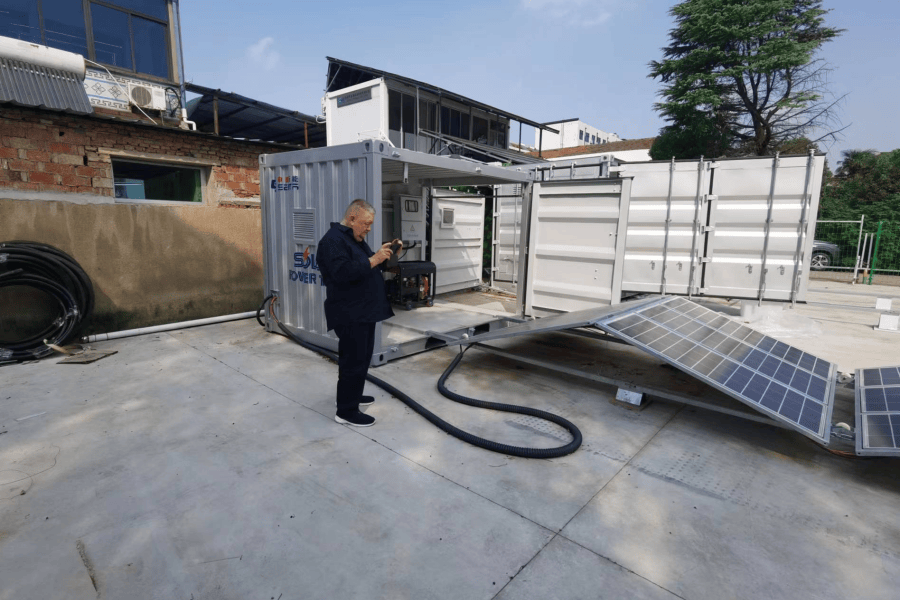
Table of Contents
- The High-Altitude Problem Everyone Sees But Few Talk About
- Why It Matters More Than Your Spreadsheet Says
- A Case in Point: The Rocky Mountain Solar+Storage Project
- The Air-Cooled Advantage: Simplicity as a Superpower
- Beyond the Container: What Really Makes a Project Work
The High-Altitude Problem Everyone Sees But Few Talk About
Let's be honest. When we talk about deploying solar and battery storage, the conversation is usually about sunny California or the plains of Texas. But some of the most promising sites for clean energy aren't on flat, temperate land. They're up in the mountains. I'm talking about high-altitude regions C places above 1,500 meters (about 5,000 feet) where the air is thin, the sun is intense, and the temperature swings can give your equipment a serious workout.
Here's the phenomenon: developers are increasingly looking at these sites. The solar irradiance can be fantastic, and land might be more available. But then they open the spec sheet for a standard battery energy storage system (BESS), and the fine print hits. Most commercial systems are rated for specific ambient conditions. Push them beyond that, and you're looking at reduced output, accelerated aging, or worse, a shutdown. According to a National Renewable Energy Laboratory (NREL) report, improper thermal management can slash battery cycle life by as much as 60%. That's a direct hit on your project's levelized cost of energy (LCOE) C the number that ultimately decides if your project is bankable or not.
Why It Matters More Than Your Spreadsheet Says
I've seen this firsthand on site. The challenge isn't just "it's cold." It's the volatility. You can have a brilliant, high-solar-gain day that heats up a container, followed by a sub-zero night. This thermal cycling stresses every component C from the battery cells themselves to the power electronics. At high altitudes, the lower air density makes traditional air-cooling less efficient. It's like trying to cool a server room with a fan, but then taking away half the air molecules. The system has to work harder, using its own precious energy just to stay in a safe operating window, which they call the "parasitic load."
The safety angle is even more critical. Thermal runaway doesn't care about your altitude. If a cell gets too hot and goes into that failure mode, the thin air can change how fire suppression systems function. Your entire risk assessment needs a rethink. For the US and European markets, this isn't just engineering; it's about liability and compliance with standards like UL 9540 and IEC 62933, which demand proven safety under defined environmental conditions.
The Real Cost of Getting It Wrong
- Downtime: A system that overheats and derates on a peak summer day is losing revenue.
- Maintenance: Sending crews to remote, high-altitude sites for unscheduled maintenance is expensive and complex.
- Warranty Voidance: Deploying a system outside its specified altitude/temperature range can invalidate manufacturer warranties, transferring all risk to you.
A Case in Point: The Rocky Mountain Solar+Storage Project
Let me walk you through a project we were involved with at Highjoule. It was a 10 MW solar + 4 MWh BESS installation in the Rocky Mountains, sitting at about 2,200 meters (7,200 ft). The developer's initial design called for a standard, liquid-cooled BESS container. On paper, liquid cooling is great for tight temperature control.
But our team pushed back based on experience. The site had wide daily temperature swings and was remote. The complexity of liquid cooling C with its pumps, coolant, and piping C meant more potential points of failure. If a leak developed or a pump failed in winter, you'd have a real problem getting it fixed quickly. The logistics of getting specialized coolant and parts up there was a headache and a cost the model didn't fully capture.
We proposed an alternative: a purpose-engineered, air-cooled solar container solution. Now, I know what you're thinking. "Air-cooled at high altitude? Isn't that less efficient?" Normally, yes. But this wasn't a standard off-the-shelf unit. We worked with the client to spec a system with a lower overall C-rate (that's the charge/discharge speed), which inherently generates less heat. We then oversized the HVAC system and used intelligent, staged fans that could move a higher volume of the less-dense air precisely when and where it was needed. The BMS (Battery Management System) was tuned for aggressive proactive thermal management, pre-cooling the space before peak charge cycles.

The result? A system that maintained optimal temperature with less energy use than a struggling liquid system would have. The simplicity of air-cooling meant local technicians could handle most maintenance. Honestly, the reduced CapEx and OpEx made the LCOE more attractive to the financiers. It's been operational for over two years now with availability above 99%. That's the real-world proof.
The Air-Cooled Advantage: Simplicity as a Superpower
This case study isn't about saying air-cooling is always better than liquid. It's about right-sizing the solution to the environment and the business case. For many high-altitude, remote, or even arid environments, a well-designed air-cooled system offers compelling advantages:
- Resilience: Fewer mechanical parts (no pumps, no liquid loops) mean fewer things that can break.
- Serviceability: It's easier to train on-site staff or use local HVAC technicians for support.
- Cost-Effectiveness: Lower initial capital expenditure and often lower operational maintenance costs.
- Safety Transparency: With air, you don't have the added risk of dielectric coolant leaks or the complex interaction of coolants in a thermal runaway event. Your fire safety strategy is more straightforward.
At Highjoule, when we design these systems for the US and EU markets, we start with the standards C UL, IEC, IEEE C as the non-negotiable baseline. Then we layer on the environmental specs. We might select cells with a wider temperature tolerance, use passive fire-resistant materials inside the container, and design the airflow to have redundant paths. The goal is to build in headroom and durability from the start, so the system isn't running at its ragged edge every sunny day on a mountaintop.
Beyond the Container: What Really Makes a Project Work
The final insight from two decades in the field is this: the technology is only half the battle. The successful deployment of a solar container in a challenging environment comes down to partnership and upfront honesty.
You need a provider that doesn't just sell you a black-box container but understands the integration C how the BESS communicates with the solar inverters, how the grid connection behaves, how the local utility's rules might affect your dispatch. For our Rocky Mountain client, our team provided the full design support and, crucially, the long-term performance monitoring. We can see from our desk if a fan curve is deviating or if the internal temperature gradient is widening, and we can proactively suggest maintenance. That's the service model that protects your investment.
So, if you're evaluating a site with challenging environmental conditions, what's the one question you should be asking your BESS provider that you might not be asking today?
Tags: UL Standard BESS LCOE Europe US Market Thermal Management Solar Container Renewable Energy High-Altitude Air-cooled
Author
James Zhang
20+ years agricultural energy storage engineer / Highjoule CTO