
High-voltage DC BESS for EV Charging: A Real-World Case Study on Grid Relief
Contents
- The Silent Bottleneck at the Charger
- The Real Cost of Waiting: It's Not Just Time
- A Smarter Path: DC Coupling and Why It Matters
- Case Study: A Texas Logistics Hub's 24/7 Operation
- The On-Site Truth: Thermal Management & Safety
- Making the Numbers Work: The LCOE Conversation
- Your Next Step: Asking the Right Questions
The Silent Bottleneck at the Charger
Honestly, if I had a dollar for every time a commercial client showed me their ambitious plans for a 10 or 20-bay EV fleet charging depot, only to get a six-figure grid upgrade quote from their utility... well, let's just say I wouldn't be writing this blog. I've seen this firsthand on site, from California to North Rhine-Westphalia. The excitement for electrification is palpable, but it runs headlong into a brutal, physical reality: the local distribution transformer and feeder lines simply weren't built for the simultaneous, massive draw of multiple DC fast chargers.
You're not just adding a new load; you're asking the grid to deliver a short, intense power surge, repeatedly. This is the core Problem we're facing. The International Energy Agency (IEA) notes that global EV sales surged past 10 million in 2022, and public charging infrastructure needs to grow nearly tenfold by 2030. The grid, in many places, is the silent bottleneck.
The Real Cost of Waiting: It's Not Just Time
Let's Agitate that pain point a bit. It's not just about the upfront capital for a transformer upgrade, which can stall a project before it begins. It's about the ongoing demand charges. Utilities charge commercial customers not only for the total energy used (kWh) but for the peak power draw (kW) in any 15 or 30-minute window. A row of 350 kW chargers flipping on can create a devastating peak, turning your operational cost savings into a nasty monthly surprise.
Then there's the opportunity cost. A logistics company can't afford to have half its fleet grounded because the grid can't support charging during peak operational hours. The "solution" of staggering charges kills fleet efficiency. I've walked sites where managers literally had a whiteboard schedule for which truck could plug in and when. That's not progress.
A Smarter Path: DC Coupling and Why It Matters
This is where the Solution in our real-world case study comes into play: the High-voltage DC-coupled Battery Energy Storage System (BESS). Forget the old model of just drawing from the grid. Think of it as placing a high-power "energy buffer" right at the charging site.
Here's the technical bit, explained simply: In a traditional, AC-coupled system, you have solar panels (DC) going to an inverter (making AC), which feeds the building's AC bus. A separate battery system also uses its own inverter to connect to that same AC bus. Then, the EV charger has another inverter to convert AC back to DC for the car's battery. That's three conversion steps, with losses at each stage.
A high-voltage DC BESS, like the systems we engineer at Highjoule, connects directly on the DC side of the central inverter. When a car plugs in, energy can flow directly from the BESS at DC voltage, often matching the charger's native DC input. This "DC coupling" cuts out conversion steps, boosting round-trip efficiency from, say, 85% to over 96%. That efficiency gain is pure financial and operational advantage.

Case Study: A Texas Logistics Hub's 24/7 Operation
Let me give you a concrete example. We worked with a large logistics hub outside Dallas. They had a mandate to electrify 15 of their short-haul trucks. Their site's grid connection was capped at 1.5 MW. Their charging plan required 3.5 MW peaks. The utility's upgrade timeline was 18 months, with a $850k cost.
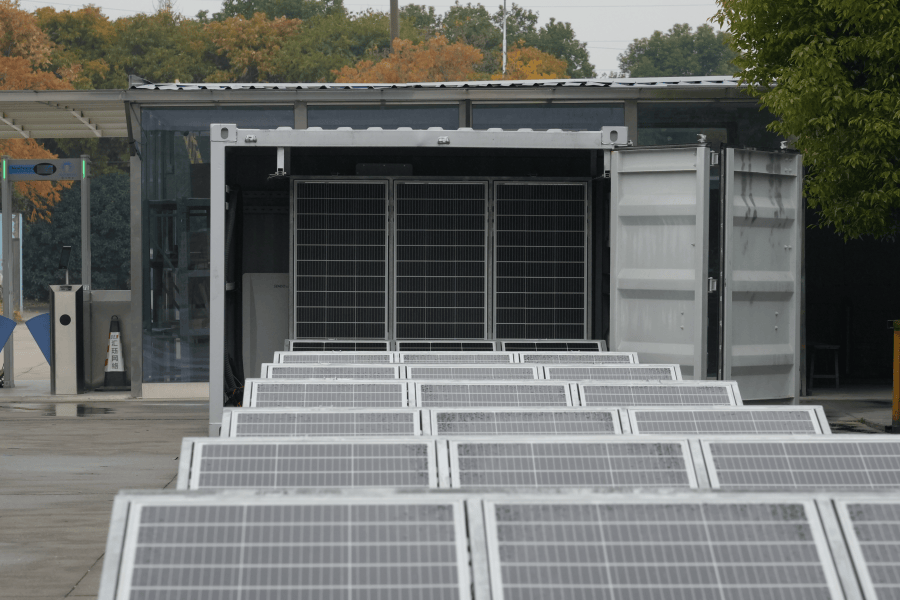
Our solution was a containerized, 2.5 MWh Highjoule BESS with a 1.5 MW inverter, paired with a 500 kW solar canopy. The system was designed to UL 9540 and IEC 62485 standards - non-negotiable for insurance and permitting here. Here's how it works in practice:
- Overnight: The BESS slowly charges from the grid at a low, steady rate, well below the site's peak limit.
- Daytime Operations: As trucks cycle in for 30-minute top-ups, the chargers draw primarily from the BESS, not the grid. The solar canopy offsets base building load.
- The Grid's Role: The grid connection acts only as a stable background trickle charger for the BESS and a final backup. The peak demand seen by the utility? It's flattened to a near-constant line.
The result? They deployed in 5 months for 60% of the cost of the grid upgrade. Their demand charges dropped by over 40% in the first quarter. Most importantly, their fleet runs on its schedule, not the grid's.
The On-Site Truth: Thermal Management & Safety
Now, any engineer will tell you pushing high C-rates (the speed of charge/discharge) through a large battery pack creates heat. And heat is the enemy of lifespan and safety. This is where field experience is everything. A spec sheet might claim a 2C discharge rate, but achieving that sustainably in a Texas summer is another story.
In our BESS designs, the thermal management system isn't an accessory; it's the core. We use liquid cooling that directly contacts the cell modules, maintaining an even temperature spread of less than 3C across the entire pack. I've opened up units after two years in the Arizona desert, and the cell degradation is consistently within 2% of our models. This predictability is key for your long-term Levelized Cost of Energy (LCOE) calculation - the total lifetime cost per kWh stored and delivered. A poorly cooled battery might have a lower capex but a much higher LCOE because you're replacing it twice as often.

Making the Numbers Work: The LCOE Conversation
Which brings me to the boardroom question: What's the ROI? We need to shift from looking at just the battery's price tag to its LCOE. A high-quality, DC-coupled system with superior thermal management might have a 20% higher initial cost. But if it lasts 50% longer, maintains higher efficiency, and avoids one downtime event from thermal throttling, the LCOE plummets.
According to analysis from the National Renewable Energy Laboratory (NREL), optimizing for long-duration, high-cycle life is becoming more economically critical than chasing the lowest upfront $/kWh. For EV charging, this is paramount. Your BESS isn't a backup generator used twice a year; it's a daily workhorse, cycling deeply every single day. You need an industrial athlete, not a weekend warrior.
At Highjoule, our service model is built around this lifecycle view. Our local teams don't just commission the system and leave. We provide performance monitoring that tracks efficiency, cycle counts, and thermal behavior, giving you a clear, real-time view of your asset's health and your actual cost per delivered kWh.
Your Next Step: Asking the Right Questions
So, if you're evaluating a BESS for your EV charging rollout, move beyond the basic "how much capacity?" Talk to your engineering partner about these specifics:
- Is the system DC-coupled or AC-coupled? What is the round-trip efficiency at my typical discharge rate?
- Can you show me the thermal model for the pack at a 1.5C discharge in 95F (35C) ambient air?
- What is the projected cycle life to 80% capacity under my daily duty cycle, and how does that affect my 10-year LCOE?
- Is the system and its installation fully compliant with UL 9540 and the latest IEEE 1547 standards for grid interconnection?
The right high-voltage DC BESS isn't just an add-on. It's the enabling technology that makes your entire EV transition feasible, affordable, and resilient. What's the one grid constraint currently holding your electrification plans back?
Tags: UL Standard BESS LCOE Grid Stability High-voltage DC EV Charging
Author
James Zhang
20+ years agricultural energy storage engineer / Highjoule CTO