
High-voltage DC Off-grid Solar Generators for Industrial Parks: A Real-World Case Study
Contents
- The Silent Crisis in Industrial Power
- The Real Cost of Inaction
- A Different Path: The High-voltage DC Off-grid Generator
- Case Study: A Midwest Manufacturing Hub
- Why This Architecture Works: An Engineer's Perspective
- Looking Ahead: Is This Your Next Step?
The Silent Crisis in Industrial Power
Let's be honest. If you're managing an industrial park or a large manufacturing facility in the US or Europe right now, you're juggling three massive pressures that keep you up at night. First, grid reliability isn't what it used to be. I've been on sites from California to North Rhine-Westphalia where a single voltage sag can ruin a batch process, costing tens of thousands before anyone even blinks. Second, your energy costs are through the roof, and a huge chunk of that is demand charges C you're paying a premium just for the potential to use power. And third, let's not forget the corporate sustainability mandates. Net-zero isn't a buzzword anymore; it's a boardroom directive with real deadlines.
The traditional answer has been diesel gensets for backup and maybe a standard AC-coupled solar farm to chip away at the bill. But that's like putting a band-aid on a pipeline leak. The gensets are loud, polluting, expensive to run, and frankly, they don't address the core issue of continuous, high-quality power. And while solar is great, when it's tied to the AC grid's whims, its value is limited.
The Real Cost of Inaction
This isn't theoretical. The International Energy Agency (IEA) points out that industrial sectors account for about 37% of global electricity use. Every minute of downtime isn't just lost production; it's contractual penalties, wasted raw materials, and equipment stress. I was at a plastics plant in Texas where a two-hour outage led to solidified material in miles of piping. The cleanup and restart took a week. A week.
Then there's the financial bleed from demand charges. Utilities structure these to penalize short, high draws on the grid C exactly what happens when heavy machinery kicks on. You could be running a super-efficient operation, but if your 15-minute peak demand spikes, your bill for the entire month skyrockets. It feels like a game you're rigged to lose.
A Different Path: The High-voltage DC Off-grid Generator
So, what if we could flip the script? Instead of seeing solar as an add-on to a shaky grid, what if we made it the bedrock of a self-sufficient power island? This is where the high-voltage DC off-grid solar generator concept comes in C and it's more than a concept, we've built it.
Think of it as a microgrid built from the ground up for industry. The core is a high-voltage battery energy storage system (BESS) C we're talking 1500V DC architecture C directly coupled to a large-scale solar PV array. No constant DC-AC-DC conversion dance. This native DC coupling is inherently more efficient, losing less energy as heat. This system operates independently, forming a stable "off-grid generator" that powers your critical loads 24/7. The public grid? It becomes a backup or a supplement, not your single point of failure.
At Highjoule, when we design these systems, safety and local compliance aren't checkboxes; they're the foundation. Every containerized BESS unit we ship to the US is built to UL 9540 and UL 9540A standards from the cell up. For the EU, it's the full suite of IEC 62485 and safety standards. This isn't just paperwork. I've seen firsthand how this rigorous design, with advanced thermal runaway propagation prevention, gives site managers and fire marshals the confidence to approve the project. It removes a huge barrier to adoption.
Case Study: A Midwest Manufacturing Hub
Let me walk you through a real project. We deployed this solution for a multi-tenant industrial park in the Midwest, home to a CNC machining center, a food cold storage facility, and a small data cluster. Their pain was classic: volatile grid, crippling demand charges, and a corporate push for clean energy.

The Challenge: They needed 2.5 MW of reliable, continuous power for critical processes. Grid outages were threatening just-in-time manufacturing contracts, and the cold storage's compressors were creating massive demand spikes.
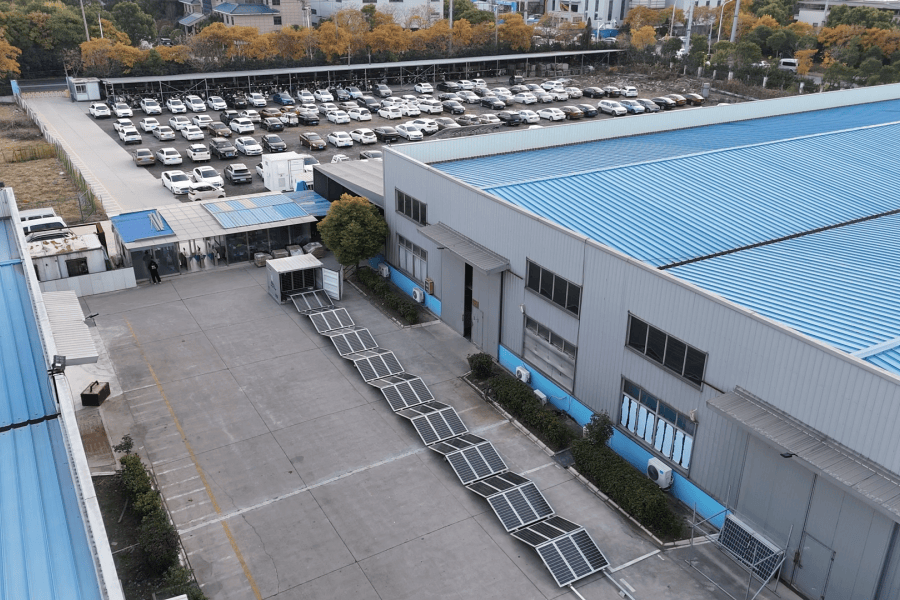
The Highjoule Solution: We installed a 3 MWp solar canopy over parking and warehouse roofs, DC-coupled directly to a 6 MWh, 1500V BESS. The system is configured as the primary power source, forming an off-grid microgrid for the park's core loads. An advanced energy management system (EMS) dynamically dispatches power, prioritizing solar charging and strategically using the battery to shave peak loads.
The Outcome: Within the first year:
- 100% Uptime for critical loads, through multiple grid disturbances.
- 40% Reduction in overall energy costs, primarily by obliterating demand charges.
- The park now operates at over 85% renewable energy self-consumption. The tenants have a powerful marketing story alongside their operational resilience.
Why This Architecture Works: An Engineer's Perspective
If you'll indulge me in a bit of shop talk, the magic is in the details. The high-voltage DC bus (e.g., 1500V) reduces current for the same power level. Lower current means smaller, cheaper conductors and less energy lost as heat. This directly improves the system's Levelized Cost of Energy (LCOE) C the total lifetime cost per kWh. You're simply getting more useful energy out of the same sun and the same batteries.
Then there's thermal management. High-power industrial cycling heats up battery cells. Our systems use a liquid cooling loop that precisely controls each module's temperature. Why does this matter? Because a battery kept at its ideal temperature degrades much slower. It maintains its capacity and safety for years longer. Honestly, proper thermal management is the single biggest factor in the 15-year lifespan we guarantee.
Finally, consider the C-rate C basically, how fast you charge or discharge the battery. For grid backup alone, you might need a high C-rate for a short burst. But for this "off-grid generator" application, we optimize for a moderate, steady C-rate. It's like cruising on a highway versus constant drag racing. This gentler operation is far less stressful on the battery chemistry, again extending its life and improving economics.
Looking Ahead: Is This Your Next Step?
The data, the case studies, and frankly, the nervous calls I get from plant managers after a near-miss grid event, all point in one direction. The old model of passive consumption is too risky and too expensive. The future for energy-intensive industry is active, resilient, and DC-native.
The technology isn't speculative. It's deployed, it's compliant with your local UL and IEC codes, and it pays for itself. The question isn't really about if this approach makes sense, but when it makes sense for your specific load profile, outage history, and sustainability goals. What's the one process in your facility that a 30-second power glitch would cost you more than you'd like to admit?
Tags: UL Standard BESS LCOE Off-grid Solar Microgrid Industrial Energy
Author
James Zhang
20+ years agricultural energy storage engineer / Highjoule CTO