
IP54 Outdoor Pre-integrated PV Container: A Real-World Case Study for Industrial Parks
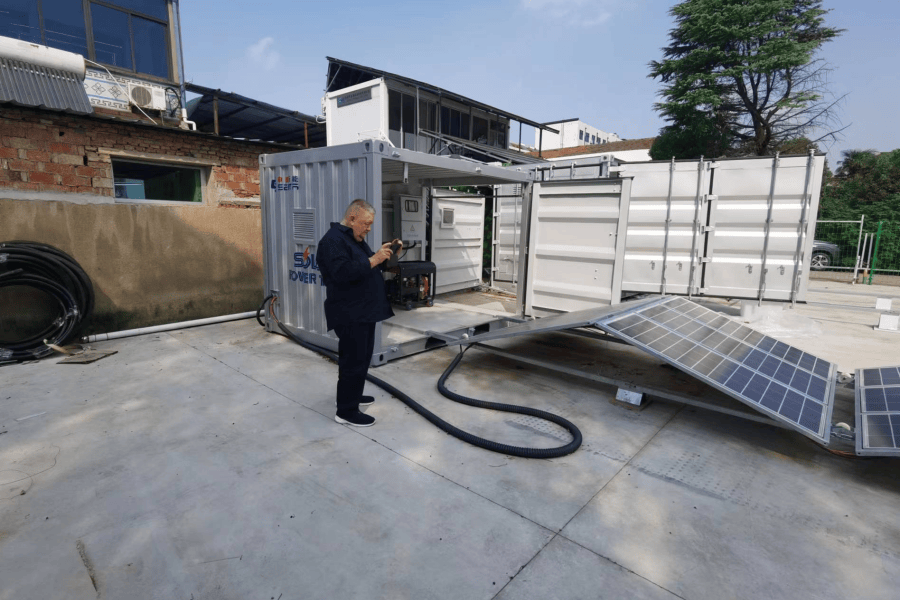
Table of Contents
- The Space Dilemma in Industrial Energy Transition
- Beyond the Spec Sheet: The Real Cost of "Site-Built"
- A Containerized Solution That Actually Works On-Site
- The Thermal Management & Safety Talk (No Jargon, I Promise)
- The LCOE Perspective: Why Pre-Integration Wins Long-Term
- What's Next for Your Park?
The Space Dilemma in Industrial Energy Transition
Honestly, if I had a dollar for every time a plant manager told me, "We want solar and storage, but we just don't have the real estate," I'd be writing this from my own private island. It's the single most common pain point I've seen firsthand on site across California, Texas, and Germany's industrial heartlands. You've got production lines, logistics yards, and warehouses consuming every square meter. The thought of allocating precious, revenue-generating space for a sprawling, custom-built battery room or a separate inverter farm just doesn't pencil out for most CFOs.
This isn't just anecdotal. A report by the National Renewable Energy Laboratory (NREL) highlights that land-use constraints and interconnection complexity are top barriers for commercial-scale solar-plus-storage adoption. The traditional, piecemeal approach - solar panels here, inverters there, a bespoke battery shelter over there - creates a spaghetti of cabling, increases points of failure, and turns your installation into a months-long construction project. Time, as we know, is capital tied up.
Beyond the Spec Sheet: The Real Cost of "Site-Built"
Let's agitate that pain point a little. The issue goes beyond physical space. It's about project risk. Every day of on-site assembly is a day exposed to weather delays, labor cost overruns, and potential safety incidents. I've been on projects where the "soft costs" - engineering, permitting, extended construction management - ended up being 30% of the total CAPEX. Worse, when systems are built from disparate components on-site, ensuring they talk to each other perfectly and meet all local codes (like UL 9540 for energy storage systems in the US or the IEC 62933 series in Europe) becomes a compliance headache. One missed detail during field wiring can delay commissioning for weeks.
I remember a project in North Rhine-Westphalia where a client's custom BESS design ran into unexpected reinforcement needs for the factory floor. The delay and retrofit cost nearly sank the project's ROI. That's the hidden cost of non-integration: unpredictability.
A Containerized Solution That Actually Works On-Site
So, what's the solution we've seen gain serious traction? It's the move towards pre-integrated, outdoor-rated containerized solutions. And I'm not just talking about a metal box with stuff thrown in. I mean a fully engineered, tested, and compliant power plant in a box. This is where that Real-world Case Study of IP54 Outdoor Pre-integrated PV Container for Industrial Parks comes to life.
Take a recent deployment we did with Highjoule for a mid-sized automotive parts manufacturer in Texas. Their challenge was classic: high demand charges, unreliable grid feed during peak summer, and a mandate to add solar. Space was non-existent. Our solution was a pre-integrated IP54-rated container that housed the battery racks, PCS (power conversion system), HVAC, fire suppression, and all controls under one roof - before it even left our facility.

The "IP54" rating isn't just marketing fluff. It means the unit is protected against dust ingress and water splashes from any direction, making it perfectly suited for outdoor placement in a corner of the parking lot or next to a loading dock. No need for a dedicated building. For the Texas client, the entire unit - pre-permitted based on its UL 9540 and UL 9540A certification - was delivered, connected to their new solar array and main switchgear, and commissioned in under three weeks. The speed was a game-changer.
The Thermal Management & Safety Talk (No Jargon, I Promise)
Now, any seasoned engineer reading this will immediately think, "Texas heat in a metal container? What about thermal management?" Absolutely the right question. This is where pre-integration shows its true value. In a factory-built environment, we can design and test a closed-loop thermal system under controlled conditions. We're not just slapping an air conditioner on the side. We're modeling airflow, cell temperatures (critical for longevity), and ensuring even cooling across all battery modules.
Think of C-rate - basically, how fast you charge or discharge the battery. A higher C-rate is great for shaving peak demand but generates more heat. A poorly managed system throttles performance to avoid overheating. In our pre-integrated design, the thermal system is matched to the battery chemistry and expected C-rate from day one. This prevents premature aging and maintains the system's rated power output even on the 105F day. It's about designed-in reliability, not field-fixed compromise.
The LCOE Perspective: Why Pre-Integration Wins Long-Term
Let's talk money through the lens of Levelized Cost of Energy (LCOE). LCOE is the total cost of owning and operating the asset over its life, divided by the total energy it produces. A lower LCOE is king. Traditional, fragmented deployments have high upfront installation costs and higher long-term O&M complexity (different vendors, scattered components).
A pre-integrated container flips this model. Yes, the unit cost might seem comparable upfront. But the dramatic reduction in installation time and risk lowers initial CAPEX. More importantly, having a single, sealed, and monitored unit simplifies operations. Predictive maintenance is easier. If a module fails, the entire system isn't down; it's a standardized swap-out procedure. Over 15-20 years, this operational simplicity and preserved performance (thanks to that robust thermal management) significantly drive down the LCOE. The International Renewable Energy Agency (IRENA) has consistently noted that standardization and scale in manufacturing are key to reducing storage costs. Pre-integration is exactly that principle applied at the system level.
What's Next for Your Park?
Look, the transition to resilient, cost-effective energy for industry is no longer a question of "if" but "how." The model of on-site, custom construction for every BESS is becoming the expensive, risky exception, not the rule. The future - and frankly, the present for savvy operators - is in smart, pre-engineered solutions that arrive on-site ready to work.
At Highjoule, our focus isn't just on selling a container. It's on delivering a guaranteed outcome: predictable performance, compliant safety, and a lower total cost of ownership. We handle the integration headaches in our shop so you don't have to on your property. The real-world case study is proving this out daily, from Stuttgart to San Antonio.
So, what's the biggest logistical hurdle you're facing for your solar-plus-storage project? Is it space, timeline, or navigating the local utility and fire code requirements? Let's have that coffee chat.
Tags: UL Standard BESS LCOE Europe US Market Solar Plus Storage Renewable Energy Industrial Energy
Author
James Zhang
20+ years agricultural energy storage engineer / Highjoule CTO