
Scalable Modular BESS for Grid Stability: Lessons from Philippine Hybrid Systems
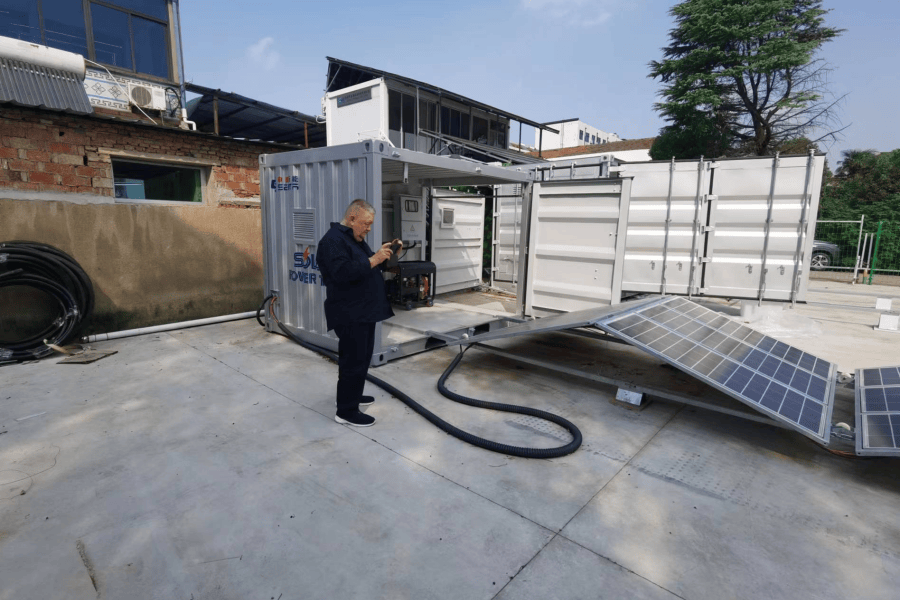
Table of Contents
- The Grid Stability Puzzle: It's Not Just About Capacity
- Why "Modular" is More Than a Buzzword
- A Case Study in Resilience: Powering Remote Philippines
- Translating Lessons to Our Markets: California & North Rhine-Westphalia
- The Tech Beneath the Surface: C-rate, Thermal Management & LCOE
- Building a Future-Proof System: What to Look For
The Grid Stability Puzzle: It's Not Just About Capacity
Honestly, after two decades on sites from Texas to Bavaria, I've seen a pattern. Many commercial and industrial clients, even utilities, approach battery storage with a single-minded focus: megawatt-hours. More is better, right? But the real headache often starts after the ribbon-cutting ceremony. You've got this massive, monolithic battery system, and when a single cell module fails or performance degrades unevenly, the entire asset's output can be compromised. Downtime for maintenance means zero revenue, and future expansion? That's a costly, complex retrofit. The problem isn't storage capacity - it's system inflexibility and operational fragility.
Why "Modular" is More Than a Buzzword
This is where the conversation gets real. A truly modular Battery Energy Storage System (BESS) isn't just about stacking containers. It's about independence. Think of it like building with high-performance LEGO blocks. Each block - a battery rack or power conversion unit - operates autonomously. If one needs service, you isolate and replace it without taking the whole system offline. This philosophy was born out of necessity in the most demanding environments, far from the structured grids of Europe or North America. Places where reliability isn't a metric, it's a lifeline. I've seen this firsthand on site: a well-designed modular system turns capex from a massive upfront bet into a manageable, scalable investment.
A Case Study in Resilience: Powering Remote Philippines
Let's talk about a project that changed my perspective. In the remote islands of the Philippines, communities relied on expensive, noisy, and polluting diesel generators. Fuel supply was erratic, costs were sky-high. The goal was rural electrification, but slapping some solar panels onto the diesel grid would just create instability - diesel gensets can't handle the wild swings from cloud cover.
The solution was a scalable modular hybrid solar-diesel system. The core was a modular BESS, built from standardized, containerized units. It did three things brilliantly: 1) It soaked up solar generation during the day, allowing the diesel gensets to shut down completely, saving 60-70% on fuel. 2) It provided instant grid-forming power to handle load steps and solar intermittency, protecting the generators. 3) Its modular nature meant the system could start small and expand as the community's needs grew, village by village. This wasn't a lab experiment; it was a real-world stress test for modular, scalable storage in harsh conditions.

Translating Lessons to Our Markets: California & North Rhine-Westphalia
You might think, "That's off-grid. My challenges are different." But are they? Let's look closer to home.
In California, a commercial microgrid project for a large food processing plant faced similar "intermittency" issues, but from the grid side. Public Safety Power Shutoffs (PSPS) and time-of-use charges were killing their bottom line. They needed resilience and cost control. Deploying a massive, single BESS was financially risky. Instead, they opted for a phased, modular approach. Phase one covered critical cold storage. Phase two, added a year later, expanded to cover the entire processing line. Each phase used identical, UL 9540-certified modules. This cut down commissioning time for phase two by over 50% and kept the plant operational during construction.
In Germany's North Rhine-Westphalia, an industrial park with high solar penetration was facing grid connection constraints and needed to provide primary frequency response (FCR) services. The grid operator required stringent compliance with IEC 62933 and VDE-AR-E 2510-50 standards. A monolithic system would have been a compliance nightmare for any future expansion. A modular BESS, where each unit is independently certified and can be precisely dialed into the required response profile, provided the perfect solution. It allowed the park to participate in the FCR market from day one with a small unit and scale its revenue stream as more tenants moved in.
The Data Behind the Need
The National Renewable Energy Laboratory (NREL) highlights that flexibility and scalability are now key drivers for BESS adoption in mature markets, not just cost-per-kWh. Meanwhile, the International Energy Agency (IEA) notes that system-level performance and longevity are becoming bigger financial determinants than simple cell chemistry.
The Tech Beneath the Surface: C-rate, Thermal Management & LCOE
Okay, let's get technical for a minute, but I promise to keep it in plain English. The magic of a good modular system isn't just in the connectors; it's in the core engineering.
- C-rate (The "Athleticism" of Your Battery): This is basically how fast you can charge or discharge the battery. A 1C rate means full discharge in one hour. For grid stability, you often need high C-rates (like 2C or 4C) for quick bursts of power. A modular system lets you optimize different blocks for different jobs - some for high-power, short-duration frequency response, others for high-energy, longer-duration solar shifting.
- Thermal Management (The Unsung Hero): Heat is the enemy of battery life. In a large, monolithic system, hot spots can develop and degrade the whole pack. Independent thermal management in each module is crucial. It's like having individual climate control in every room of a house, versus one thermostat for the whole building. This granular control is what we insisted on for the Philippine project and is now standard in our Highjoule systems - it's what ensures your 20-year performance warranty isn't just words on paper.
- LCOE (Levelized Cost of Energy - The True Cost): This is the big one for CFOs. It's the total lifetime cost of your energy asset divided by the energy it produces. A cheaper, non-modular system that fails early or has huge downtime has a terrible LCOE. A modular system with higher upfront cost but near-zero downtime, easy repairs, and seamless expansion actually delivers a lower LCOE over 15-20 years. It de-risks your investment.

Building a Future-Proof System: What to Look For
So, what does this mean for you, whether you're planning a microgrid, a C&I peak-shaving project, or a utility-scale storage farm?
Look for a partner who thinks in blocks, not monoliths. The hardware - like our Highjoule H-series modules - must be pre-certified (UL/IEC/IEEE) as standalone units. The software must be able to orchestrate a fleet of these units as one virtual power plant or let them operate independently. Service should mean swapping a module in hours, not diagnosing a whole system for weeks.
The lesson from remote Philippines is universal: resilience comes from intelligent design, not just brute force. It's about building a system that can adapt, grow, and heal itself. That's the kind of future-proofing that makes financial sense on both sides of the Atlantic.
What's the one scalability constraint in your current project plan that keeps you up at night?
Tags: UL Standard LCOE Optimization BESS Modular Energy Storage Grid Stability IEC Standard Scalable Design
Author
James Zhang
20+ years agricultural energy storage engineer / Highjoule CTO