
Maximizing ROI with High-voltage DC Off-grid Solar Generators for Military Bases
Beyond the Grid: A Real-World Look at ROI for Military Base Energy Independence
Hey there. Let's grab a virtual coffee. Over the last two decades on job sites from California to Bavaria, I've had countless conversations with facility managers and engineers who are tasked with one of the toughest jobs out there: keeping the lights on and mission-critical systems running, no matter what. The push for energy resilience, especially for off-grid and tactical military installations, isn't just a trend - it's a pressing operational imperative. But honestly, the business case has often been... murky. Today, I want to cut through the noise and talk plainly about what really drives the ROI Analysis of High-voltage DC Off-grid Solar Generator for Military Bases. It's not just about buying solar panels and batteries; it's about designing a system that pays for itself by solving real, expensive problems.
Jump to a Section
- The Real Cost of "Business as Usual"
- Why Efficiency Losses Are a Budget Killer
- The High-Voltage DC Advantage: Simpler, Tougher, Smarter
- Field Report: A European Forward Operating Base
- Decoding the Tech That Drives ROI
- Your Move: Framing the Investment
The Real Cost of "Business as Usual"
We all know the traditional setup: diesel generators. They're loud, they're a huge thermal signature, and they require a constant, vulnerable logistics chain for fuel delivery. I've been on sites where the fuel convoy itself was a major security and cost headache. The problem isn't just the price per gallon; it's the fully burdened cost of energy - the transportation, the guard force, the storage, and the maintenance. Every time prices spike or a supply line gets interrupted, the entire operation is at risk. Furthermore, generators are notoriously inefficient at partial load, which is how they run most of the time, burning fuel and money without delivering proportional power.
Why Efficiency Losses Are a Budget Killer
Here's where the conversation gets technical, but stick with me - it's where the money hides. A standard commercial off-grid system often uses solar panels that generate direct current (DC), converts it to alternating current (AC) for the base, then right back to DC to charge the battery bank, and then back to AC again for most loads. Every one of those conversions, handled by inverters and rectifiers, loses energy - anywhere from 2% to 8% per step. Over a year, that adds up to a staggering amount of wasted solar energy you paid for but never get to use. According to the National Renewable Energy Lab (NREL), system architecture can impact overall efficiency by 10% or more. In an ROI analysis, that's not a minor detail; it's the difference between a 7-year and a 10-year payback.
The High-Voltage DC Advantage: Simpler, Tougher, Smarter
This is where the high-voltage DC off-grid approach changes the game. The core idea is elegant in its simplicity: keep as much of the system as possible on a native high-voltage DC bus. Modern solar arrays and advanced battery energy storage systems (BESS) like the ones we engineer at Highjoule Technologies are inherently DC. By minimizing AC-DC conversion stages, we can push system efficiency above 97% from solar input to battery storage. Fewer conversion steps also mean fewer points of failure, higher reliability, and a simpler system - which, from my on-site experience, translates directly into lower maintenance costs and higher uptime. For a military base, reliability isn't a feature; it's the requirement.
When we design these systems, compliance isn't an afterthought. Every component and the integrated system is built from the ground up to meet and exceed the rigorous safety and performance benchmarks demanded by UL 9540 for energy storage and IEEE 1547 for grid interconnection (even in islanded mode, the principles apply). This isn't just about ticking boxes; it's about risk mitigation. A properly certified system significantly de-risks the deployment and ensures long-term operational safety.
Field Report: A European Forward Operating Base
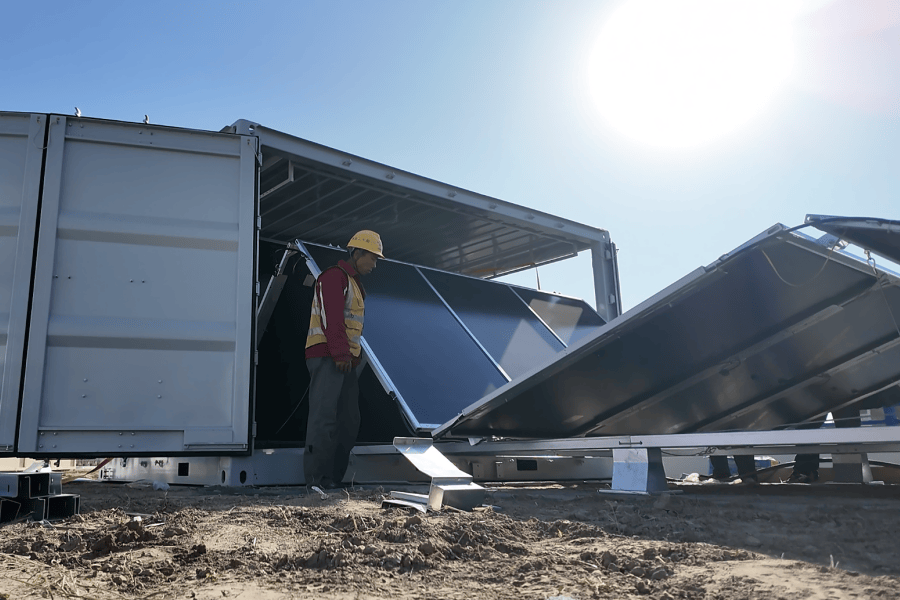
Let me give you a real example, though specifics are naturally guarded. We deployed a containerized Highjoule BESS integrated with a high-voltage DC solar field for a NATO-affiliated forward operating base in Southern Europe. Their challenge was classic: reduce diesel consumption by over 70%, eliminate daytime generator runtime entirely, and create a silent, zero-emission backup for critical comms and surveillance infrastructure.
The solution was a 1.5MW/3MWh system. The key was our DC-coupled architecture. The solar arrays feed directly onto a 1500V DC bus, which charges the battery racks and powers compatible DC loads (which are more common in modern facilities than you might think). An inverter only engages when needed for specific AC loads. The result? They hit their 70% fuel reduction target in the first year of operation. The reduced generator runtime has slashed maintenance intervals and parts replacement costs. The thermal management system - a closed-loop liquid cooling - keeps the battery at optimal temperature even in 45C (113F) heat, ensuring performance and longevity. This directly impacts the Levelized Cost of Energy (LCOE), making the renewable source cheaper than the diesel alternative over the project's life.

Decoding the Tech That Drives ROI
When you're reviewing an ROI analysis, don't just look at the bottom-line number. Ask about the engineering choices behind it.
- C-rate & Battery Life: A battery's C-rate is basically how fast you can charge or discharge it. For base load applications, you don't need an extremely high C-rate. Opting for a moderate C-rate (like 0.5C) over an ultra-high one reduces stress on the battery, dramatically extending its cycle life. This is the single biggest factor in long-term ROI. A battery that lasts 15 years instead of 10 completely transforms the financial model.
- Thermal Management: This is non-negotiable. I've seen air-cooled systems in the desert struggle, with capacity fading fast. Active liquid cooling, like in our Highjoule units, maintains a uniform temperature. It costs a bit more upfront but prevents expensive degradation, safeguarding your capital investment.
- LCOE - The True Metric: The Levelized Cost of Energy bundles all costs - capital, installation, O&M, fuel - over the system's life. A high-efficiency, durable high-voltage DC system will have a lower LCOE than a less efficient, conversion-heavy AC system or a diesel generator. That's the number that wins the budget debate.
Your Move: Framing the Investment
So, where does this leave you? When you're evaluating a ROI Analysis of High-voltage DC Off-grid Solar Generator for Military Bases, shift the mindset from "project cost" to "total cost of ownership and mission assurance." The right system isn't an expense; it's a force multiplier. It reduces logistical vulnerability, enhances stealth, and provides predictable energy costs for decades.
The technology is here, it's proven, and it's financially compelling. The question isn't really if this is the future for resilient base power. The question is, what's the cost of waiting? What could a 30% reduction in your energy logistics footprint free up for other critical missions?
I'd love to hear what your biggest hurdle is when trying to build the case for energy resilience. Is it the upfront CAPEX, the technology uncertainty, or something else? Let's talk.
Tags: UL Standard BESS LCOE Off-grid Solar ROI Analysis High-voltage DC Military Energy Security IEEE
Author
James Zhang
20+ years agricultural energy storage engineer / Highjoule CTO