
ROI Analysis: Liquid-cooled Off-grid Solar Generators for Military Base Energy Security
Beyond the Diesel Gen: A Real-World Look at Energy ROI for Critical Sites
Hey there. If you're reading this, chances are you're weighing some serious energy decisions for a critical facility. Maybe it's a forward operating base, a remote communications site, or a domestic installation prioritizing resilience. For over two decades, I've been on the ground at sites just like yours, from the deserts to the Arctic Circle, wrestling with the same core problem: how to guarantee 100% uptime without getting crushed by fuel costs and logistical nightmares. Honestly, the old paradigm is breaking. Let's talk about what comes next, and more importantly, how to justify the investment.
Quick Navigation
- The Real Cost of "Business as Usual"
- Why Traditional ROI Calculations Stumble
- Case in Point: A Shift in Deployment Strategy
- Building Your Own ROI Analysis: Key Levers to Pull
The Real Cost of "Business as Usual"
We all know the traditional setup: a massive array of diesel generators, a fuel convoy that's a security vulnerability in itself, and the constant hum (and fumes) that gives away a position from miles away. The initial CapEx seems low, so the spreadsheet often looks favorable. But I've seen this firsthand on site C that spreadsheet lies. It ignores the true operational drag.
Think about the fully-burdened cost of fuel. A study by the National Renewable Energy Laboratory (NREL) highlights that delivered fuel costs in conflict or remote zones can be 10-100 times higher than stateside pump prices. Every gallon needs armed escort. Every generator needs frequent maintenance, and good luck getting a certified technician out there quickly. Downtime isn't just an inconvenience; it's a mission risk. The real "cost" includes vulnerability, force protection resources, and strategic flexibility lost.
Why Traditional ROI Calculations Stumble
When we run a standard ROI Analysis of Liquid-cooled Off-grid Solar Generator for Military Bases, we often make a critical error. We compare the upfront cost of a solar-plus-storage microgrid to just the generator's price tag. That's like comparing the cost of buying a farm to the cost of a single restaurant meal. You're not comparing the same things.
The new system's value is in eliminating recurring costs and risks. A properly designed off-grid system with advanced battery storage slashes or even zeroes out the fuel line item. It dramatically reduces maintenance visits. It provides silent, emissions-free power that enhances stealth and reduces the facility's thermal signature. How do you put a dollar value on increased operational security or the ability to sustain operations if supply lines are cut? You have to. That's where a modern, holistic ROI analysis starts.
The Liquid-Cooling Advantage: More Than Just a Feature
Now, let's get technical for a moment, but I'll keep it simple. Any battery system's heart is its thermal management. Air-cooled systems, common in early BESS, struggle with hot climates and high-power demands. They create hotspots, leading to faster degradation C meaning your battery's capacity and lifespan take a hit. This directly destroys your ROI.
Liquid cooling, like what we engineer into our systems at Highjoule, is a game-changer. It's like comparing a basic fan to a precision car radiator. The liquid pulls heat away from each cell uniformly. This allows two crucial things:
- Higher, Sustained C-Rate: The battery can safely discharge at a higher power (C-rate) when needed C for starting large loads or during peak demand C without overheating. This means you can potentially size the battery bank smaller for the same power output.
- Doubling the Lifespan: By maintaining an optimal, stable temperature, cell degradation slows dramatically. Where an air-cooled system might see significant capacity loss in 5-7 years, a liquid-cooled system can reliably operate for 15+ years. This is the single biggest lever on Levelized Cost of Energy (LCOE) C the total lifetime cost per kWh. Longer life = lower LCOE.
This isn't just lab theory. On a project in the Middle East, moving to a liquid-cooled design allowed us to meet the client's extreme 2C peak power requirement while still guaranteeing a 15-year performance warranty. The air-cooled alternative simply couldn't pass the stress tests without derating, which would have meant a much larger, more expensive system.

Safety & Compliance: Non-Negotiable Foundations
Of course, none of this matters without absolute safety. For any critical installation, compliance with UL 9540 (the standard for BESS safety) and IEEE 1547 (for grid interconnection) is the baseline. Our design philosophy goes beyond passing the test. It's about designing out failure modes. From cell-level fusing to full-scale fire suppression integrated into the thermal management loop, every layer is there to protect personnel and mission. This reduces insurance premiums and, more importantly, catastrophic risk C another "soft" ROI factor that's hard to overstate.
Case in Point: A Shift in Deployment Strategy
Let me share a relevant example, though I'll keep specifics generic for security. A U.S. National Guard facility in a wildfire-prone region needed a resilient backup power solution. Their old diesel generators were unreliable if not constantly exercised, and refueling during a regional emergency was a low priority.
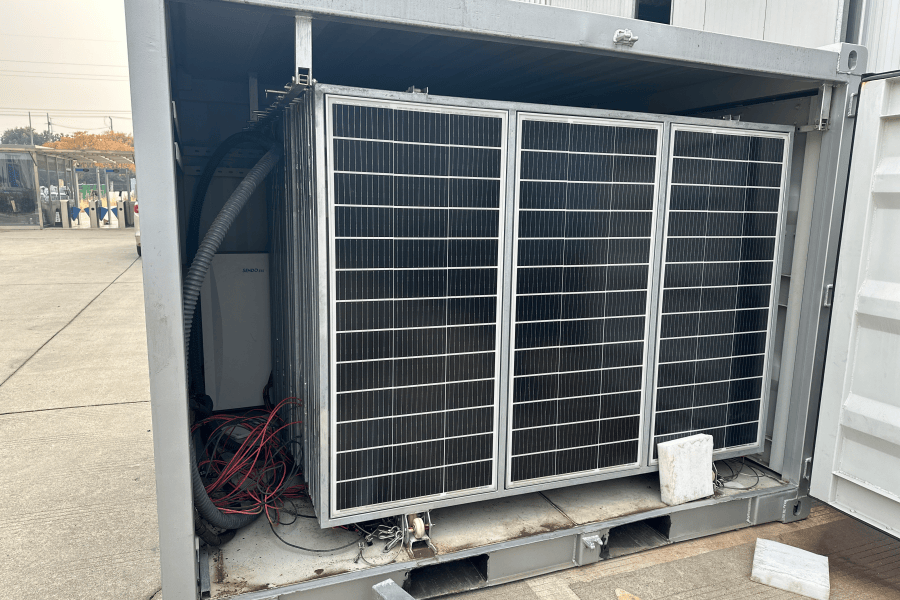
The challenge was creating an off-grid capable system that could also participate in local utility demand-response programs when the grid was up, creating a revenue stream. The solution was a containerized, liquid-cooled BESS paired with a solar canopy. The thermal stability of liquid cooling was critical because the container had to be sited in an area with high ambient summer temperatures.
The ROI analysis became compelling when we factored in:
- Elimination of generator maintenance contracts.
- Revenue from grid services (validated by the local utility's tariff structure).
- State energy resilience grants that covered a portion of the CapEx.
- The avoided cost of potential mission failure during a public safety power shutoff.
The payback period dropped from a theoretical 12 years to under 7. The command now views it not as a cost, but as a strategic, revenue-generating asset that guarantees their operational readiness.
Building Your Own ROI Analysis: Key Levers to Pull
So, how should you frame your own analysis? Move beyond simple payback. Build a model that includes:
| Cost Factor | Traditional Generator | Solar + Liquid-cooled BESS |
|---|---|---|
| Fuel (Fully Burdened) | Very High, Recurring, Volatile | Near Zero |
| Preventive Maintenance | High (Oil, filters, parts, labor) | Very Low (Primarily HVAC/filter checks) |
| System Lifespan | ~10-15 years (with major overhauls) | 15-20+ years for BESS, 25+ for solar |
| Operational Security Risk | High (Logistics, signature, emissions) | Dramatically Reduced |
| Scalability / Flexibility | Incremental (add another gen set) | Modular (add more containers) |
Work with a partner who understands both the technology and your operational constraints. At Highjoule, our deployment teams are used to working with stringent specs. We don't just drop off a container; we provide the ongoing performance monitoring and localized support to ensure the system delivers the ROI we modeled, year after year.
The question isn't really if advanced off-grid solar makes sense for critical sites. The data is overwhelming. The real question is: what's the cost of waiting? What's the next fuel convoy or generator failure going to cost you, in dollars and in mission capability? Let's have that conversation over a proper coffee sometime.
Tags: UL Standard BESS Liquid Cooling ROI Analysis Off-grid Solar Generator Military Energy Security
Author
James Zhang
20+ years agricultural energy storage engineer / Highjoule CTO