
ROI Analysis of Scalable Modular 5MWh Utility-scale BESS for Public Utility Grids
Contents
- The Grid Dilemma: More Renewables, More Problems
- The ROI Puzzle: Why Bigger Isn't Always Better
- The Scalable, Modular 5MWh Unit: Your Financial and Technical Sweet Spot
- Breaking Down the ROI: It's More Than Just Capex
- A Case in Point: The Texas Balancing Act
- The Hidden ROI Factors You Can't Ignore
- Making the Leap: What to Look For
The Grid Dilemma: More Renewables, More Problems
Let's be honest, if you're managing a public utility grid in North America or Europe right now, you're living a paradox. Your mandate is clear: integrate more wind and solar. The IEA states renewables are set to contribute 80% of new power capacity globally through 2030. But every new MW of intermittent generation you add makes your grid a bit more... nervous. The duck curve in California isn't a theory; it's a daily operational headache. Frequency dips, congestion, the need for rapid ramping C these aren't future challenges. I've seen control rooms where operators are literally riding the curves, praying the gas peakers fire up fast enough.
The old solution C building a massive, single-purpose gas plant for a few hundred hours of peak use a year C feels financially reckless and environmentally tone-deaf today. You need flexibility. You need a shock absorber. That's where utility-scale Battery Energy Storage Systems (BESS) come in. But here's the kicker: just wanting storage isn't enough. You need storage that makes financial sense. And that's where most of the industry chatter falls short.
The ROI Puzzle: Why Bigger Isn't Always Better
Early in the utility-scale storage game, the thinking was monolithic. "Need 100MWh? Let's build a 100MWh fortress on a 5-acre plot." Honestly, I've been on sites where these behemoths were being commissioned, and the complexity was staggering. The financial model was often just as rigid. You'd get a simple payback calculation based on one or two revenue streams, like energy arbitrage.
The problem? This approach locks you in. Grid needs evolve. Market rules change (look at FERC Order 2222 in the US). If your technology or capacity isn't adaptable, your ROI evaporates. A 2023 NREL study on storage costs and performance highlights how Levelized Cost of Storage (LCOS) varies wildly based on use case and duration. Deploying a one-size-fits-all behemoth often means you're leaving 30-40% of potential revenue on the table because it can't efficiently chase the most lucrative grid services at any given moment.

The Scalable, Modular 5MWh Unit: Your Financial and Technical Sweet Spot
This is where the concept of a scalable, modular 5MWh utility-scale BESS changes the ROI conversation entirely. Think of it as the building block of a modern, resilient grid. Instead of one massive, inflexible asset, you're deploying a fleet of intelligent, interoperable units.
From my two decades on site, the advantages for a public utility are crystal clear:
- Phased Investment: Match capital expenditure to actual grid growth and regulatory certainty. Start with 20MWh, add 5MWh blocks as demand increases.
- Disperse for Resilience: Place 5MWh units at strategic substations to relieve local congestion, defer costly transmission upgrades, and improve community-level resilience. This geographic flexibility is a huge, often underestimated, part of the value stack.
- Technology Agnosticism: Battery tech is improving fast. A modular architecture lets you potentially adopt newer, better chemistry in future blocks without scrapping your entire initial investment.
Breaking Down the ROI: It's More Than Just Capex
When we at Highjoule Technologies work with utilities on an ROI analysis for a modular approach, we look at a multi-layered value stack. The initial capital cost per kWh is just the entry ticket.
A Case in Point: The Texas Balancing Act
Let me give you a real example. We worked with a municipal utility in Texas that was facing severe evening ramping challenges due to nearby solar farms. Their need was about 15MWh of capacity, but budget and space were constrained.
Challenge: They needed fast response, high reliability, and the ability to potentially expand. A traditional single-unit system would have been overkill for their immediate need and a nightmare to permit on their limited substation footprint.
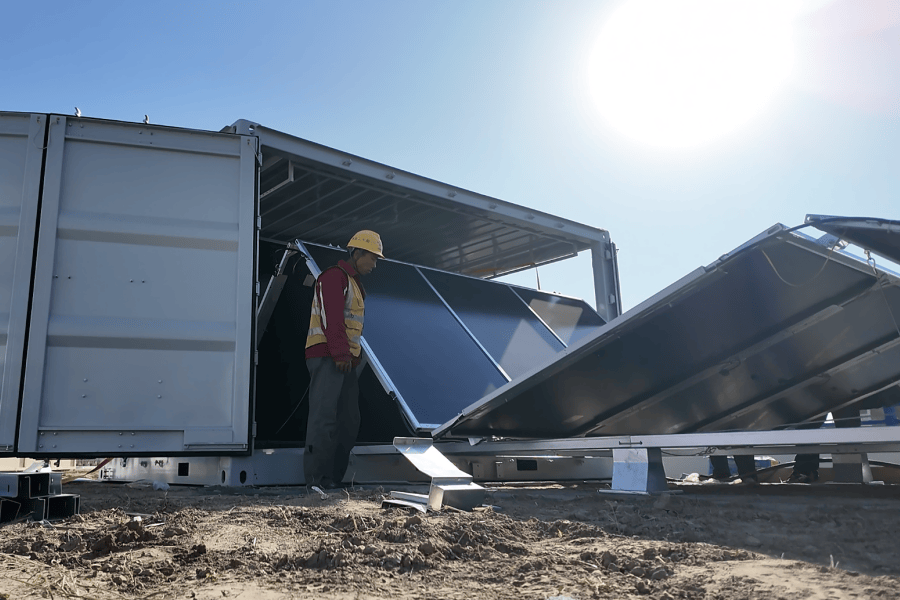
Solution: We deployed three of our 5MWh modular BESS units. They were installed in under a week. The key was the C-rate C a term that just means how fast the battery can charge or discharge relative to its size. A higher C-rate (like 1.5C or 2C) means more power (MW) from the same energy capacity (MWh). Our units have a configurable C-rate, so they could deliver a high-power "burst" for frequency events while still having enough duration for energy shifting.
Outcome: The system now earns from ERCOT's frequency response market daily, smoothes the solar output, and provides local backup. The modular design allowed them to use space they already owned, and their board has already approved adding a fourth unit next year. The ROI timeline shortened because they could generate revenue from day one, phase the spend, and adapt to market signals.
The Hidden ROI Factors You Can't Ignore
Beyond the spreadsheet, there are softer, crucial ROI factors. Safety and Compliance is not a cost center; it's an ROI protector. A single fire incident can wipe out years of projected revenue and cause irreparable brand damage. Insisting on UL 9540A test-certified enclosures and a robust thermal management system isn't us being cautious; it's us protecting your multimillion-dollar investment and community trust.
Then there's O&M. A decentralized fleet of identical 5MWh units simplifies everything. Spare parts inventory is smaller. Technician training is faster. If one unit needs service, you don't take your entire 100MWh asset offline. You lose 5MWh, and the others pick up the slack. This operational resilience has a direct, positive impact on your long-term ROI.

Making the Leap: What to Look For
So, when you're evaluating a ROI Analysis of a Scalable Modular 5MWh Utility-scale BESS, push your vendors on the details. Ask them how their thermal system works in your specific climate. Demand to see the UL and IEC certificates C don't just take a "designed to meet" statement. Challenge them to model at least four different revenue streams in their financial analysis.
The goal isn't just to buy a battery. It's to deploy a flexible financial asset that strengthens your grid for the next 20 years. The modular, scalable approach isn't just a technical design choice; it's the most prudent financial strategy for utilities navigating an energy landscape that refuses to stand still.
What's the single biggest grid constraint you're facing that a flexible asset could solve? Is it transmission, frequency, or something else entirely?
Tags: BESS LCOE UL Standards Renewable Integration IEEE Standards ROI Analysis Utility-Scale Energy Storage Grid Stability Modular Battery Systems
Author
James Zhang
20+ years agricultural energy storage engineer / Highjoule CTO