
ROI Analysis of Scalable Modular Industrial ESS for EV Charging
Contents
- The Hidden Cost of "Just Plugging In" More EVs
- When the Grid Says "No": The Demand Charge Killer
- The Scalable, Modular Industrial ESS: Your Financial and Operational Shock Absorber
- Breaking Down the Real-World ROI: A California Case Study
- From the Field: Key Technical Levers That Drive Your ROI
- Building a Future-Proof Charging Hub
The Hidden Cost of "Just Plugging In" More EVs
Honestly, I've been in this field long enough to see a pattern. A business - a logistics park in Germany, a fleet depot in Texas - decides to go big on EV charging. The vision is clear: support sustainability, meet new customer or regulatory demands. The initial plan often focuses on the chargers themselves, the software, the stalls. But there's a massive, often overlooked, piece of the puzzle: the grid connection. It's not just about having enough power; it's about when you use it and at what cost. Deploying a dozen 150kW+ fast chargers without a buffer is like trying to drink from a firehose - you get the water, but the pressure and the cost can break the system.
When the Grid Says "No": The Demand Charge Killer
Let's talk numbers, because this is where the pain becomes real. According to the National Renewable Energy Lab (NREL), demand charges - fees based on your peak power draw in a billing period - can constitute 30% to 70% of a commercial site's electricity bill. Now, imagine six trucks plugging in for a simultaneous fast charge at 7 AM. That instantaneous spike becomes your "demand" for the entire month, and the utility charges you a premium for it. I've seen firsthand on site how a single month of unmanaged charging can turn a projected profit into a loss.
The other harsh reality is grid capacity. In many industrial zones in Europe and the US, the physical infrastructure simply can't support a large-scale EV charging hub without prohibitively expensive grid upgrades. The local utility might quote you a 2-year timeline and a seven-figure sum to bring in a new substation or heavier lines. This isn't a hypothetical; it's a daily conversation we have with project developers.
The Scalable, Modular Industrial ESS: Your Financial and Operational Shock Absorber
This is where the ROI analysis of a scalable, modular Industrial Energy Storage System (ESS) container shifts from a "nice-to-have" to the core of a viable business case. Think of it not as an added cost, but as a strategic asset that manages your most volatile operational expense: grid power.
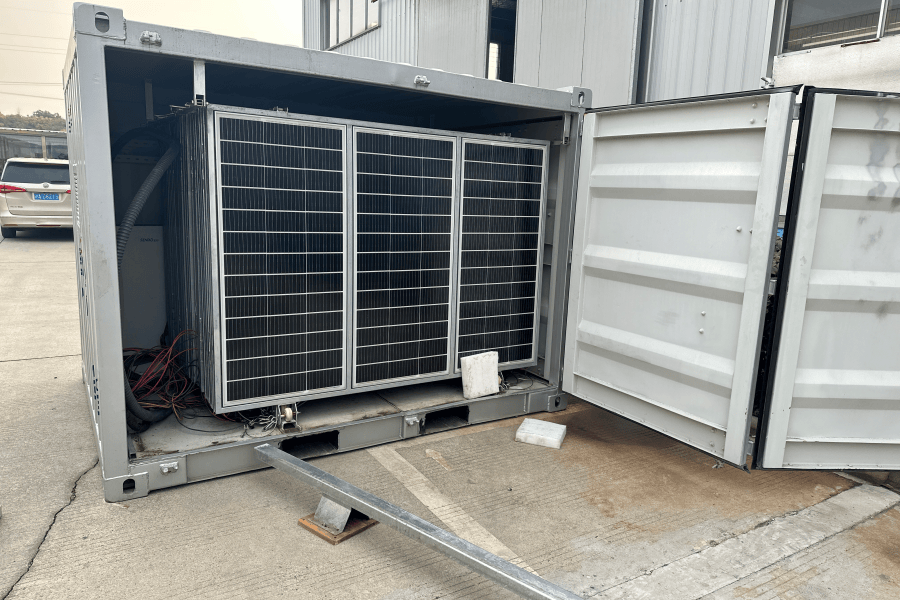
A modular BESS container works like a giant, intelligent battery bank. It charges slowly and steadily from the grid overnight or during off-peak hours when rates are low. Then, during the day, when your chargers are humming and grid power is expensive, it discharges to supplement or even temporarily replace grid power. It flattens that demand spike, saving you thousands in demand charges every month. More importantly, its modular nature means you don't overbuild. You start with what you need for today's 10 chargers, and as your fleet or customer base grows, you simply add more pre-integrated battery modules or additional containers. This "pay-as-you-grow" scalability is a game-changer for financial planning.

Breaking Down the Real-World ROI: A California Case Study
Let me walk you through a project we did with Highjoule for a regional distribution center in Southern California. They needed to power 8 new fleet charging stalls but faced a $850k grid upgrade quote and punishing Southern California Edison demand charges.
The Challenge: Avoid the upgrade, manage demand charges, and ensure 24/7 uptime for critical logistics operations.
The Highjoule Solution: We deployed a single 1 MWh modular ESS container, pre-certified to UL 9540 and UL 1973 standards (non-negotiable for insurance and permitting here). The system was sized to shave the peak demand from simultaneous charging events and provide backup power to the critical load panel.
The ROI Breakdown (Simplified):
- Capital Avoided: Saved $850k on grid upgrade.
- Monthly Demand Charge Savings: Reduced peak by 80%, saving ~$12,000/month.
- Energy Arbitrage: Charging at night (low rate) vs. daytime discharge saved ~$1,500/month.
- System Cost (incl. installation & our GridSync? controller): ~$550k.
With over $13k in monthly savings, the simple payback period landed under 3.5 years. And the container is designed for a 15-year life. That's over a decade of positive cash flow and operational resilience they wouldn't have had otherwise. The local fire marshal and utility approved the plan quickly because of the recognized UL standards.
From the Field: Key Technical Levers That Drive Your ROI
When we run these analyses for clients, we drill into specifics that generic models miss. Here's what matters:
- C-rate Isn't Just Tech Spec: It's a cost and longevity driver. A battery with a higher C-rate can discharge faster, meaning you might need a smaller capacity unit to meet a short, high-power peak. But pushing high C-rates constantly stresses the battery. Our design uses a moderate C-rate chemistry optimized for daily cycling, which extends lifespan and protects your long-term ROI. We're not building a race car; we're building a reliable daily driver.
- Thermal Management = Asset Life: Heat is the enemy of batteries. I've opened containers where the thermal design was an afterthought, and the degradation is visible. Our systems use a liquid-cooled thermal management system that maintains an even temperature. This might add a bit upfront, but it's the single biggest factor in hitting that 15-year design life, protecting your investment.
- Thinking in LCOE (Levelized Cost of Storage): Don't just look at the upfront $/kWh of the battery. Look at the total cost over its life, including installation, maintenance, degradation, and software. A cheaper system that degrades 30% faster or needs expensive specialist servicing will have a much higher LCOE. Our modular design allows for easy, low-cost module swaps if needed, keeping the LCOE predictably low.

Building a Future-Proof Charging Hub
The conversation is evolving. It's no longer just about saving on demand charges. Forward-thinking sites are looking at their BESS as a grid asset - participating in demand response programs, providing frequency regulation services. A well-designed, modular system from Highjoule, compliant with local IEEE 1547 standards for grid interconnection, is built with this future revenue stack in mind. The controller we include is software-upgradable to tap into these value streams as they become available in your region.
The bottom line? A proper ROI analysis for an EV charging project must start with the grid constraint and the demand charge reality. The scalable, modular industrial ESS container isn't an extra line item; it's the enabling technology that makes the entire project financially viable and operationally robust. It turns a grid problem into a competitive advantage.
What's the single biggest grid constraint you're facing in your next EV charging deployment?
Tags: UL Standard BESS Industrial Energy Storage ROI Analysis EV Charging Modular ESS
Author
James Zhang
20+ years agricultural energy storage engineer / Highjoule CTO