
Air-Cooled BESS Installation: Streamlining Mining Operations in Remote Sites
When Your Energy Storage Project is an Expedition: The Real Cost of Complexity
Honestly, after two decades on sites from the Australian Outback to the Chilean highlands, I've learned one thing: deploying energy storage in remote, demanding environments like mining operations is less about pure engineering and more about logistics, risk management, and frankly, sheer grit. I've seen firsthand how a "standard" Battery Energy Storage System (BESS) deployment can turn into a months-long puzzle of coordinating dozens of suppliers, managing complex on-site assembly, and wrestling with thermal management in 45C heat. The promise of lower operational costs and sustainability gets buried under unforeseen delays and ballooning CapEx. This isn't just a hunch; it's the core challenge I see our clients in the Americas and Europe facing when they look to power remote assets reliably and cleanly.
What You'll Learn in This Guide
- The Hidden Cost of "Field Integration"
- Why Air-Cooling Isn't a Compromise Anymore
- A Blueprint from the Mauritanian Desert
- Beyond the Container: The Real-World Impact
The Hidden Cost of "Field Integration"
Let's talk about the traditional approach. You order a container, the batteries from one vendor, the power conversion system (PCS) from another, the fire suppression and thermal management as separate units. They all arrive on different ships, at different times, to a site with limited skilled labor. The integration and commissioning phase becomes a high-stakes, high-cost endeavor. Every day of delay means lost revenue. A National Renewable Energy Laboratory (NREL) analysis highlights that balance-of-system (BOS) and soft costs can constitute up to 50% of total BESS project costs, a figure that skyrockets in remote areas.
The pain point isn't just financial. It's about safety and performance. Mismatched components, field-wired connections under dust and time pressure C each is a potential point of failure. For a mining operation where uptime is directly tied to profitability, this operational risk is a non-starter. You need predictability.
Why Air-Cooling Isn't a Compromise Anymore
I often get asked about liquid cooling vs. air cooling. The industry narrative pushes liquid as the "premium" solution. But here's my field insight: for many commercial and industrial applications, especially in arid or temperate climates, modern air-cooled systems are not just adequate, they are superior in simplicity and total cost of ownership. The key is in the design and integration.
A well-engineered air-cooled system uses intelligent airflow management, high-efficiency fans, and cell-level monitoring to maintain optimal temperature. It eliminates the risk of coolant leaks, reduces maintenance complexity, and cuts parasitic load. When you're 200 miles from the nearest service center, simplicity equals reliability. This directly optimizes your Levelized Cost of Energy Storage (LCOS) C the metric that truly matters for your CFO.
A Blueprint from the Mauritanian Desert
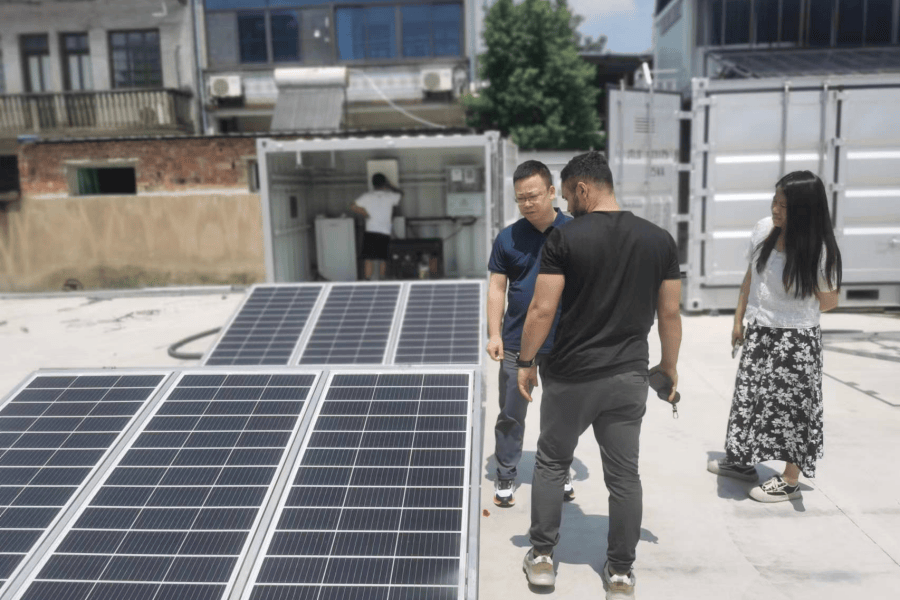
Let me walk you through a project that crystallizes this philosophy. We recently deployed a pre-integrated, air-cooled PV container system for an iron ore mining operation in Mauritania. The challenge was classic: reduce diesel dependency at a remote processing plant with extreme heat, abrasive dust, and zero local BESS expertise.
The solution was our "plug-and-play" approach:
- Step 1: Factory Integration & FAT. The entire system C UL 9540-certified battery racks, PCS, HVAC, fire suppression, and controls C was assembled and tested in our controlled facility. The client witnessed a Full Factory Acceptance Test (FAT) over video link. This meant the system shipped not as a thousand parts, but as one validated solution.
- Step 2: Simplified Logistics. Instead of 15 separate shipments, we had one. The pre-integrated container was the only major item. This slashed customs clearance time and on-site receiving headaches.
- Step 3: Foundation & Placement. On-site, the prep work was minimal: a simple level concrete pad. The container was lifted from the truck and placed. The most physically demanding part was done.
- Step 4: Connection & Commissioning. Here's where the magic paid off. With pre-wired and pre-tested interfaces, our two-person crew had the system connected to the site's PV array and medium-voltage switchgear in under a week. The intelligent BMS was already configured for the local climate, managing C-rate (charge/discharge speed) to balance performance and battery longevity in the heat.
From ship arrival to commercial operation took less than three weeks. The mining engineers, who were not BESS specialists, could focus on their core operation, not on becoming energy storage project managers.

Lessons for the European and US Market
You might think, "That's for a remote mine, my site in Nevada or Spain is more accessible." True, but the principles are universal. I've seen similar time and cost overruns on projects in Texas and Italy. The "Mauritania Model" proves that reducing on-site complexity is the single biggest lever for de-risking deployment, whether you're subject to strict IEEE 1547 grid codes in the US or seeking EU compliance. It's about shifting the integration risk from your windy, rainy, time-constrained site back to the vendor's controlled environment.
Beyond the Container: The Real-World Impact
So, what does this streamlined installation actually deliver? Beyond the obvious faster ROI, it's about creating a resilient, manageable asset. The system in Mauritania now provides predictable peak shaving, allowing the mine to run critical crushing equipment without expensive diesel spikes. The air-cooling system, designed for high ambient temperatures, operates efficiently with a clear maintenance schedule - filter changes our local crew can handle.
For companies like Highjoule, our job isn't just to sell a container. It's to deliver a guaranteed outcome: predictable energy costs and uptime. That's why our designs prioritize safety standards like UL 9540 and IEC 62619 from the ground up, not as an afterthought. It's why we obsess over LCOE in our technical whitepapers C because that's the number on your balance sheet. The pre-integrated, air-cooled approach is the vehicle to make that outcome a reality, not a risky promise.
The question for any asset owner or developer isn't just "what's the $/kWh of the battery?" It's "what's the total installed cost and operational risk by the time this system is live and earning?" The step-by-step process we refined in places like Mauritania provides a clear, low-risk answer. What's the single biggest logistical hurdle you're anticipating in your next BESS deployment?
Tags: UL Standard BESS Mining Operations Energy Storage Installation Remote Power
Author
James Zhang
20+ years agricultural energy storage engineer / Highjoule CTO