
Novec 1230 Fire Protection in Pre-integrated PV & BESS Containers for EV Charging
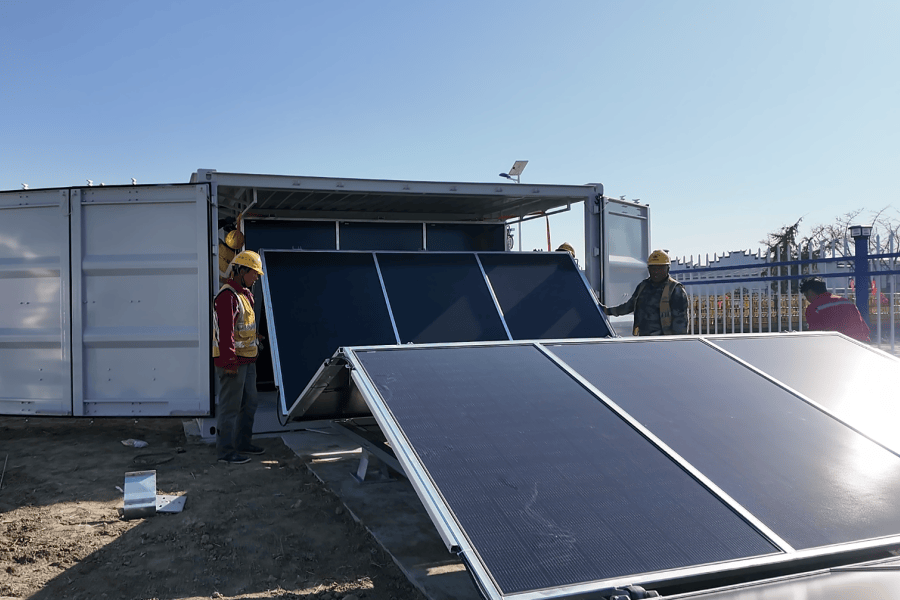
Table of Contents
- The Silent Risk in Your EV Charging Expansion Plan
- Beyond the Battery Cell: The Real Fire Safety Headache
- Enter the Pre-Integrated Container: A Game Changer, If Done Right
- Novec 1230 Deep Dive: Why It's Becoming the Go-To Choice
- A Real-World Balancing Act: Safety, Cost, and Speed
- Your Next Step: Asking the Right Questions
The Silent Risk in Your EV Charging Expansion Plan
Let's be honest. When you're planning a high-power EV charging hub, especially one backed by solar and on-site battery storage, the conversation is all about power ratings, grid connection queues, and of course, the all-important levelized cost of energy (LCOE). The fire suppression system inside the battery container? It often gets a line item in the spec sheet, but rarely the deep dive it deserves. I've seen this firsthand on site - a last-minute scramble to meet local fire marshal requirements can derail a project timeline and budget faster than a faulty inverter.
The trend is clear. The IEA reports that global EV sales surged in 2023, pushing demand for reliable, high-uptime charging infrastructure. These stations, particularly the fast-charging corridors, are increasingly paired with Battery Energy Storage Systems (BESS) and solar canopies to manage demand charges and ensure reliability. This creates a unique challenge: a compact, pre-fabricated container housing sensitive power electronics, lithium-ion batteries, and often the grid connection point, operating 24/7. It's a powerhouse, but it concentrates risk.
Beyond the Battery Cell: The Real Fire Safety Headache
Everyone talks about battery cell thermal runaway. But from an engineering and deployment perspective, the bigger, messier problem is containment and collateral damage. A fire event, whether initiated by a battery cell or a faulty electrical connection, inside a sealed container is a nightmare scenario. Traditional water-based systems can cause catastrophic short circuits and ruin millions of dollars in equipment, turning a manageable incident into a total loss. Clean agent systems are mandatory, but the choice of agent is where the real comparison happens.
You're not just protecting the battery rack. You're protecting the PV inverters, the medium-voltage switchgear, the climate control system, and the very structure of the container itself. The wrong suppression agent can leave corrosive residues, harm the environment, or simply not be effective enough to gain approval from authorities having jurisdiction (AHJs) who are, rightly, becoming more stringent. In the US, UL 9540A test data is now a key ask for many fire departments. In Europe, IEC 62933-5-2 standards loom large. Your fire suppression choice directly impacts your ability to get a permit.
Why This Comparison Matters Now
For years, FM-200 and other agents were common. But the industry is shifting. I was on a project in Texas last year where the local fire marshal rejected the initial system design because of environmental and toxicity concerns for nearby public access areas. We had to go back to the drawing board. This is the new reality. Your fire suppression system is no longer just a technical checkbox; it's a critical path item for environmental compliance, community safety, and insurance underwriting.
Enter the Pre-Integrated Container: A Game Changer, If Done Right
This is where the concept of the pre-integrated PV container for EV charging shines. It's a plug-and-play solution that bundles solar inversion, storage, and sometimes even the charging dispensers into a single, factory-built unit. The massive advantage is speed and quality control. At Highjoule, we've seen deployment times cut by 40% because most integration and testing happens in our controlled facility, not in a muddy field.
But here's the critical insight: the value of pre-integration is completely undermined if the safety systems are an afterthought or a generic add-on. The fire suppression system must be designed in tandem with the thermal management system (that's the HVAC and liquid cooling for the batteries, by the way) and the electrical layout. You need precise nozzle placement, agent concentration calculations based on the exact internal volume, and seamless integration with the container's own fire detection and control panel. A truly "pre-integrated" solution has this done for you, to the relevant UL or IEC standards, before it ever ships.

Novec 1230 Deep Dive: Why It's Becoming the Go-To Choice
So, let's get into the nitty-gritty of the Comparison of Novec 1230 Fire Suppression. In my 20+ years, I've seen the evolution of clean agents. Novec 1230, developed by 3M, is gaining serious traction for these mobile, energy-dense applications, and for good reasons that matter to owners and operators:
- Zero Residue & Non-Conductive: This is huge. It discharges as a gas, leaves no mess, and won't short your equipment. If you have an incident, your cleanup and downtime are minimized. You're back online faster.
- Exceptional Environmental Profile: Its global warming potential is 1, which is practically negligible compared to older agents. Its atmospheric lifetime is just five days. This makes it far easier to justify in environmentally conscious communities and aligns with the green credentials of your EV charging project.
- Space-Efficient: It requires less storage pressure and often fewer cylinders than some alternatives. In a pre-integrated container where every square foot is optimized for power density, this is a real design advantage.
- Broad Acceptance: It's listed under NFPA 2001 and is widely accepted by UL and FM Global. This doesn't guarantee automatic approval everywhere - you still need to do your homework with the local AHJ - but it provides a strong, recognized foundation.
The "comparison" often comes down to Novec 1230 vs. traditional inert gases (like Argonite) or other chemical agents. Inert gases are great but require a lot more cylinder storage space to achieve the right concentration. Other chemical agents may have higher toxicity levels or longer environmental lifetimes. For the specific use case of a containerized system at a publicly accessible EV station, Novec 1230 often presents the best balance of safety, environmental responsibility, and space efficiency.
A Real-World Balancing Act: Safety, Cost, and Speed
Let me give you a concrete example from our work at Highjoule. We supplied a turnkey microgrid solution for a fleet charging depot in Northern Germany. The challenge was fitting a 1 MWh BESS, two 500kW PV inverters, and all switchgear into a single 40-foot container, while meeting stringent German building and environmental codes (Baurecht and Umweltbundesamt guidelines).
The initial design from a sub-supplier used a different clean agent. Our engineering team pushed for a switch to a Novec 1230-based system. Why? First, the environmental profile simplified the permitting process with local authorities. Second, the space savings allowed us to add an extra battery rack, boosting storage capacity without changing the container footprint. The upfront cost was marginally higher, but the LCOE improved due to greater energy throughput, and the project avoided potential delays. The system passed all commissioning tests, including a full functional test of the suppression system, and has been operating flawlessly for 18 months. The client sleeps better knowing the asset is protected with a future-proof solution.

Your Next Step: Asking the Right Questions
So, when you're evaluating suppliers for your next EV charging-plus-storage project, don't just ask about the battery brand or the inverter efficiency. Drill down on the safety system. Ask them:
- "Is the fire suppression system pre-engineered and integrated at the factory, or is it a field retrofit?"
- "Can you provide the UL 9540A test report for the specific battery module and rack design used in this container?"
- "What is the agent, and what is the justification for its use in my specific location regarding environmental and toxicity regulations?"
- "How does the suppression system interface with the container's thermal management to prevent a thermal runaway event in the first place?"
The answers will tell you everything you need to know about the maturity of their solution. At Highjoule, we build this conversation into our first client meeting, because honestly, getting this part wrong isn't an option. The right pre-integrated container, with the right safety backbone like a well-designed Novec 1230 system, isn't an expense - it's the insurance policy that protects your entire investment and ensures your charging station stays in revenue service, where it belongs.
What's the single biggest hurdle you've faced with local permitting for a BESS project? I'd love to hear your story.
Tags: UL Standard BESS EV Charging Infrastructure Renewable Energy Novec 1230 Fire Suppression Energy Storage Safety Pre-integrated Container
Author
James Zhang
20+ years agricultural energy storage engineer / Highjoule CTO