
Step-by-Step Installation of Liquid-Cooled Solar Container for Construction Site Power
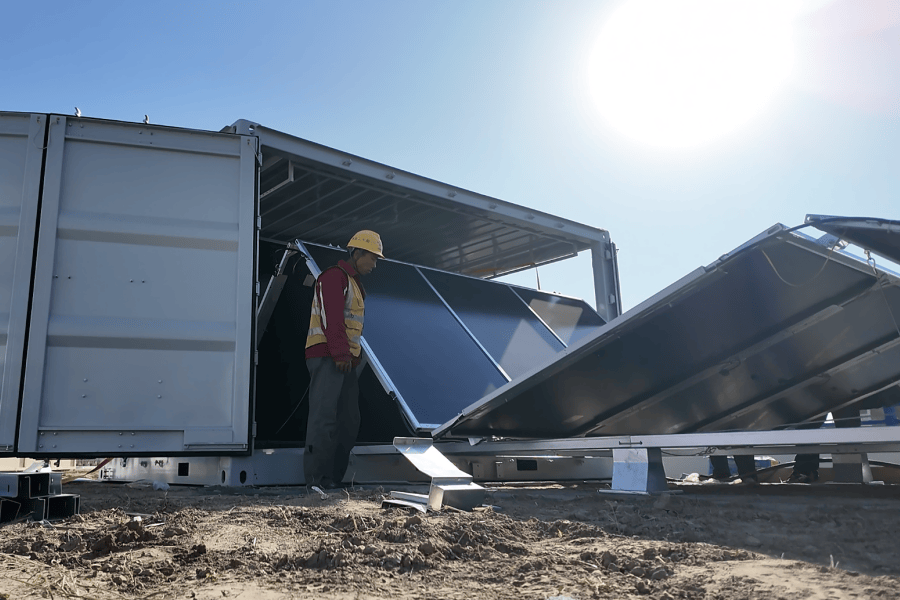
From Grid Dependence to Site Independence: A Real Talk on Powering Construction with Liquid-Cooled BESS
Honestly, if I had a nickel for every time a project manager told me their temporary power setup was a headache, I'd have retired years ago. I've seen it firsthand on site across California and Germany - the diesel generators roaring, the fuel trucks making a mess, the noise complaints piling up, and the carbon footprint looking worse by the day. It's not just an operational nuisance; it's a massive, often hidden, cost center and a compliance tightrope. The construction industry is at a turning point, and the smart move is towards self-contained, clean power. That's where the step-by-step installation of a liquid-cooled solar container for construction site power isn't just an option; it's becoming the new standard for forward-thinking teams. Let's walk through why and, more importantly, how it's done right.
Quick Navigation
- The Real Cost of "Temporary" Power
- Why a Liquid-Cooled Container is Your Best Bet
- The Installation Blueprint: From Delivery to Dispatch
- Proof on the Ground: A Berlin Case Study
- The Tech That Makes It Work: C-Rate & Thermal Management Explained
The Real Cost of "Temporary" Power
We all know the old playbook: order a few diesel gensets, run cables everywhere, schedule fuel deliveries, and hope the local environmental inspector isn't in a bad mood. The problem is, this model is breaking down. Fuel price volatility is a killer for budgeting - just look at the spikes over the past few years. According to the International Energy Agency (IEA), diesel prices in commercial sectors remain highly susceptible to geopolitical and market shocks, making long-term project costing a gamble.
But it's more than just fuel. It's the noise ordinances that halt work during certain hours. It's the air quality permits that are getting stricter by the month, especially here in Europe and in states like California. It's the sheer logistical headache of securing and refueling equipment on a busy, muddy site. I've watched projects lose half a day of productivity just coordinating a fuel truck around crane operations. That's lost money, plain and simple. This aggravation translates directly into higher operational expenses and project risk, eroding your bottom line before the first foundation is even poured.
Why a Liquid-Cooled Container is Your Best Bet
So, what's the alternative? Enter the liquid-cooled battery energy storage system (BESS) container, paired with a solar canopy. Think of it as a quiet, self-sufficient power plant in a box. Unlike air-cooled systems that struggle with dust and extreme temperatures on open sites, a liquid-cooled system is built for the harsh realities of construction. The closed-loop cooling precisely manages cell temperature, which is the absolute key to battery safety, longevity, and performance. This isn't a theoretical advantage; it's what allows systems like ours at Highjoule to meet and exceed the rigorous safety benchmarks of UL 9540 and IEC 62933 - standards that are non-negotiable for insurance and permitting in our key markets.
The value proposition is clear: lock in your energy cost with sun and stored power, eliminate fuel logistics, slash your Scope 1 emissions to zero on-site, and work 24/7 without noise complaints. You're not just buying equipment; you're buying predictability.
The Installation Blueprint: From Delivery to Dispatch
One of the biggest misconceptions is that these systems are complex to deploy. With a modern, pre-integrated container solution, it's more like a well-orchestrated logistics operation. Here's the typical flow, refined from dozens of deployments:
- Week 1: Site Prep & Foundation. This is the most critical pre-arrival work. We need a level, compacted gravel or concrete pad, usually outlined in our site-specific design pack. Access roads for a flatbed truck and a crane are crucial. This is where our local partners come in, ensuring everything meets local civil engineering codes.
- Day of Delivery: Craning & Placement. The container arrives pre-assembled and pre-tested. A crane lifts it onto the prepared foundation. I've supervised this in a Texas windstorm and a Dutch drizzle - the process is standardized and fast, often taking less than half a day. The goal is minimal disruption to your ongoing site work.
- Week 2: Hard Connection & Commissioning. This is where the technical magic happens, but it's streamlined. Our crew connects the main AC power lines to your site's temporary distribution panel. The liquid cooling lines are internal, so there's no complex external plumbing. Then comes the digital commissioning: we boot up the system, run a full self-diagnostic, and calibrate the energy management system (EMS) for your specific load profiles. The EMS is the brain - it decides when to draw from solar, when to discharge the batteries, and when to take a tiny bit from the grid if needed, all to save you the most money.
- Handover & Training. We don't just leave you with a manual. We train your site foreman on the basic touchscreen interface - it's about as complex as using a high-end thermostat. You'll see real-time data on power flow, state of charge, and system health. And with Highjoule's remote monitoring, our support team often spots and can diagnose minor issues before you even notice them, scheduling maintenance at your convenience.

Proof on the Ground: A Berlin Case Study
Let's make this real. Last year, we deployed a 500 kWh Highjoule Hydra-Cool? container for a major residential complex developer in Berlin. The challenge? Zero grid connection available for the first eight months of construction, and a city council with extremely strict anti-noise and emission rules for the inner city.
The system was paired with a temporary solar array on the site office roof. For six months, it powered the entire site office, tower crane, electric tool charging stations, and temporary lighting. The project manager later shared their data: they avoided over 40,000 liters of diesel, saved an estimated ?55,000 in fuel and generator rental, and faced zero complaints or work stoppages. The "power plant in a box" just sat there, humming along quietly. At project end, the container was disconnected, lifted out, and is now being recommissioned for its next project - that's the circular economy in action.
The Tech That Makes It Work: C-Rate & Thermal Management Explained
Okay, let's get into the weeds for a minute, but I'll keep it simple. You might hear engineers like me talk about C-rate. It simply means how fast you charge or discharge the battery. A 1C rate means using the full battery capacity in one hour. Construction sites have "peaky" demand - a crane lifts, welders fire up, that's a big power spike. You need a battery that can handle a high discharge C-rate without breaking a sweat or degrading quickly. Liquid cooling is the enabler here. By keeping each battery cell at an optimal, uniform temperature, the system can safely sustain that high power output when you need it and recharge quickly from solar when the sun's out.
This directly ties into the Levelized Cost of Energy (LCOE) - the total lifetime cost of your power. A cheap, air-cooled system might degrade 30% faster under heavy construction site loads, meaning you replace it sooner. A properly liquid-cooled system maintains its capacity for thousands more cycles. So, while the upfront investment might be slightly higher, the LCOE is dramatically lower because the asset lasts through multiple projects. You're buying durability, not just capacity.

Your Next Move
Look, the data and the case studies are there. The standards (UL, IEC, IEEE) have evolved to make these systems safer than ever. The question isn't really if containerized BESS is the future for temporary construction power - it's when your competitors will start using it to underbid you on project costs because their operational overhead is lower. What's the one persistent power-related headache on your current site that you'd love to eliminate for the next one?
Tags: Construction Site Power UL Standard BESS LCOE Europe US Market Renewable Energy
Author
James Zhang
20+ years agricultural energy storage engineer / Highjoule CTO