
Step-by-Step Installation of Rapid Deployment Photovoltaic Storage System for Industrial Parks
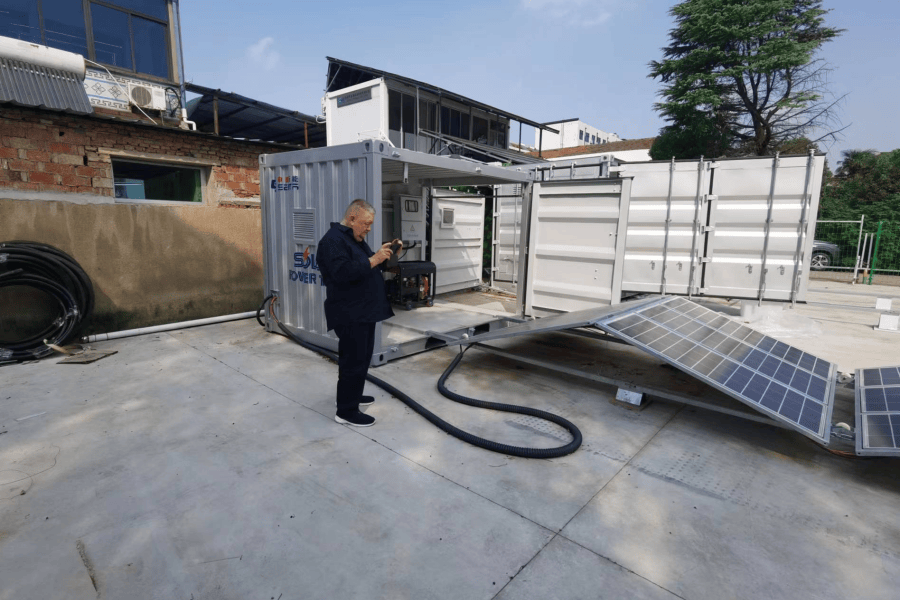
Table of Contents
- The Real Problem Isn't the "Why," It's the "How Long"
- The Staggering Cost of Delay (It's More Than Just Money)
- The Rapid Deployment Solution: A Game Plan, Not Just Gear
- The Step-by-Step: From Site Assessment to Commissioning
- A Case in Point: How a German Auto Supplier Did It in 10 Weeks
- Expert Insight: The Three Things We Always Check On-Site
- Making It Real for Your Park
The Real Problem Isn't the "Why," It's the "How Long"
Honestly, if you're managing an industrial park in the US or Europe today, you already know why you need a photovoltaic storage system. The drivers are staring you in the face: volatile energy prices, grid reliability concerns, and let's be real, some serious corporate sustainability targets. The business case is solid. I've sat across the table from dozens of plant managers and CFOs, and the conversation has shifted. It's no longer "Should we do this?" It's "How fast can we get it done without disrupting my production line?"
The core pain point I see firsthand on site is the sheer time and complexity of traditional deployment. We're talking 12 to 18-month timelines for a major system. That's a year and a half of navigating endless permit labyrinths, pouring custom concrete foundations, dealing with complex electrical interconnection studies that feel like they're written in another language, and hoping your construction crew doesn't hit another delay. All while energy prices could spike again next winter. This drawn-out process kills ROI momentum and introduces massive project risk.
The Staggering Cost of Delay (It's More Than Just Money)
Let's agitate that pain point a bit. What does a 6-month delay really cost? It's not just the lost savings from cheaper, self-generated solar power. According to the National Renewable Energy Laboratory (NREL), soft costs - like permitting, interconnection, and customer acquisition - can still make up a significant chunk of total project costs. Every month of delay adds to those soft costs. But more critically, it delays your ability to:
- Lock in energy cost certainty: In today's market, that's a financial superpower.
- Provide backup power for critical processes: A single outage can cost an automotive parts manufacturer hundreds of thousands per hour.
- Meet a fast-approaching Scope 2 emissions deadline: That's a reputational and compliance risk.
The traditional "design-bid-build" approach for industrial-scale BESS is like building a Swiss watch in a hurricane. It's precision engineering in a chaotic environment. What we need is a kit-based, rapid-deployment methodology that brings predictability back to the table.
The Rapid Deployment Solution: A Game Plan, Not Just Gear
This is where the concept of a true Step-by-step Installation of Rapid Deployment Photovoltaic Storage System for Industrial Parks comes in. It's a philosophy as much as a process. At Highjoule, we don't just sell battery containers. We provide a pre-engineered, standardized deployment protocol that cuts timeline from concept to commissioning by 50% or more. The solution hinges on three pillars:
- Pre-certified, Containerized Systems: Our core BESS units are pre-assembled and tested in-factory to relevant UL (like UL 9540/9540A) and IEC standards. They arrive on-site not as a pile of components, but as a "plug-and-play" energy asset on a skid or in a container. This eliminates about 80% of the field assembly headaches.
- Parallel-Path Project Management: While the physical unit is being built, our local teams work in parallel on your site-specific permits and grid interconnection agreements. We speak the utility's language because we've done it a hundred times before in your region.
- Minimal Site Civil Work: The goal is a simple, ballasted foundation or a quick concrete pad. We design for that from day one, avoiding the need for deep pilings or complex structural engineering in most cases.
The Step-by-Step: From Site Assessment to Commissioning
So, what does this rapid process actually look like? Let's break it down.
Phase 1: The 2-Week Feasibility & Design Sprint
We start with a deep dive into your load profiles, solar PV output (existing or planned), and local utility rate structures. The deliverable isn't a 200-page report, but a clear system sizing recommendation and a single-line diagram. We nail down the optimal C-rate (that's the charge/discharge speed of the battery) for your use case. Is it for daily solar shifting? You might need a moderate C-rate. For high-power demand charge reduction? We'll spec a system with a higher C-rate capability. Getting this right upfront maximizes the system's economic life.
Phase 2: Pre-Fabrication & Parallel Permitting (The Secret Sauce)
Once you approve the design, the container goes into production. Simultaneously, our permitting specialists submit the packaged documentation to your AHJ (Authority Having Jurisdiction). Because we're using pre-certified systems, the review is often faster - the inspectors are familiar with the UL stamps on our documentation.

Phase 3: Site Mobilization & Installation (Weeks, Not Months)
The unit arrives. This is where the step-by-step site work shines:
- Day 1-3: Site prep and foundation placement.
- Day 4-5: Container placement and anchoring.
- Day 6-10: Electrical interconnection - MV transformer, switchgear, and the critical grid-tie point. Thermal management is key here; we ensure the HVAC system for the battery container is properly commissioned. A battery's worst enemy is heat, and proper cooling is non-negotiable for safety and longevity.
- Day 11-14: System commissioning, functional testing, and personnel training.
A Case in Point: How a German Auto Supplier Did It in 10 Weeks
Let me give you a real example from North Rhine-Westphalia. A mid-sized automotive components manufacturer had a 2 MW solar array on their factory roof but was still getting hammered by high evening grid prices. Their challenge? They had a 14-week production window during a scheduled line upgrade to implement any new infrastructure. A traditional BESS project was out of the question.
We deployed our rapid process. Using a pre-engineered 1.5 MWh / 1.5 MW system, we ran feasibility and permitting in parallel with factory build. The container arrived 7 weeks after contract signing. Site work began immediately. The total time from signed contract to synchronized operation was 10 weeks. They now store excess midday solar and discharge it during peak evening hours, slashing their grid draw. Their project's Levelized Cost of Storage (LCOS) - the all-in lifetime cost per kWh stored and discharged - became attractive almost immediately because they avoided so much soft cost and started saving so fast.
Expert Insight: The Three Things We Always Check On-Site
Beyond the manuals, here's what my 20 years on the toolbelt have taught me to obsess over during a rapid deployment:
- The Dirt (Literally): A quick soil bearing test during the initial site visit. It saves us from a nasty surprise on pour day. You'd be surprised how many old industrial sites have... fill material where you don't want it.
- The Utility Vibe Check: Having a coffee with the local utility field engineer early on. Understanding their specific concerns about protection settings or metering can smooth the interconnection process immensely. It's about relationships.
- Operator Training: The system can be fully automated, but we always insist on training the facility's own engineers. They need to know how to check the system status, understand basic alarms, and who to call (that's us, with local 24/7 support). An educated client is a happy, safe client.

Making It Real for Your Park
The step-by-step rapid deployment model turns a complex, risky capital project into a predictable, fast-tracked operational upgrade. It's about getting you to the finish line - where the savings and resilience start - in one piece and on time. The technology is proven. The standards (UL, IEC, IEEE 1547) are clear. The bottleneck has always been the field deployment process.
We've cracked that code. So, what's the one process line in your park that absolutely cannot go down, and how much would 10 weeks of energy cost certainty be worth for your finance team? Let's have a coffee and map it out.
Tags: UL Standard BESS LCOE Rapid Deployment Europe US Market Photovoltaic Storage Industrial Energy Storage Renewable Energy
Author
James Zhang
20+ years agricultural energy storage engineer / Highjoule CTO