
Utility-Scale BESS for Rural Electrification: A Blueprint for Global Grid Stability
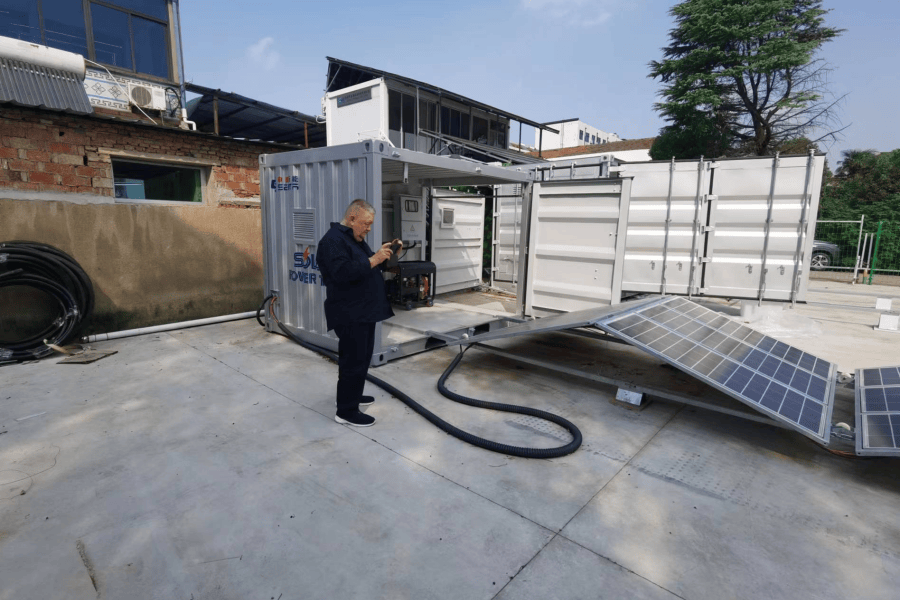
Table of Contents
- The Grid Dilemma: Stability vs. Renewables
- Beyond the Spec Sheet: What a 5MWh Container Really Solves
- The Texas Test: A Case in Grid Resilience
- C-rate & Thermal Management: The Heart of Longevity
- LCOE: The Real Metric for Your ROI
- Your Next Step: From Specification to Reality
The Grid Dilemma: Stability vs. Renewables
Let's be honest. Whether you're in California, Germany, or a remote island in the Philippines, the core challenge for grid operators is converging. It's no longer just about adding more solar panels or wind turbines. The real puzzle is how to manage the inherent intermittency of these fantastic resources without compromising grid stability. I've seen this firsthand on site: a cloud bank rolls over a solar farm, and suddenly, you have a 50MW dip that needs to be compensated in milliseconds. According to the International Energy Agency (IEA), global renewable capacity is set to grow by almost 2,400 GW between 2022 and 2027. That's a tidal wave of variable power looking for a home.
The problem gets amplified in rural or islanded grids, like many in the Philippines, but the lessons are universal for us in developed markets. These grids are often weaker, with less inertia. A sudden loss of generation or a spike in demand can cause frequency excursions that lead to blackouts. The traditional answer - spinning reserves from gas peakers - is becoming economically and environmentally untenable. You need a solution that's fast, scalable, and can be deployed exactly where the grid is most vulnerable. That's where a well-specified, utility-scale battery energy storage system (BESS) becomes not just an asset, but a critical grid component.
Beyond the Spec Sheet: What a 5MWh Container Really Solves
When we look at a technical specification - like the one for a 20ft High Cube 5MWh BESS designed for rural electrification - it's easy to get lost in the numbers. 5MWh, 20ft container, certain C-rate. But the real value isn't in the raw specs; it's in how that engineered package addresses the trifecta of modern grid pain points: Speed, Safety, and Siting.
For a project in the Philippines, the priorities are extreme durability (think high humidity, salt air), plug-and-play deployment to remote sites, and flawless safety to operate unattended. Honestly, these are the same priorities for a project in a coastal region of Texas or an industrial park in Poland. The solution is a standardized, pre-fabricated power block. A single 20ft container housing 5MWh means you're not building a power plant from scratch. You're delivering a finished, tested product. The key is that this product is built to the most rigorous global standards from day one - UL 9540, IEC 62933, IEEE 1547. This isn't a "nice-to-have"; it's the non-negotiable foundation for insurance, financing, and community acceptance in North America and Europe.

The Texas Test: A Case in Grid Resilience
Let me give you a real-world parallel. A few years back, we worked with a mid-sized utility in Texas. Their challenge wasn't rural electrification, but "grid edge" stabilization. They had a fast-growing commercial corridor at the end of a long transmission line. Peak demand was straining the line, and the cost of a traditional upgrade was in the tens of millions. They needed incremental capacity, fast.
The solution? Two 20ft, 4.8MWh BESS containers (similar in scale and concept to the 5MWH unit for the Philippines) deployed at a substation. Their job was simple but critical: peak shaving and frequency regulation. During the winter storm of 2023, while the broader grid was under stress, these systems provided local grid support, preventing rolling blackouts in that corridor for over 8 critical hours. The deployment time? From contract to commissioning was under 6 months. The lesson here is universal. Whether you're preventing blackouts in a Philippine village or a Texas suburb, the value proposition of a modular, utility-scale BESS is identical: targeted, rapid, and reliable grid reinforcement.
C-rate & Thermal Management: The Heart of Longevity
Now, let's talk about two specs that matter more than anything else for your bottom line: C-rate and thermal management. I've seen too many projects focus solely on energy capacity (MWh) and ignore the power (MW) and thermal design.
The C-rate essentially tells you how fast you can charge or discharge the battery. A 5MWh system with a 1C rating can deliver 5MW of power for one hour. A system with a 0.5C rating delivers 2.5MW for two hours. For rural electrification, you might prioritize longer duration at lower power (e.g., 0.25C for 4 hours of evening load). For a US grid service like frequency regulation, you need high power bursts (1C or even 2C). The specification must match the use case. A mismatched C-rate is like buying a sports car to haul gravel - it's inefficient and wears the asset out prematurely.
This leads directly to thermal management. High power or continuous cycling generates heat. Heat is the number one enemy of battery life. A passive air-cooled system might look cheaper on paper, but in a 40C (104F) Philippine climate - or a Arizona summer - it's a recipe for rapid degradation. A liquid-cooled system, like the one we engineered at Highjoule for these high-ambient environments, keeps cell temperatures within a tight, optimal range. This isn't a luxury; it's what ensures your 10-year performance warranty is a reality, not a liability. It directly protects your investment and keeps your levelized cost of energy (LCOE) low.
LCOE: The Real Metric for Your ROI
Which brings me to the ultimate metric: Levelized Cost of Energy (LCOE) for storage. Forget just the upfront capex. Smart developers and utilities are looking at the total cost of ownership over 15-20 years. LCOE factors in capex, opex, efficiency losses, degradation, and cycle life. A cheaper system with poor thermal management will degrade faster, losing capacity and requiring earlier replacement - its LCOE will skyrocket.
The design philosophy behind a system like the 5MWH Philippines unit is to minimize LCOE from the start. How?
- Longevity through Thermal Design: As discussed, liquid cooling extends cycle life.
- Efficiency: High-quality power conversion systems (PCS) with >98% efficiency mean less energy is wasted as heat during charge/discharge cycles.
- Standardization: A 20ft containerized design slashes installation and commissioning costs. I've supervised deployments where a container was energizing the grid within 48 hours of arriving on site.
- Serviceability: Our design at Highjoule includes clear access aisles and hot-swappable modules. This reduces mean time to repair (MTTR) and keeps opex predictable.
When you run the numbers, a slightly higher initial investment in a properly engineered, safety-certified system consistently yields a lower LCOE. That's the calculation that wins boardroom approvals in Chicago or Berlin.

Your Next Step: From Specification to Reality
So, the next time you look at a technical specification for a utility-scale BESS - whether it's destined for Southeast Asia or your own backyard - look beyond the MWh and footprint. Ask the hard questions: Is the safety system certified to UL 9540 by an NRTL? Does the thermal design match your worst-case ambient conditions? Does the cycle life at the proposed C-rate support your financial model?
The project in the Philippines isn't just a niche case. It's a blueprint. It proves that robust, remotely managed storage is the key to integrating renewables and strengthening grids everywhere. The standards and engineering principles that make it work there - durability, safety, plug-and-play deployment - are exactly what we need for the next wave of grid investment in Europe and North America.
What's the single largest bottleneck you're facing in your next storage deployment? Is it interconnection queues, safety permitting, or the long-term performance guarantees?
Tags: UL Standard BESS LCOE Thermal Management Rural Electrification Utility-Scale Energy Storage Grid Stability
Author
James Zhang
20+ years agricultural energy storage engineer / Highjoule CTO