
Grid-Forming BESS for Remote Operations: Meeting UL/IEC Standards in Harsh Environments
Contents
- The Silent Problem in Remote Power
- Beyond the Spreadsheet: The Real Cost of Unreliable Power
- The "Former" Grid: A Different Kind of Intelligence
- Case in Point: A Lesson from the Desert
- The Devil's in the (Technical) Details
- Your Next Step
The Silent Problem in Remote Power
Let's be honest. When we talk about energy storage for remote industrial sites - mining, agri-processing, you name it - the conversation in boardrooms often starts and ends with the price per kilowatt-hour. It's a natural focus. But after two decades on sites from the Australian Outback to the Chilean highlands, I've learned that the real conversation we should be having is about something far more critical: inherent stability and safety. You can have the cheapest system in the world, but if it can't create a stable, clean "grid" from nothing and handle brutal conditions without a babysitter, your project is a liability waiting to happen.
The industry standard for off-grid solar hybrids has been to use grid-following inverters paired with a diesel genset as the "grid former." It works, sort of. But it's like having a car that only works if another car is already pushing it. When a large motor kicks on or a cloud passes over, the system stumbles. The genset governor reacts, fuel efficiency plummets, and equipment suffers from power quality issues. Honestly, I've seen this firsthand on site: the maintenance logs get longer, the diesel bills stay high, and the promise of "green" power feels a bit empty.
Beyond the Spreadsheet: The Real Cost of Unreliable Power
This isn't just an engineering headache; it's a massive financial drain. The International Renewable Energy Agency (IRENA) points out that in mini-grids, system failures and poor power quality are primary reasons for financial underperformance. Every voltage dip can mean a production line shutdown. Every time you have to ramp a diesel genset to meet a transient load, you're burning money and carbon credits.
The aggravation amplifies when you add in local standards. For our clients in North America and Europe, even projects overseas often need to comply with UL 9540 for system safety and IEEE 1547 for interconnection and stability principles. Why? Because corporate risk management demands it. Insurers ask for it. And frankly, it's just good practice. Deploying a "black box" system with uncertified components in a remote location isn't just risky - it's a career-limiting move for the project manager who signs off on it.
The "Former" Grid: A Different Kind of Intelligence
So, what's the solution? It's shifting from a generator-led system to a storage-led system with true grid-forming capability. This isn't just marketing jargon. We're talking about a Battery Energy Storage System (BESS) that doesn't wait to see a voltage before it acts. It creates it. It establishes the frequency and voltage waveform itself, acting as the foundational "anchor" for the entire microgrid. Solar, wind, and even the backup genset all become followers to this stable source.
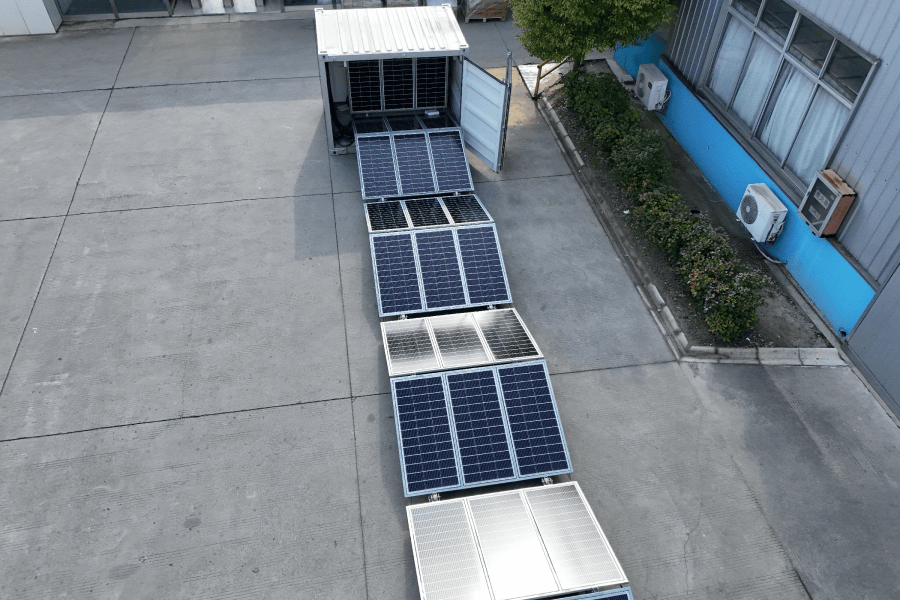
This is precisely the thinking behind the technical specs for a project we developed for a mining operation in Mauritania. The core requirement wasn't just "store solar energy." It was: "Create a resilient, diesel-minimizing power plant in the desert that can run sensitive processing equipment 24/7, with zero tolerance for blackouts, and managed by a lean crew." That's a grid-forming mandate. And to meet it, the specs had to be exceptionally rigorous, borrowing heavily from the safety and performance principles of UL and IEC standards we work with daily in the US and EU markets.
Case in Point: A Lesson from the Desert
Let me give you a relatable parallel from a project in Nevada, USA. A mining company wanted to reduce diesel use but had a site with massive, erratic crushing loads. A standard grid-following BESS would have been constantly playing catch-up, causing genset wear. Our solution centered on a Highjoule grid-forming BESS with a very specific C-rate specification.
Now, C-rate simply means how fast you can charge or discharge the battery relative to its size. A 1C rate means you can discharge the full capacity in one hour. For this site, we didn't just spec a high peak C-rate for those crusher surges; we ensured a continuous high C-rate capability to handle the base load shifts seamlessly. This, combined with an active liquid cooling thermal management system (more on that below), meant the BESS could be the steady "boss" of the microgrid. The result? Diesel fuel use dropped by over 70% in the first year, and the maintenance team finally stopped getting midnight calls about power trips.

The Devil's in the (Technical) Details
Reading a spec sheet can be daunting. Let me translate the three most critical items we insisted on for the Mauritania project, and why they matter for any demanding application:
- Grid-Forming Inverter with < 40ms Response: This is the brain and the muscle. When a large load hits, the system must respond within milliseconds to inject power and hold frequency steady. Slower responses lead to dips that crash sensitive equipment. Our design uses technology validated to the same response benchmarks required in ancillary service markets in Europe.
- Active Liquid Cooling Thermal Management: This is non-negotiable for harsh environments. In Mauritania, ambient temps hit 50C (122F). Air-cooled battery cabinets simply can't keep up, leading to accelerated degradation, hot spots, and safety risks. Liquid cooling, like what's in your car engine, precisely controls each cell's temperature. This extends battery life dramatically, which directly lowers your Levelized Cost of Energy (LCOE) - the total lifetime cost per kWh. It's the difference between replacing batteries in 8 years versus 15+.
- Cell-to-Pack Safety Architecture with UL 9540A Tested Design: Safety isn't a feature; it's the license to operate. We design our systems with inherent safety barriers between cells. More importantly, the entire pack's thermal runaway propagation mitigation is based on designs that have passed the rigorous UL 9540A test series. This gives our clients, and their insurers, empirical data on fire safety, not just promises.
These specs weren't pulled from a catalog. They were derived from a fundamental principle we hold at Highjoule: Optimize for the lowest possible LCOE with the highest possible safety. Sometimes that means a slightly higher capex for a much, much lower lifetime cost and risk. For the savvy financial decision-maker, that's the only math that truly matters.
Your Next Step
The shift to storage-led, grid-forming microgrids isn't just a trend; it's the logical evolution for reliable, cost-effective, and sustainable remote power. The technical specifications that enable this - like those proven in the Mauritanian desert - are now the benchmark for industrial projects everywhere.
Does your current project's BESS spec prioritize inherent stability and certified safety, or is it still built around the old generator-led paradigm? What would a 60% reduction in your operational diesel spend do for your project's bottom line and ESG goals?
Tags: UL Standard BESS LCOE Thermal Management Off-grid Power Grid-forming
Author
James Zhang
20+ years agricultural energy storage engineer / Highjoule CTO