
Rapid Deployment Hybrid Solar-Diesel Systems: The Smart Backup for Modern Data Centers
Contents
- The Quiet Crisis in Data Center Power
- Why This Hurts More Than Just Your Backup Plan
- A Smarter Way Forward: The Rapid Deployment Hybrid
- Beyond the Spec Sheet: What Really Matters On-Site
- Real-World Proof: It's Not Just Theory
- Your Next Step: Asking the Right Questions
The Quiet Crisis in Data Center Power
Let's be honest. If you're managing a data center in the US or Europe right now, you're probably having more conversations about power than ever before. The demand is skyrocketing - think AI, hyperscaling, the whole digital economy - but the grid? It's feeling the strain. I've been on sites from Frankfurt to Phoenix where the primary concern has shifted from pure compute capacity to a more fundamental question: "How do we keep this running reliably, sustainably, and without bankrupting ourselves?"
The traditional answer, of course, has been the diesel genset. It's the old faithful. But between tightening emissions regulations (looking at you, EPA and EU directives), volatile fuel costs, and the sheer noise and maintenance headache, it feels more like a necessary evil than a smart solution. The backup power system, which used to sit quietly in the corner, is now a major line item for both Capex and Opex, and a key factor in your ESG reporting.
Why This Hurts More Than Just Your Backup Plan
I've seen this firsthand. A client in Texas was running their diesel gensets for weekly tests and during what seemed like an increasing number of "grid stability events." Their fuel bill for backup alone had jumped 40% in two years. But the bigger issue was the risk. What happens during an extended outage? You're burning diesel around the clock, worrying about refueling logistics, and praying the mechanical systems hold up. It's a reactive, stressful mode of operation.
And let's talk about the "green" elephant in the room. According to the International Energy Agency (IEA), data centers are among the fastest-growing consumers of electricity globally. Relying solely on diesel for backup is a tough story to tell to your stakeholders and customers who are demanding cleaner operations. It's a triple bind: reliability risk, cost uncertainty, and sustainability goals all pulling you in different directions.
A Smarter Way Forward: The Rapid Deployment Hybrid
This is where the concept of a Rapid Deployment Hybrid Solar-Diesel System moves from a nice-to-have to a critical piece of infrastructure. It's not about replacing your diesel entirely - that's not realistic for mission-critical backup yet. It's about making it smarter, cleaner, and used far less often.
Think of it as a dynamic trio: solar PV generates clean power during the day, a battery energy storage system (BESS) acts as a shock absorber and immediate backup source, and the diesel genset becomes the last-line, long-duration defender. The real magic is in the control system that orchestrates this dance seamlessly, prioritizing solar and battery use to minimize diesel runtime. At Highjoule, when we design these systems, the core specs we focus on are all about creating that seamless, reliable handoff and maximizing the clean energy contribution.
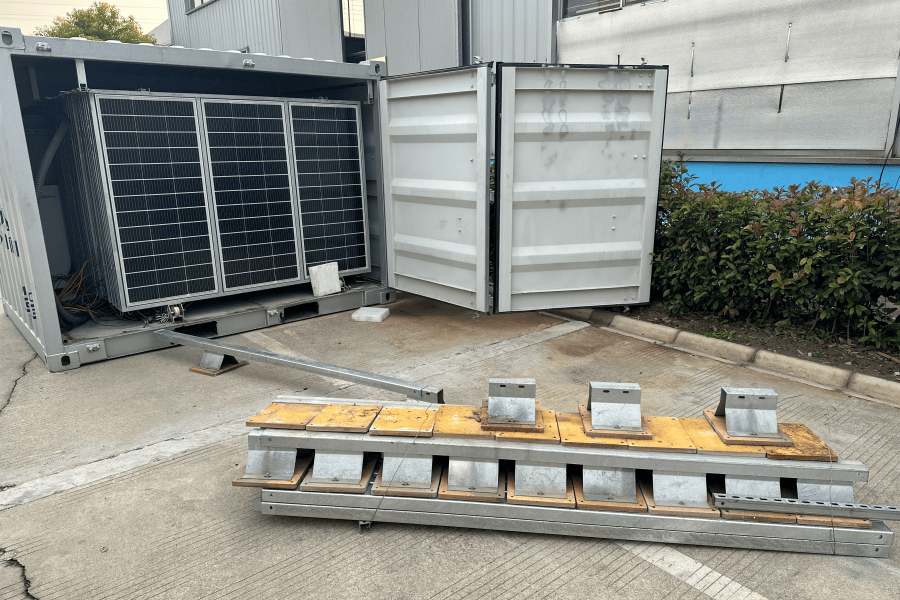
Our approach is always to containerize the solution - pre-assembled, pre-tested units that meet strict UL 9540 and IEC 62933 standards. This isn't just for safety (though that's paramount); it's for speed. We're talking about deployment in weeks, not months, with minimal on-site construction. That rapid deployability is a game-changer for data centers needing to scale power resilience quickly.
Key Technical Pillars We Never Compromise On:
- Grid-Forming Inverters: This is crucial. The BESS must be able to "black start" and form a stable microgrid for the data center load before the diesel even needs to spin up. It provides that instant, seamless transition.
- Intelligent Thermal Management: Batteries perform best within a tight temperature range. We design our BESS containers with N+1 cooling systems, because in a data center backup application, failure isn't an option. I've seen too many systems derate power output on a hot day because of poor thermal design.
- Cycling & C-Rate Optimization: For backup, you don't need a battery that cycles 500 times a day. You need one optimized for high power (a suitable C-rate) to support large loads instantly, and for high cycle life over many years of occasional, but critical, use. We engineer for that specific duty cycle.
Beyond the Spec Sheet: What Really Matters On-Site
Anyone can list specs on a page. But after 20+ years on project sites, I'll tell you what actually matters when the alarms go off.
First, Levelized Cost of Energy (LCOE) for your backup system. This is where the hybrid model wins. By offsetting hundreds of hours of diesel runtime with solar and battery, you dramatically lower the fuel and maintenance portion of your LCOE. The initial investment in solar+BESS is offset by 5-7 years of avoided fuel costs and potential demand charge savings from the grid. We build the financial model with our clients, and honestly, it's what usually seals the deal.
Second, localized service and control. A system deployed in Germany needs to comply with VDE-AR-N 4110, while one in California needs to meet Rule 21. Our engineering teams live and breathe these local codes. The system's controller isn't a black box; it gives your operators a clear view of energy flow, state of charge, and fuel levels, putting control back in your hands.

Real-World Proof: It's Not Just Theory
We deployed a rapid hybrid system for a colocation provider in the Midwest US. Their challenge was classic: need to add backup capacity for a new server hall, but the substation upgrade was 18 months out. A traditional diesel-only solution would have been loud, dirty, and expensive to run for the frequent grid dips they experienced.
We installed a 2 MW/4 MWh UL 9540-certified BESS container integrated with a 1 MW solar canopy on their parking structure and their existing diesel generators. The system is programmed to use the battery as the first responder for any outage under 30 minutes. The result? In its first year, it prevented over 200 unnecessary diesel engine starts. Their fuel consumption for backup dropped by nearly 70%, and they've since used the BESS for daily peak shaving, creating an additional revenue stream. The project was online in 11 weeks from contract signing.
Your Next Step: Asking the Right Questions
So, if you're evaluating your data center's power resilience, move beyond just "how many hours of diesel do we have?" Start asking:
Can our backup system make money or reduce costs when we're not in an outage?
How do we integrate a pathway for more renewables over time?
Is our solution compliant not just today, but with the evolving regulatory landscape?
What does the total cost of ownership look like over a decade, not just the installation quote?
The specification for a rapid deployment hybrid system is more than a technical document; it's a blueprint for a more resilient, sustainable, and financially sensible data center. The technology is here, it's proven, and it's ready to deploy. The real question is, how much longer can you afford to wait?
Tags: UL Standard BESS LCOE Data Center Backup Power Renewable Energy Hybrid Solar-Diesel System
Author
James Zhang
20+ years agricultural energy storage engineer / Highjoule CTO