
The Ultimate Guide to All-in-one Integrated Industrial ESS Container for Agricultural Irrigation
Contents
- The Silent Crisis on the Farm: Power Unreliability and Sky-High Costs
- Why Traditional "Fixes" Often Fall Short for Agriculture
- The All-in-One Answer: More Than Just a Big Battery in a Box
- A Case in Point: From Grid Anxiety to Energy Independence in California
- Beyond the Basics: The Tech That Makes It Work (And Last)
- What's Next for Your Operation?
The Silent Crisis on the Farm: Power Unreliability and Sky-High Costs
Let's be honest. When most people think about farming, they picture tractors, soil, and sunshine. They don't picture the massive, silent electricity bill that comes from running high-power irrigation pumps, or the gut-wrenching moment when the grid flickers during a critical growth cycle. I've sat across the table from farm managers in the Central Valley and agribusiness owners in Southern Spain, and the story is frustratingly similar: energy is their largest unpredictable cost and their biggest operational risk.
The problem is twofold. First, you're often at the mercy of the grid. In rural areas, power quality can be poor, and outages - whether from storms, heatwaves, or simple infrastructure strain - can literally wither a crop. Second, time-of-use rates and demand charges from utilities can turn efficient irrigation into a financial nightmare. Pumping water during peak afternoon rates? That's a fast way to erase your profit margin. According to the National Renewable Energy Laboratory (NREL), integrating storage with agricultural loads is a key pathway to resilience and cost savings, but the complexity has been a major barrier.

Why Traditional "Fixes" Often Fall Short for Agriculture
So, the smart folks look for solutions. Maybe they consider a diesel generator for backup. That works, but now you're locking in volatile fuel costs and emissions - not exactly future-proof or sustainable. Perhaps they look at a basic battery system. That's where the real headache often begins for an industrial user.
I've seen this firsthand on site. A farm decides to go solar and add storage. They end up dealing with multiple vendors: one for the solar inverters, another for the battery racks, a third for the thermal management system, and then an integrator to try and tie it all together with a control system. You end up with a patchwork of equipment from different manufacturers, all with different warranties, communication protocols, and service requirements. When something goes wrong (and it will), the finger-pointing begins. Is it the inverter's fault or the battery management system? Meanwhile, your irrigation schedule is compromised.
This approach also struggles with scalability. Your needs this season might be different from the next. Adding capacity to a disjointed system is expensive and complex. For agricultural businesses, you need simplicity, durability, and a single point of responsibility.
The All-in-One Answer: More Than Just a Big Battery in a Box
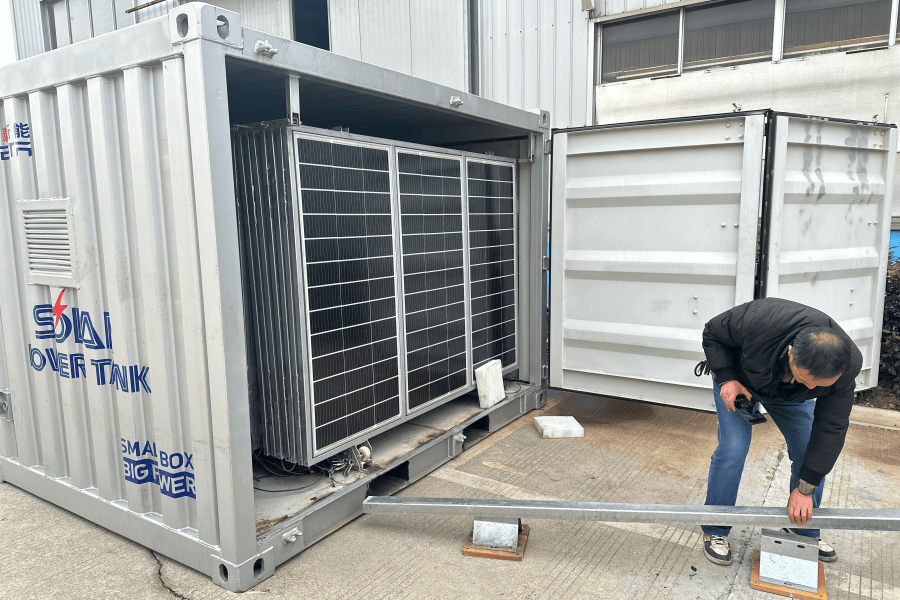
This is where the concept of the all-in-one integrated industrial ESS container becomes a game-changer. Think of it not as a product, but as a power asset delivered to your site. At Highjoule, we build these solutions based on two decades of field experience. The goal is to eliminate the integration nightmare.
Inside a single, ruggedized container that meets UL 9540 and IEC 62933 standards, you get a fully optimized ecosystem:
- High-Energy Battery Racks: Designed for the long-duration discharge needed to run large pumps, not just short grid bursts.
- Bi-Directional Inverters: Seamlessly manage power flow between solar, grid, battery, and your pumps.
- Advanced Thermal Management: A self-contained liquid cooling system that keeps batteries at their ideal temperature whether it's 110F in Texas or -10F in Minnesota, maximizing lifespan.
- Integrated Fire Suppression & Safety: Built to the highest local codes (NFPA, etc.) because safety isn't an add-on.
- The "Brain": A unified energy management system (EMS) pre-programmed with strategies for demand charge reduction, irrigation scheduling, and backup power.
Your team doesn't need to be PhDs in electrical engineering. It's a plug-and-play solution for industrial-scale power. We handle the entire deployment, from site assessment and permitting support to commissioning, ensuring it meets all local utility interconnection requirements in North America and Europe.
A Case in Point: From Grid Anxiety to Energy Independence in California
Let me give you a real example. We worked with a large almond grower in California's San Joaquin Valley. Their challenges were classic: crippling demand charges, unreliable grid power during fire season, and a desire to use their existing solar more effectively.
The traditional multi-vendor approach was quoted, but the complexity and projected maintenance costs were prohibitive. Instead, we deployed a single 2 MWh all-in-one ESS container. It was delivered, connected to their solar array and main irrigation feeder, and was operational in a fraction of the time a customized system would take.
The results? They shifted nearly 100% of their irrigation pumping to off-peak hours or solar generation, slashing their demand charges by over 60%. During a planned utility outage, the system kept critical blocks irrigated without a hitch. The unified Highjoule platform gives them a simple dashboard to see cost savings in real-time, and because it's one system from one vendor, service and warranty support is straightforward. That's peace of mind you can't put a price on.
Beyond the Basics: The Tech That Makes It Work (And Last)
Okay, let's get slightly technical - but I promise to keep it in plain English. When evaluating an ESS container, especially for demanding cycles like irrigation, you need to look under the hood at two key concepts: C-rate and Thermal Management.
C-rate essentially tells you how fast a battery can charge or discharge. A 1C rate means a battery can fully discharge in one hour. For irrigation, you often need a slower, sustained discharge (like a 0.5C or C/2 rate) over several hours to match pump runtime. Our containers are engineered with the right battery chemistry and configuration for these agricultural duty cycles, avoiding the stress that comes from forcing batteries to discharge too quickly.
Which leads directly to Thermal Management. Heat is the enemy of battery life. Poor cooling leads to rapid degradation. The integrated liquid cooling in our units is like a precision climate control system for the batteries. It ensures even temperature distribution cell-to-cell, which is critical for longevity and safety. This directly lowers your Levelized Cost of Storage (LCOS) - the total cost of owning the system over its life. A cheaper system that degrades in 5 years is far more expensive than a robust one that lasts 15+ years.

What's Next for Your Operation?
The conversation around farm energy is shifting from simple cost reduction to strategic energy management and resilience. An all-in-one industrial ESS container isn't just an expense; it's an asset that stabilizes your operating costs, protects your investment in crops, and future-proofs your operation against an uncertain grid and climate.
The best part? The technology is proven, the standards are clear, and the economics now make sense. What does your current energy bill look like, and what would it mean for your business to have total control over your irrigation power schedule?
Tags: Energy Storage Container UL Standard BESS LCOE Agricultural Irrigation Microgrid
Author
James Zhang
20+ years agricultural energy storage engineer / Highjoule CTO