
The Ultimate Guide to LFP (LiFePO4) Energy Storage Container for EV Charging Stations
The Ultimate Guide to LFP (LiFePO4) Energy Storage Container for EV Charging Stations
Hey there. If you're reading this, you're probably looking at the massive opportunity in EV charging, but also feeling the headache of grid constraints and unpredictable demand charges. I've been on-site for over two decades, from California to North Rhine-Westphalia, and honestly, I've seen the same story play out: the grid is struggling to keep up with our clean energy ambitions. That's where a well-designed LFP (LiFePO4) energy storage container comes in. It's not just a battery box; it's the linchpin for a viable, profitable, and scalable EV charging future. Let's talk about why.
Quick Navigation
- The Real Problem: It's More Than Just "Power"
- Why This Hurts Your Bottom Line
- The LFP Container Solution: More Than Chemistry
- A Case in Point: Germany's Autobahn Challenge
- Key Specs Decoded: C-Rate, Thermal Management & LCOE
- What to Look For in a Real-World Deployment
The Real Problem: It's More Than Just "Power"
The phenomenon is clear: EV adoption is skyrocketing. The International Energy Agency (IEA) reports global EV sales jumped over 35% in 2023. But here's the catch I see firsthand. Most commercial and fleet charging sites weren't built to handle a simultaneous demand for six or eight DC fast chargers pulling 350 kW each. That's like adding a small factory's load to a local grid overnight. The problem isn't just availability; it's the quality and cost of that power.
Why This Hurts Your Bottom Line
Let's agitate that pain point a bit. Without storage, you're at the mercy of two things:
- Demand Charges: Utilities bill you based on your peak 15-minute power draw in a month. A few EVs charging at once can spike that peak, resulting in staggering bills that can wipe out your charging revenue. I've seen sites where demand charges make up 70% of the total electricity cost.
- Grid Upgrade Costs & Delays: Requesting a transformer or line upgrade can cost hundreds of thousands of dollars and take years for approval and construction. That's a death sentence for a business plan.
- Intermittent Renewables: You want to pair with solar? Great. But without storage, that solar energy might not be there when charging demand peaks in the evening. You're missing the synergy.
This isn't theoretical. It's a daily operational and financial roadblock.

The LFP Container Solution: More Than Chemistry
So, what's the solution? Enter the LFP energy storage container. It's a pre-engineered, plug-and-play system built around Lithium Iron Phosphate chemistry. But the magic isn't just in the cells - it's in the system integration.
LFP has become the de facto standard for stationary storage, especially in the US and Europe, and for good reason. Its inherent stability offers a much wider thermal safety margin than other chemistries. This is non-negotiable for sites near public areas or critical infrastructure. When we at Highjoule design our containers, we build on this chemical safety with physical and system-level safeguards - think advanced thermal runaway propagation prevention and strict compliance with UL 9540 and IEC 62619 standards. It's about creating a system you can trust to operate unattended, 24/7.
A Case in Point: Germany's Autobahn Challenge
Let me give you a real example. We worked with a service area operator along the A3 Autobahn in North Rhine-Westphalia. They wanted to install eight HPC (High-Power Charging) points, but the grid connection was weak and prohibitively expensive to upgrade.
The Challenge: Deliver reliable 350 kW charging without a grid upgrade, manage demand charges, and integrate with an existing rooftop PV system.
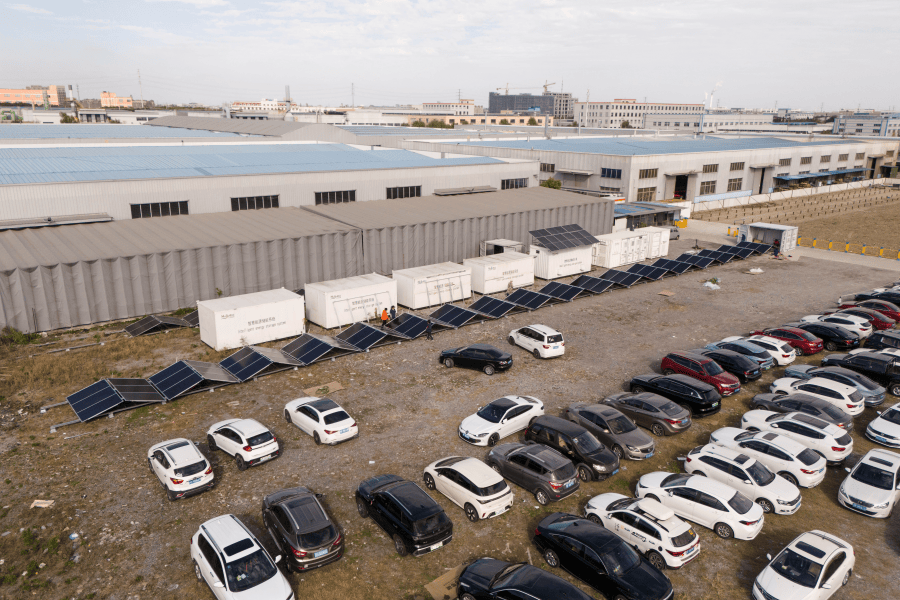
The Solution: We deployed a 1.5 MWh LFP storage container. The system is smart. It continuously draws a steady, low amount of power from the grid to "trickle-charge" the battery. When multiple EVs plug in, the container discharges at a high rate to supply the peak power, while the grid connection remains stable and unstrained. The on-site solar feeds the battery first, maximizing green energy use.
The Outcome: Zero grid upgrade costs, a 40% reduction in peak demand charges from day one, and a future-proof site. The container was commissioned in under a week. That's the power of a pre-fabricated solution.
Key Specs Decoded: C-Rate, Thermal Management & LCOE
When you look at spec sheets, don't get lost in the jargon. Here's my take on what truly matters:
- C-Rate (The "Athleticism"): This is how fast the battery can charge or discharge. A 1C rate means a 1 MWh battery can output 1 MW for one hour. For EV charging, you need a high discharge C-rate (like 0.5C to 1C) to handle those sudden, high-power demands. A low C-rate battery would be oversized and uneconomical.
- Thermal Management (The "Endurance"): This is everything. Passive air cooling is often insufficient for the high, sustained loads of EV charging. Look for a liquid-cooled system. It maintains optimal cell temperature, which is critical for performance, safety, and - here's the key - longevity. A well-cooled LFP battery can deliver 6000+ cycles. That directly impacts your...
- Levelized Cost of Storage (LCOE - The "True Cost"): Forget just upfront price. LCOE spreads the total cost (equipment, installation, maintenance) over the system's total lifetime energy output. A cheaper battery that degrades in 5 years has a terrible LCOE. A robust, long-life LFP system with smart controls, like the ones we engineer, delivers a lower LCOE, meaning cheaper stored energy over 10-15 years.
What to Look For in a Real-World Deployment
Based on my field experience, here's your shortlist:
Honestly, the journey to deploying a resilient EV charging hub is complex, but it doesn't have to be a leap of faith. The technology, particularly LFP-based containerized storage, is proven, safe, and economically sound. The right partner will help you navigate the standards, the financials, and the long-term operation.
What's the biggest hurdle you're facing in your next EV charging project - is it the grid connection study, the demand charge analysis, or something else entirely? Let's discuss.
Tags: Energy Storage Container UL Standard BESS LCOE Europe US Market EV Charging Infrastructure Renewable Energy LFP Battery
Author
James Zhang
20+ years agricultural energy storage engineer / Highjoule CTO