
Step-by-step Installation of All-in-one Integrated Mobile Power Container for Construction Site Power
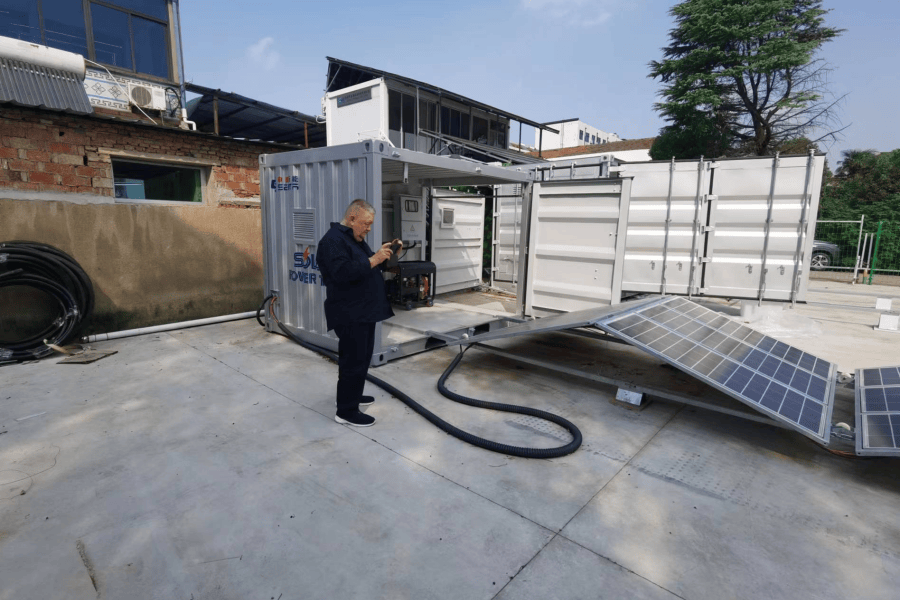
Table of Contents
- The Diesel Hangover on Your Job Site
- Why "Modular" Power Isn't Always Easy
- The Mobile Power Container Advantage
- A Real-World, Step-by-Step Installation Guide
- Beyond the Connection: What Really Matters
- The Final Word from the Field
The Diesel Hangover on Your Job Site
Let's be honest. If you're managing a construction site in the US or Europe right now, you're probably dealing with a diesel generator headache. The noise complaints from the new neighborhood, the fuel delivery logistics, the wild swings in fuel costs, and that nagging worry about emissions regulations tightening up. I've been on sites from Texas to Bavaria, and the story is surprisingly similar. You're not just building a structure; you're managing a temporary, noisy, and expensive power plant.
The industry knows there's a better way. According to the National Renewable Energy Laboratory (NREL), integrating battery storage with temporary power can slash fuel use by up to 80% in hybrid setups. The math is compelling, but the hesitation is real. The biggest barrier I hear from project managers isn't about the technology itself - it's about the perceived complexity of deployment. "Can my crew handle it?" "How long will we be offline during the switch?" "What about all these electrical codes?"
Why "Modular" Power Isn't Always Easy
Here's the aggravation part, straight from my field notes. The promise of "plug-and-play" energy storage can sometimes fall short on day one. I've seen projects where the BESS unit arrives, but the power conversion system (PCS) is on a separate skid. Then come the HVAC units, the fire suppression system, the cabling, and the control cabinets - all needing individual placement, interconnection, and commissioning. What was sold as a simple solution suddenly requires a small army of specialized electricians and a week of fine-tuning. The downtime eats into your schedule, and the installation costs blow past the estimate.
The core problem? A lack of true, site-ready integration. For a construction site, every hour of non-productive setup is money lost. You need a solution that lands, gets connected, and works. Period.
The Mobile Power Container Advantage
This is where the concept of a true All-in-One Integrated Mobile Power Container shifts from marketing speak to a site superintendent's best friend. The solution isn't just putting components in a box. It's about pre-integrating, pre-testing, and pre-certifying the entire system - battery racks, PCS, thermal management, safety systems, and controls - into a single, self-contained unit that's built to travel. At Highjoule, we design these containers not just for performance, but for the reality of a muddy, time-pressed job site. Every system that leaves our facility is tested against the relevant standards - UL 9540 for the energy storage system, UL 1973 for the batteries, and IEC 62477 for the power conversion - so you're not the one doing the compliance experimentation.

A Real-World, Step-by-Step Installation Guide
So, what does a smooth installation actually look like? Let's walk through it, step-by-step, based on a project we completed for a solar farm construction site in Nevada last year. The challenge was providing reliable, quiet power for the site office, equipment charging, and lighting without running miles of temporary poles in a fragile desert environment.
Step 1: Pre-Site Visit & "Virtual Landing" (Week -2)
This is the most critical, and most overlooked, phase. Before the container ever ships, our team does a virtual site assessment. We review the GPS coordinates, ground conditions (is it compacted soil, gravel, sand?), and access roads. We digitally "place" the unit using satellite imagery to plan the crane lift path and final positioning. For the Nevada site, this planning flagged a low-hanging power line the local team had missed. We adjusted the delivery truck route and saved a potential two-day delay.
Step 2: Site Prep & Foundation (Day -1)
Our containers are designed for simple foundations. In most cases, a level, compacted gravel pad or concrete blocks is sufficient - no massive concrete pours. The Nevada crew prepared a 6-inch compacted gravel bed in a single afternoon. The key specs we provide are simple: load-bearing requirement (we give you the exact PSI) and levelness tolerance (usually within 1 degree).
Step 3: Delivery, Offloading, and Positioning (Day 1, Morning)
The unit arrives on a standard flatbed truck. With the pre-planned lift points (clearly marked on the container exterior), a local crane operator can safely offload it. The integrated design means there's only one major item to move. I was on site in Nevada, and from truck arrival to the container sitting perfectly on its gravel pad, it took under 90 minutes. The crew was shocked - they'd budgeted a full day.
Step 4: The "One-Connection" Hookup (Day 1, Afternoon)
This is where the integration pays off. On a standard, non-integrated system, you might have 10+ high-voltage and data connections to make. On our all-in-one unit, there are typically just two primary external connections:
- The Grid/Generator Connection: A single, large, weatherproof connector for your main AC feed (from the local grid or a backup gen).
- The Site Distribution Panel Feed: The output that powers your site's temporary panel.
A certified electrician makes these connections. Because the internal wiring is all done at the factory, the risk of field connection errors plummets. In Nevada, the local electrician had us powered up and running diagnostics in under three hours.
Step 5: Digital Commissioning & Go-Live (Day 1, Evening)
Once powered, the system boots up. We use a secure, web-based interface for commissioning. Our remote support team can log in (with site permission) to guide the final settings - things like setting the charge schedule from the grid to avoid peak demand charges, or syncing with the site's solar panels if they're part of the mix. The Nevada site foreman was able to set a simple "quiet hours" profile himself via a tablet, reducing battery discharge at night and minimizing noise to zero. The system was fully operational by end of day one.
Beyond the Connection: What Really Matters
Anyone can bolt things together. The real expertise is in the design decisions that make those connections safe, efficient, and durable. Let me give you two insights from the engineering side:
Thermal Management is Everything: A battery's lifespan and safety are tied directly to its temperature. In a sealed container in the Arizona sun or a German winter, this is a huge challenge. Our integrated design uses a dedicated, closed-loop liquid cooling system. It's not an afterthought AC unit; it's a precision system that keeps every battery cell within a 2-3C range. This is what allows us to offer a higher C-rate (basically, how fast you can safely charge and discharge) without degrading the batteries. You get more power, faster, for longer.
Thinking in LCOE, Not Just Capex: The initial price tag is one number. The Levelized Cost of Energy (LCOE) - the total cost of ownership divided by the energy you actually get out - is what hits your bottom line. By integrating everything and simplifying installation, we slash the "soft costs" (labor, engineering, delays). By optimizing thermal management and battery chemistry, we extend the system's life from maybe 5 years to 10+ years. That LCOE figure drops dramatically, making the business case undeniable.

The Final Word from the Field
After two decades in this game, I've learned that the best technology is the one that disappears into reliable, quiet service. The goal of a mobile power container isn't to be a complex showpiece; it's to be the most reliable, least fussy piece of equipment on your site. When you choose a truly integrated solution, you're not just buying batteries in a box. You're buying peace of mind, predictable costs, and a schedule you can actually stick to.
So, next time you're budgeting for site power, ask your vendor not just for the datasheet, but for their step-by-step installation playbook. If it looks more like a novel than a checklist, you know what you're in for. What's the one site power challenge you wish would just disappear?
Tags: Construction Site Power UL Standard BESS Mobile Energy Storage Energy Container Installation
Author
James Zhang
20+ years agricultural energy storage engineer / Highjoule CTO